Sunday, September 14, 2025

Good Will Triumph

Perhaps you saw that, last Sunday, two new saints were added to the register of those canonized by the Church. There are maybe a dozen canonizations per year, usually of men and women who lived hundreds of years ago, often who founded religious orders, or who lived lives of obvious holiness through some outstanding sign, such as dedicating themselves entirely to service to the poor or renouncing the world to live a life of penance and prayer.

The two canonizations that happened on Sunday were a bit notable though in that they were young men declared saints despite not doing anything overly remarkable. Saint Pier Giorgio Frassati lived in Turin in the early 20th century. He loved sports of all kinds, especially mountaineering. He was involved in works of charity, especially for the sick of his hometown, and was involved in organizations and causes dedicated to social reform. He contracted polio and died at age 24 in 1925. Saint Carlo Acutis was born in 1991. He was a self-professed computer geek, who taught himself programming and website development. Raised in a non-religious family, he became fascinated by and eventually devoted to the Eucharist. He built a website that catalogued the Eucharistic miracles that have been recorded throughout the world – a website you can still visit to this day. He died of leukemia at the age of 15.

The remarkable thing about Saint Pier Giorgio and Saint Carlo is how *ordinary* they were. Some have questioned whether, because of this, they really deserved to be canonized. But I agree with those who say that they are important saints for our day precisely because they are so relatable. They didn’t found a religious order or become missionaries to foreign lands or receive heavenly visions or the stigmata. What they did do is live lives of what we might call real-but-regular holiness. They were in love with the love of Jesus, and they radiated that love to all who knew them.


I mention all of this as a sort of long prelude to today’s feast. We take a break from the Sundays of Ordinary Time to celebrate today the Feast of the Exaltation of the Holy Cross. One of the oldest feasts of the Church’s year, we remember today what we just read in the Gospel – that God so loved the world that he sent his Son, so that whoever believes in him will have eternal life. But the way we are called to believe in Jesus is not just in his teachings and in his miracles, but in his Cross – his salvific death and resurrection. It is the Cross that heals us – looking upon it and believing, just like the Israelites did in the desert. It is the Cross that opens up the way to eternal life. Indeed, it is the Cross that *shows* us the way to eternal life.

Today’s feast used to be called the Triumph of the Cross, and I have to say that in some ways, I like that name better. Because as much as the Cross may look like a defeat, we proclaim it to be a triumph – a triumph of love and self-sacrifice over sin, hatred, ignorance, and error. Jesus was lifted upon the Cross, and as Christians we lift up the Cross as the sign of hope by which we believe that nothing in this world can overwhelm the love of God. We have all kinds of reasons to see the brokenness of the world; we see examples of it every day in the news. And we all know far too well our own brokenness – the error, confusion, violence, and immorality that too often marks our lives. But the Cross tells us that God so loves us that he can save us from all of these things – indeed, that in the life, death, and resurrection of his Son, he *has* saved us from these things.

Saint Pier Giorgio and Saint Carlo were not perfect people. They were sinners – like all saints before them, with the exception of the Blessed Virgin Mary. But they were redeemed by the Cross of Christ, lifted up from sinfulness to friendship with God, and they became cooperators with his grace to achieve real sanctity – real holiness. And that holiness is not just for the canonized saints – it is what the Lord calls us all of us to, every one of the baptized. That’s why we have canonized saints – to show us that holiness really is possible, really attainable. The Cross of Jesus makes it so, and the saints show us that it not some fairy tale or fantasy, but is lived out in the ordinariness of daily life.

"St. Carlo at the Cross" (sculpture, detail), Assisi, Italy

Friends, what is the form of real-but-regular holiness the Lord is calling you to? In our homes and families, in our schools and workplaces, on the sports field, at the restaurant, in the deer woods – Jesus is calling each one of us to holiness just as surely as he called Pier Giorgio Frassati and Carlo Acutis. And like them, we can respond, we can cooperate – because of the Cross of Christ. The Lord has shown us that, in the end, good will triumph. May we triumph with him!

Sunday, May 11, 2025

'Follow Me'

“Peace be with you all! Dear brothers and sisters, these are the first words spoken by the risen Christ, the Good Shepherd who laid down his life for God’s flock. I would like this greeting of peace to resound in your hearts, in your families, among all people, wherever they may be, in every nation and throughout the world. Peace be with you!”

If those words sound familiar, it is because they are the first words spoken to the world and to each of us by Pope Leo XIV, elected this past Thursday by the College of Cardinals. A lot has already been said about this man from Chicago, an Augustinian friar, a bishop from Peru, and now the 267th Successor of Saint Peter. But these first words of our new Holy Father struck me precisely because of how they relate to our liturgy today.

This Fourth Sunday of Easter is often called Good Shepherd Sunday, because we always hear from the tenth chapter of the Gospel of John, in which Jesus refers to himself as the Good Shepherd, who knows his sheep, and those sheep hear his voice and follow him to eternal life. In light of this Sunday, and this Gospel, I don’t think it’s accidental that Pope Leo, in his very first words, conveyed to us the peace of the Good Shepherd, the Risen Christ, he who can give a peace the world does not know.

I don’t know about you, but when I think of the Good Shepherd, I usually have the mental image of a painting or statue, of Jesus with sheep around him or with a sheep around his shoulders. These images tend to remind us of the Parable of the Lost Sheep, found in Matthew and also in Luke’s Gospel, when he tells us that a shepherd will leave his flock in search of the one lost sheep until he finds it. And Jesus tells us, “Just so, I tell you, there will be more joy in heaven over one sinner who repents than over ninety-nine righteous persons who need no repentance.” This passage certainly reminds us of the mercy of the Good Shepherd, who seeks us out when we are lost, who brings us back and reconciles us to our loving Father.
 

But there is another aspect to the Good Shepherd motif that perhaps we overlook – and that is its connection to the Resurrection. In today’s Gospel, Jesus says that his sheep hear his voice and follow him, and he leads them to eternal life. But how does he do this? Eternal life is nothing other than the Resurrection, so to receive eternal life is to share in Jesus’s own risen life. If we put the two images together, then, we arrive at precisely the full picture that Pope Leo gave us in his opening words – the Good Shepherd is the Risen Christ, who seeks us out when we are lost, who calls us to follow him, and who leads us to eternal life.

No doubt Pope Leo when he spoke those words was also mindful of his own new role as the shepherd of the Universal Church. The pope is not the Good Shepherd, but he stands in his place on earth as his Vicar, and he seeks to be a human shepherd with the same heart as the Risen Jesus, and so help us to hear the Lord’s voice calling us to eternal life. But how do we get to eternal life? How does Jesus share his Resurrection with us? Only by also sharing with us his Cross.

Remember in last week’s Gospel, after the Risen Jesus appears to the disciples on the shore of the Sea of Galilee, after they have breakfast, Jesus asked Peter three times if he loved him. Each time, Peter responds “Yes,” and each time Jesus tells him “Feed my lambs”, “Tend my sheep.” It is only after the third time, after Peter has made up for his three-time denial of the Lord during his Passion, that Jesus then invites Peter to embrace his own future death:

"Amen, amen, I say to you, when you were younger,
you used to dress yourself and go where you wanted;
but when you grow old, you will stretch out your hands,
and someone else will dress you
and lead you where you do not want to go."
He said this signifying by what kind of death he would glorify God.
And when he had said this, he said to him, "Follow me."


“Follow me.” In other words, follow me to the Cross, to death, and through death to my Resurrection. *That* is the voice of the Good Shepherd, and that is the voice that you and I must hear and recognize and follow if we are to receive eternal life.

I think we have a stirring reminder of what this looks like in the very example of our new Holy Father. In the homily at his first Mass, the morning after he was elected, he told the College of Cardinals: “I invite you to reflect on … the blessings that the Lord continues to pour out on all of us through the Ministry of Peter. You have called me to carry that cross, and to carry out that mission…” That mission, yes. But did you catch it? That *cross*. What an awesome responsibility; what a tremendous burden. It is said that when then-Cardinal Prevost realized during the Conclave that he was receiving enough votes to be elected, he dropped his head into his hands. No doubt, he realized the weight of this Cross that was being given to him. Just like the first Peter, Jesus was saying “Feed my lambs,” “Tend my lambs,” “Follow me” – all the way to death, and through death to eternal life. Pope Leo XIV, although he is the same man he was last Wednesday, will never be able to go back to the life he had before. In many ways, his life will now be led and dictated by others – by attending to various tasks and responsibilities that others tell him must be done, by caring for the Universal Church day and night with no breaks, by spending the rest of his remaining days in bearing the Cross and the mission that is the See of Peter. Most likely, this is not something he ever sought for himself, but he has accepted it willingly, because in those few moments in the conclave, he heard the voice of the Good Shepherd calling him, and he knew the Risen Lord was saying, “Follow me.”

Pope Leo XIV (Photo Credit, Alessandra Tarantino, AP)

You and I are also called by the Risen Christ, to follow him – not to take up the Chair of Peter, but to embrace our own crosses with faith and with total abandonment to his will. And ultimately, we are called to be faithful to that which he has given us all the way to death, because that is the only kind of discipleship – the kind that ends with death – that will also lead to everlasting life. It is only by embracing the Cross of Christ, that we throw open our arms to receive his Resurrection. While we wait for that moment in which each of us will be asked to share in that ultimate Cross, there are also lots of little deaths that come along the way, each day, in which the Lord asks us to die to self and follow him. At times, we may drop our head in our hands at what we are being asked to endure or to give up. But as Pope Leo knew, we are not alone. The Good Shepherd always leads us, assuring of his presence and his peace – a peace that comes from acceptance of his will, a peace the world cannot give because it reaches beyond this life.

Friends, let’s keep Pope Leo, the new Peter in Rome, in our prayers. He will need them. Let’s pray that through his ministry, we may also hear the voice of the Good Shepherd, the Risen Jesus. And let us listen closely each day, because Jesus is calling us too – to embrace his Cross, to accept it as our own, and only in this way receive eternal life: “My sheep hear my voice; I know them, and they follow me.”

Sunday, February 11, 2024

Mercy Among the Lepers

A hundred years ago, the world was a very different place. That’s true in lots of ways, but I’m thinking of one way specifically. It wasn’t until 1928 that a Scottish scientist discovered by accident what would become the world’s first broadly effective antibiotic: penicillin. Suddenly, because of penicillin, diseases that had often been a death sentence – like strep throat or pneumonia – became curable, basically overnight.

Our readings today give us an insight into what things were like before penicillin and before modern medicine generally. Specifically, we hear about a disease that is rare nowadays but is still around. Leprosy, or Hansen’s disease, is easily treated by antibiotics if caught early enough, although it can still cause nerve damage and disfigurement in more advanced cases. In the ancient world, though, leprosy was more than a disease – it was a social stigma of the entire person, a visible affliction that eroded one’s health and one’s relationships. Because they were thought to be contagious, people were shunned from the community, as we hear in the first reading. Social distancing works when nothing else will.

Because of its physical and social effects, leprosy was seen by the ancients to be a mark of not just physical illness but also of spiritual impurity. For them, it was a sign of sin. Like leprosy, sin starts slowly and invisibly, but it progresses with time, eventually causing distortion and isolation. It’s fashionable today, even among some Christians, to minimize the notion of sin – or even to dismiss it entirely. Some want to attribute human faults merely to weakness or ignorance. But while much can be said for those explanations, they don’t completely suffice. Our faith teaches us that there is – within each of us, and within us collectively – something that has fundamentally gone awry from how God created us to be.

Fortunately, God has provided a remedy for our sin. What he gives us is not penicillin but his mercy, through the person of his Son. In our Gospel we hear how Jesus comes to heal the discord and dysfunction of our sinfulness. We know, with our 21st century scientific knowledge, that the man was afflicted with leprosy not because of sin but because of a bacterium. But the power of Jesus to heal him of the physical ailment is indicative also of his power to heal him of the deeper illness that beset him. The dysfunction of sin besets us too – dividing us from God, from each other, and even from ourselves. But that affliction is precisely what the Lord has come to heal, if we will turn to him and allow him to make us clean.

Sometimes the talk about God’s mercy can begin to sound a little rote. So let me share with you a brief story that I think might illustrate it better. A few weeks ago, the Diocese of Honolulu sent to the Vatican in Rome a very large package – 2000 pages about the life of a man who is now being considered for canonization. Ira Dutton was born in Vermont in the middle of the 19th century. Eventually he made his way to Wisconsin and enlisted in the Union Army at the outbreak of the Civil War. After the war, he was married for a time, but Ira slowly began to descend into alcoholism and his marriage failed. Not much is known about this period in his life, but it lasted some ten years; he referred to it as his “degenerate decade.”

Eventually, in 1881, Ira swore off alcohol entirely. He began studying Catholicism, and in 1883, he was baptized a Catholic in Memphis, Tennessee, and took the name of Joseph. For a while he considered religious life, and spent time with the Trappist monks in Kentucky. But eventually he felt called to a more active means of penance for his past sins. He had heard about a Belgian priest who was working among the leper colony in Molokai, Hawaii. Joseph went there and soon became the priest's assistant. When the priest – whose name was Fr. Damien, better known today as St. Damien of Molokai – fell ill with leprosy himself, Joseph ministered to him, and when he died, he carried on his work among the sick for some 35 more years until his own death in Honolulu in 1931.

Joseph Dutton in 1922

In his journey to the Church, Joseph Dutton surely must have heard the story of today’s Gospel. And when he did, perhaps he recognized himself in that leper whom Jesus healed, and perhaps in that moment he was given insight into why he had suffered for so many years. Perhaps it was in that moment that God planted the seed of the idea that would one day lead Joseph to the leper colony in Molokai. A few weeks ago, at a Mass in Honolulu, Bishop Larry Silva said about Joseph Dutton, “For 44 years, he, who could have decided to leave at any time, stayed to minister to the most vulnerable, so that they would change course from a path of desperation and despair to a path of hope and joy.” Friends, that’s what God’s mercy looks like – that’s what it means to be cured of the bacterium of sin and to be restored to the fullness of spiritual health. That’s how a man who had been as down and out as Joseph Dutton could one day be canonized as a saint.

This coming week, we begin the season of Lent – a time for us to wrestle with our own brokenness, and to admit, like Joseph Dutton did, our own need for conversion and healing. It’s a time, if we need it, to experience the fullness of the Lord’s healing in the sacrament of penance – and then having been healed, to consider, as Joseph did, how to share that mercy with others. As we prepare for this Eucharist, let’s ask the Lord to fill us with the same trust in his power, which heals every infirmity and division.

Sunday, December 24, 2023

The Timeless into Time

NB: This homily refers to the Gospel for the "Mass During the Night" (Lk 2:1-14)

This past Thursday, I went to another parish not far from here to help with the last of our deanery’s Advent penance services. Afterward, the pastor invited me and the other priests over to the rectory for a bite to eat. I got there a little earlier than everyone else, and so I spent a few minutes marveling at the beautiful Christmas decorations that filled the living room. Most impressive to me were the various representations of the Nativity scene. They came in all shapes and sizes, classic and modern, lifelike and abstract. I asked the pastor about his collection later, and he told me it's been formed over time from the different places where he has traveled.

Thinking about how our Lord’s birth has been depicted through the centuries, I remembered that this year marks the 800th anniversary of the first Nativity scene. Saint Francis of Assisi made the very first one in a cave in Greccio, Italy, for some of the people of that town, and ever since then, the tradition has continued in every country and culture in the world. As a famous painter once wrote, “Every work of art is the child of its age and, in many cases, the mother of our emotions” (Wassily Kandinsky, Concerning the Spiritual in Art). In other words, that which we fashion with our hands comes from our lived experiences, but it also is often the key to unlocking those experiences. In every Nativity scene, for example, there is something timeless and eternal that speaks to us, no matter how much the individual details may vary.

Tonight we gather to celebrate an event in time but one which has a timeless, eternal quality – the birth of the Child who is God. The image of that Nativity scene has been visualized and represented countless times in human history, and yet each time, in every scene, it says something important to us. It shows us the presence of the God who has come to dwell with us, the Lord who comes to save his people. In the Gospel we just heard, the image of that birth, the idea was evoked for the very first time, in the minds of the shepherds. As they heard the words of the angel, they visualized the Child’s birth even before they saw it, because we know they go on to say to each other, “Let us go to Bethlehem and see this thing that has taken place.”

The first Nativity scene, therefore, was not made of human hands, but of human thoughts – of human hopes and dreams that were directed toward the true reality. And so too, it is still for us. Like the shepherds in the field, the Good News of the Lord’s birth first reaches our ears, and there it enters our minds and resonates with our hearts, with all of our lived experiences, good and bad, joyful and sorrowful. Wherever this Christmas may find us, whether at the highest of highs or the lowest of lows, there the Lord comes to meet us. Into our own world, he is born for us anew.

Christ in the Rubble, Kelly Lattimore, 2023, © Kelly Lattimore Icons

Over the last few weeks, I’ve been especially conscious of our Christian brothers and sisters who are in the Holy Land. Imagine what this Christmas must be like for them, amid the devastation of war, separation from loved ones and friends, perhaps even displacement from their homes. So much darkness that we are tempted to not even believe the Light is there. And yet precisely in that darkness, the angel’s words are spoken and the heavenly host sings in highest praise. I assure you that, in a certain sense, for our brothers and sisters in the Lord’s land, this year’s celebration of Christmas means all the more for them – not because everything is okay, but because everything isn’t. In the dysfunction and darkness, the Nativity scene, and the reality behind it, mean all the more.

Like the shepherds who heard the angel’s words and believed, like Saint Francis and his faithful in the cold cave of Greccio, may that birth in Bethlehem be evoked within us, newly this night. Whether our present moment be one of joy or sorrow, may the celebration of the Nativity of our Lord awaken within us a deepened faith in He who comes to save us – and a renewed love for the timeless God born into time.

Sunday, November 5, 2023

Helping the Holy Souls

For the last three weeks, our Gospel has given us accounts of conversations between Jesus and members of other Jewish groups. Two weeks ago, Jesus spoke with the Pharisees and Herodians about whether it was lawful to pay Caesar’s tax. Last week, Jesus discussed with a scholar of the law which commandment is the greatest. And now, this Sunday, Jesus is in a sort of dialogue with the scribes and Pharisees – not directly, but via his preaching to the crowds and to his disciples.

All of these conversations in St. Matthew’s Gospel serve to highlight the rising tensions between Jesus and the religious authorities of his day, and in that way set the stage for his eventual betrayal, arrest, and crucifixion. But they also are instructive to us, showing us the reason how and why Jesus took issue with these different groups of religious leaders. He didn’t do so as a rebel or a troublemaker, which is how they viewed him. Rather, he did so as the Messiah, the heir to the Davidic throne, and even more fundamentally, as the Son of God. When we hear Jesus debating with the scribes and Pharisees, we’re not just hearing esoteric debates about Jewish law. We’re hearing the same God, who once gave the Law to his people in the desert at Sinai, now expounding it and interpreting it with human voice.

In today’s Gospel, what Jesus takes issue with is that these Jewish leaders have not matched words with actions. Though apparently devout and religiously observant, the Pharisees and scribes have failed to practice what they preached, and have instead made religious observance more difficult for everyone else. Jesus’s criticisms here harken back to the words of the prophet Malachi in our first reading, who decried the Temple priests for leading the people astray by failing to offer proper sacrifice. The best kind of sacrifice, just like the best kind of religious devotion, is the one that seeks to honor God by also caring for those most precious to him: the poor, the lowly, and the oppressed. The Pharisees and scribes have failed to do this, exalting themselves instead. Jesus will show them, and us, the meaning of true devotion, true service in the humility of his Cross.

This Gospel is a challenging one, especially for those of us who occupy some leadership capacity in the Church. Power is to be used for service, but there is always the danger to misuse it, and to serve oneself instead of others. This Gospel is a good examination of conscience for priests and pastors, but also for parish employees, council members, and volunteers of every stripe. We have to ask ourselves, are our words matched by our actions? Is our work aimed at humble service to those in need, or at something else? And perhaps finally, is there someone or some group that I might be overlooking, whom the Lord might be asking me to attend to?

Prayer (1882) by Luigi Nono

One group who is very much in need of our help but who might not immediately jump to our minds are the souls in purgatory. We sometimes call them the “holy souls,” because they died in friendship with God and are assured of eventually reaching heaven. But we also refer to them as the “poor souls” because they are not in heaven yet, and while in the state of purification that we call purgatory, they cannot help themselves. They are dependent upon us – our prayers and sacrifices – to call upon God’s mercy to cleans them of their faults and finally make them ready to see him face to face. Most of us know that it is part of our Catholic tradition to pray for the dead – the faithful departed, who were our friends, loved ones, and even others unknown to us who are in need of our prayers. But we should ask ourselves: do I really do that? Are my good intentions and pious thoughts actually matched by action – by prayers, sacrifices, and supplications to God on behalf of those in purgatory? This month of November is a chance for us to redouble our efforts in this regard.

Friends, Jesus wants all in his Church to humble ourselves now so as to one day be exalted. While on earth, we do this through loving service, including by our prayer and supplication for the poor, holy souls of purgatory. Perhaps one day we may ourselves require the prayers of those whom we aided, by God’s grace, to reach his kingdom. As we prepare for this Eucharistic sacrifice, may we turn our hearts and minds to the humble Lord who meets us there, that he may see our humble prayers and praises now and so one day raise us to his glory.

Sunday, October 1, 2023

Change Is Possible, Change Is Necessary

Here’s a list of seemingly unrelated things: coffee, the light bulb, refrigeration, the forward pass. What do each of these things have in common? Believe it or not, each of these inventions was at one time opposed by those who wanted to keep the status quo. I don’t know about you, but I can’t imagine a morning without a cup of coffee, or living indoors without air conditioning, or watching football without wide receivers, but people actually were against those things at one point in time. Change, even change for the better, is sometimes resisted simply because it is new.

In the Gospel today, Jesus highlights something new that is happening, and he is resisted by the chief priests and the elders, the highest authorities of the Jewish religion. The parable he crafts for their consideration is simple enough: a man had two sons; he tells both to go work in the vineyard. One says “No,” but then goes after all; the other says “Yes,” but does not go. The first son resists the father’s invitation, but some reflection about what is best, he decides to change his ways and do as he was called. The second son, having responded correctly and politely, is content with his “Yes,” but fails to put that into action.

The key to this parable is not in the story itself, but in the audience to whom it is addressed. Jesus had at this time been in his public ministry for about three years. His message, at its heart, was very simple – repent and believe in the Gospel. And that message had resonated with thousands, with people who recognized their own need for healing and conversion: tax collectors, prostitutes, sinners of every kind. Their lives had previously been a “No” to God, but hearing the Good News of Jesus, they responded with faith and with conversion of life. The chief priests and elders, on the other hand, the authorities of the Jewish religion, resisted and even ridiculed this same message. They appeared by external appearances to be faithful sons of the father, but as Jesus pointed out, their “Yes” to God was hollow.

The change that Jesus announces – which is heard by the tax collectors and sinners but resisted by the chief priests and elders – is that the kingdom of God will belong not to those who only appear to do God’s will but rather to those who really humble themselves and do it. What God desires is not just exterior conformity to his commandments, but also interior conversion of heart. The sinful person who does terrible things, realizes their error, and repents of them is much closer to the kingdom of heaven than the person who fails to see their sinfulness at all. The chief priests and elders, for all of their exterior piety and correct religion, fail to grasp what the tax collectors and prostitutes have – the simplicity of repenting and believing in the Gospel.

Eugene Burnand, The Two Sons (late 19th cent.)

This Gospel naturally makes us think, “Well, which son am I?” Most of us naturally gravitate toward thinking of ourselves like the first son. At times, we respond “No” to what the Lord calls us to, out of selfishness or laziness, but eventually, because of guilt or a sense of duty, we do the right thing: forgiving that person who has hurt us; helping that person who is continually in need; praying with the person who is troubled; giving of our time to serve our parish in that area where no one else is stepping up. Of course, it would have been better if we had responded “Yes” and done the good thing right away, but at least we are not like all those other people who never do the right thing, right? We can think of any number of people who are living much more sinfully than we are. Thank God we are at least better than they are!

Perhaps we can see the problem with that way of thinking – it sounds very much like that of the chief priests and the elders. Like them, we too can be guilty of letting our “Yes” merely be one of lip service, one that doesn’t touch the depths of our own heart. It also ignores the ways that we tell the Lord, “Yes, I will,” and then fail to follow up: giving up that sinful habit; making sure our family attends Mass every Sunday, even when we’re traveling; inviting someone we know who has fallen away from the parish to come back and join us. For as many ways as we say “No, I won’t” but then respond, there are at least as many where we say “Yes, I will” but never do. Like the chief priests and the elders, the Lord wants us to look honestly, critically at ourselves and recognize where we really stand. He wants to deal fairly with us, but it is we who are not fair with him.

The Good News, of course, is that change is possible. Not only possible but necessary! Like the tax collectors and prostitutes, we must recognize that the path to the kingdom of God is conversion, which begins with conversion of heart – and a recognition of where we have fallen short – and then which proceeds to a conversion of our ways. Jesus offers us that grace to us – the grace to respond to the Lord’s invitation with a firm “Yes,” and then follow through with action. It can be a little scary, but like refrigerators and coffee and the football forward pass, learning how to be humble and open to repentance are changes we should not resist. They will make our lives far better than they would be otherwise.

Saint Thérèse of Lisieux, whose feast day our Church would typically celebrate today on the 1st of October, once wrote: “Holiness consists simply in doing God's will, and being just what God wants us to be.” Let’s ask ourselves today, “What is God’s will for me? What is he asking me to do? Where is he calling me to change?” With the grace of this Eucharist, may we hear God’s invitation, personal to each of us, and respond today, not just with our lips but with our lives, “Yes.”

Sunday, September 24, 2023

Labors of Love

One of the first songs that I remember learning is the classic spiritual, “When the Saints Go Marching In.” If you’re like me, just saying the title immediately brings to mind the tune, and it’s hard not to start singing it. I must have first heard it when I was very young, perhaps in preschool, or perhaps as one of the songs that my grandmother taught me. But wherever I learned it, I remember how the song conjures up for me a particular mental image – a great crowd of people, clothed in white, marching on clouds into the sunlit gates of heaven.

In today’s Gospel, Jesus describes this same scene, although in a different way than I imagined it. The purpose of a parable is to use things we are familiar with to describe something that we are not familiar with. And the purpose of today’s parable is to describe a day we might imagine but which none of us has yet experienced – the day when the saintly men and women from all time will go marching into the kingdom of heaven. It’s that final day that we should all be striving for, that all of our lives on earth should be directed toward – to being counted, as the song goes, “in that number” of the righteous in the life to come.

The Ladder of Divine Ascent (12th c.), St. Catherine's Monastery, Egypt

As nice as that sounds, there’s something about this parable that bothers us. It kind of messes with our sense of justice; it doesn’t seem fair to us that those who worked all day in the vineyard should receive the same as those who worked only one hour. That discomfort that we feel is important to pay attention to. This parable comes as part of Jesus’s response to a question from Simon Peter of exactly what the disciples are going to be rewarded with, having left everything to follow him. Perhaps like Peter, we can sometimes think of our relationship with God in terms of a reward system: we do what God commands and therefore he will reward us, perhaps in this life, but definitely in the life to come. That's the basic equation of a lot of people's faith. But today’s parable puts a different spin on this idea. In the kingdom of heaven, the righteous are rewarded, but not according to earthly notions of fairness and equity. Instead, a different principle seems to be at play. 

The key to understanding this parable, I think, is to focus on the landowner. Time and again, he goes out to hire more and more laborers. He is intent upon bringing as many of them into his vineyard as he can. And in the end, he gives them compensation for their labors. But notice that what defines his actions and motivations is not strict justice but something greater. The distinguishing characteristic of the landowner is love. It is love for his vineyard that leads him to go and find out laborers who will work it. It is love for those who have been standing idly by that makes him go out again and again to bring them in and give them work. And in the end, it is love – generous love – that prompts him to reward a full daily wage even to those who had only worked one hour.

So what is Jesus telling us? That love is the best lens through which to view our daily lives and especially the daily labors we offer in service to the kingdom. It’s love that helps best understand what might be happening around us – what the Lord is doing and what we are doing in response. Our God is a just God, and so we do believe that he sees all and will reward us accordingly if we labor for his kingdom and make sacrifices in this life in order to be with him in the next. But if we look at our relationship with God strictly in terms of earthly notions of justice and fairness, we are going to miss the deeper purpose of love that motivates all that God is about. And if we think of our spiritual lives as only a kind of eternal reward system, then we will fail to see the invitation the Lord is offering to us right now to participate in the work of his vineyard with joy and thanksgiving.

Friends, perhaps you and I today can think about the labors of love that we are offering – the work that we are doing right now in the vineyard of the Lord. For some of us it may be caring for children or the elderly; for others of us, it is donating our time in service to the needy and to worthwhile causes. Maybe it is working for understanding between friends who are squabbling, or forgiving from the heart a person who has not asked to be pardoned. Perhaps our labors are resisting the temptation to gossip that arises in the workplace, or accepting graciously injustice or hardship when it comes our way because of what our faith teaches. Whatever it is, the question we must ask is, what is motivating us? What is underlying what we are doing? Jesus invites us, like he invited Simon Peter and the disciples, to try to understand love as the key to all that happens – to comprehend the love of the Lord who is providing for his vineyard, who time and again calls us out of idleness and invites us to imitate his love by sharing in the work that he is doing. At times, we will be challenged, we will grow weary and discouraged, we may even find ourselves momentarily jealous of what is happening in the life of someone else that seems to be better than what is going on in our life. But when that happens, remember that your labors are given to you as labors of *love* first and foremost. It is the Owner of the vineyard who has entrusted that work to you, and if you are faithful to it, he will see it to completion.

It will be a great day, indeed, when the saints – after their long labors, their faithful hardships born out of love – go marching into the heavenly gates. May the Lord make us part of their number.

Sunday, August 13, 2023

Faith in Fear

Once in a while, someone will say to me, “Father, I want to read the Bible more. Where should I start?” While there are lots of responses to that question – lots of great places to begin reading more Scripture – often I will say, “Read the psalms.” Why? Because unlike other parts of the Bible that recount a story or expound on a theological point, the psalms immediately show us how to pray to God. The Book of Psalms contains 150 prayer-hymns that fit every kind of human circumstance. Joy, sorrow, praise, fear, indignation, gratitude – there’s a psalm for every condition of the human heart. And because we believe that God is the author of Scripture who inspired its human writers, then we can say that the psalms are really examples of God showing us human beings how he wants us to pray to him.

On Sundays, the responsorial psalm often gives us a clue or insight into the theme of the readings of the Mass. For example, today the psalmist says, “Lord, let us see your kindness and grant us your salvation.” Those words tell us that the psalmist’s prayer was being made in difficult circumstances. Maybe the psalmist was going through a difficult time personally, or maybe the whole Israelite people were facing some calamity, but you only cry out to God to show his kindness and salvation when those things are not at that moment readily apparent.

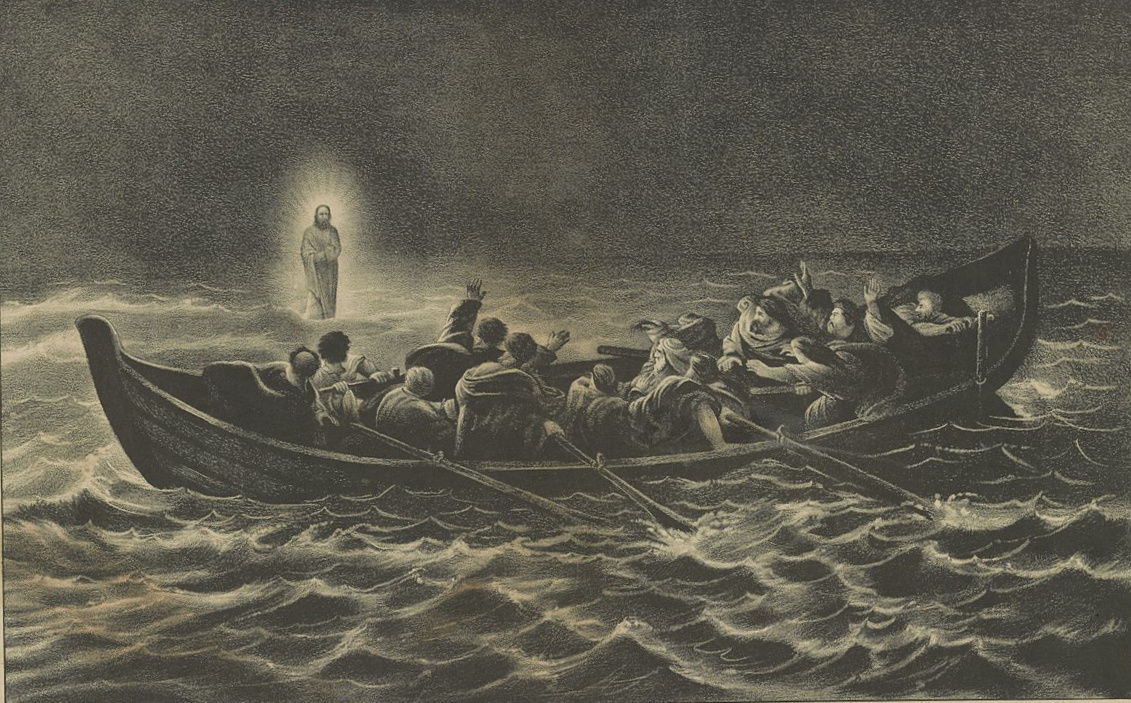
We might well imagine that the words of this psalm – “Lord, let us see your kindness and grant us your salvation” – were on the minds of the disciples in today’s Gospel. They are in very dire straits: caught in a storm, their boat being tossed about on the rough sea, and Jesus not with them. And this story is perhaps symbolic of inner turmoil that was going on within them at the same time. Shortly before this story in Matthew’s Gospel, Jesus and the disciples receive word that John the Baptist had been beheaded. The death of Jesus’s cousin, whom some of the disciples had followed before they followed Jesus, surely filled them with sorrow and grief. And it probably also gave rise to fear – fear that perhaps a similar fate awaited Jesus and perhaps even themselves.

So, turmoil, distress, fear – our Scriptures today focus upon those realities. And that’s a good thing, because those realities are our realities, too – each of us, in some way, because of one or more circumstances in our lives, face something that is causing inner turmoil, or filling us with fear, or giving us anxiety. The question is how do we respond? Often, we are tempted to act based solely on the way we are feeling in that moment. Because we are feeling afraid, and because we don’t like that feeling, we are tempted to alleviate our fear in any way possible – by denying it, or rationalizing it, or numbing it.

Christ Walking on the Sea, Currier & Ives, 19th cent.

What our readings today invite us to consider is how fear and turmoil, as unpleasant as they may be, are also an invitation into a deeper faith. To do so, sometimes we have to enter into our fear and wait. Sometimes the Lord does not alleviate our fears right away – not because he wants us to suffer, but because he wants us to recognize our total dependence on him. And fear has a great way of doing that. In the midst of fear, there is a temptation to abandon faith altogether; but there’s also the chance to see more clearly what is true. There’s an opportunity to make the prayer of the psalmist our own – “Lord, let us see your kindness and grant us your salvation.”

Friends, like the disciples, our boats are at times tossed about on rocky seas. In those moments, let’s turn fully to the Lord, leaving behind our own devices and self-made ideas. Let’s offer a prayer – our own words, or perhaps the words God has given to us in the Book of Psalms. And may that prayer help us to know that the Lord will surely come, just as he did in the Gospel, just as he does in this Mass. When he does, may he find us with deepened trust in him – not having tried to sort things out ourselves, but rather seeing our turmoil and difficulty as the instruments by which he invites us to a new level of faith.

“Lord, let us see your kindness, and grant us your salvation.”

Sunday, August 6, 2023

Big Words

Our Catholic faith uses a lot of big words. For example, after this homily, we will recite the Creed, during which we will use words like “only-begotten,” “consubstantial,” and “incarnate.” And in our broader tradition, there are even bigger words like “hypostasis,” “perichoresis,” and “transubstantiation.” These words might seem unwieldy or confusing, but learning what they mean helps us to understand what we believe.

Today we celebrate the Feast of the Lord’s Transfiguration – another big word. We probably know “transfiguration” refers to the event in Jesus’s life that we just heard about in the Gospel, but it’s worth looking at the word itself and understanding what it means. A transfiguration is a change in outward characteristics only; the underlying thing remains what it has always been while the figure and appearance change. Standing on the mountaintop, the apostles Peter, James, and John beheld the same Jesus they had always known, but in a radically different way, with his face shining like the sun and his clothes white as light.

Luca Giordano, The Transfiguration (1685)

We celebrate today’s feast in the context of our Sunday Mass. And at every Mass, there is another change which occurs – one for which we use another big word that I mentioned before: transubstantiation. Transubstantiation is the word that explains what we believe happens in every Eucharist. In a certain sense, you can say it is the opposite of a transfiguration. In transfiguration, what something is stays the same while its outward appearance changes. But in transubstantiation, the outward appearance remains the same, but what it *is* changes. During the consecration of the Mass, the elements of bread and wine appear to remain unchanged; but what is present there on the altar – the substance – is no longer bread and wine but the Body and Blood of Jesus. All of the outward characteristics remain the same as before – the appearance, the taste and smell, even the biochemical makeup would suggest that it is still bread and wine present. But we believe, by faith, that on the altar is no longer bread and wine at all but instead the Body and Blood, Soul and Divinity of our Lord Jesus Christ.

Both of these changes – transfiguration and transubstantiation – tell us something important. In the Transfiguration, Jesus showed the disciples his own true identity as God’s Son and gave them preview of the glory he would have in the Resurrection so that they would not be afraid when he began his journey toward the Cross. By the transubstantiation of the elements at Mass, Jesus shows us disciples here at Mass his nearness to us, the closeness of his abiding Presence that reaches down from heaven to be with us continually in the Eucharist. Like Peter, James, and John, we are witnesses to this change – a change not in appearance that we can see, but a change in substance that we believe by faith.

And in faith, the Real Presence of Jesus under the appearance of bread and wine is our food for the journey of life. Like Jesus, we too must journey toward Calvary. We must take up our Cross, as he did, but thanks be to God that he comes to be with us, to nourish us with presence. By receiving him in the Eucharist – he who was begotten of the Father before all time, who was born of Mary into our world, who was transfigured on the mountain, who died and rose again and sits at the Father’s right hand – by receiving him, we pray that we might one day be brought to share in the glory of the Resurrection ourselves.

Luca Giordano, Communion of the Apostles (c. 1659)

I have been following this week some of the coverage of the events of World Youth Day. Around one million young people have gathered from around the world in Portugal to deepen their Catholic faith and to pray with our Holy Father Pope Francis. On Friday, the pope prayed with the youth before they began a Way of the Cross, and he told them that the Cross is “the sacred sign of the greatest love, the love with which Jesus wants to embrace our lives. The Cross shows us the true beauty of love.”

Friends, I think we see the truth of those words in both transfiguration and transubstantiation – in the event that happened on the mountain two thousand years ago, and in the event that will happen here on the altar, at this and every Mass. The apostles beheld the Lord Jesus in glory; we behold him under sacramental signs. But for both of us, it’s the same Jesus who comes to encourage and strengthen us. Let us ask him in this Eucharist to not be afraid by our sufferings, but to be sustained by our faith – faith in the glory that we pray awaits us in the Resurrection and faith in his very Presence here on the altar. And let us say with grateful and believing hearts, “Lord, it is good that we are here.”

Sunday, July 23, 2023

A Harvest by Providence

I have had the privilege of celebrating Mass here various times over the last year, but as the lector mentioned at the beginning of Mass, I’m happy to be here today as your associate pastor, assisting Fr. Greg with the care of the parish. I began that responsibility at the beginning of this month, so it is a nice to finally be able to be here with you for Holy Mass.

It is also nice to be with you on this particular Sunday, the 16th Sunday of Ordinary Time, a Sunday that has had some significance for me through the years. It was on this Sunday eleven years ago that I celebrated my first Mass at Christ the King across town, the parish where I was raised. And going a little further back, it was on this Sunday fifteen years ago that I got on a plane and left Arkansas, left the United States, to move to Rome, Italy for four years of studies for the priesthood. That period of my life was full of a lot of different emotions: excitement, to be sure, but also nervousness and a bit of fear as I left behind everything familiar.

I attended Mass on that Saturday evening of the night before and I remember being struck by what we heard today in the first reading – how the author of the Book of Wisdom speaks of the providential care of God. He “who has the care of all”, we are told, the Lord whose “might is the source of justice” is also the one who rules with clemency, who teaches his children with patience and mercy and who gives them reason to hope. That idea was very consoling to me in that moment, as I was about to move halfway around the world, to pursue a calling which at the time I still wasn’t completely sure about. I was being told to trust that the Lord would care for me, that all was in his hands, that even though everything about my life was about to change, he would not.

Fast forward fifteen years later, and I’m much more sure about the vocation God has called me to, even if I am even more convinced of my own unworthiness for it. But the Lord remains faithful. If there’s one thing that eleven years of priesthood has taught me, it’s that he sustains us – priests and people – in our highs and our lows, always caring for us, always teaching us something powerful and important, although it may take us time to see what exactly it is. That’s what we call God’s Providence – the way he has ordered all things, everything in creation, with himself as the final end of it all. That’s a consoling truth – whether we are on our highest high or our lowest low – that somehow, no matter what is happening, God is there, constant and caring, drawing us more fully to himself.

Jesus also speaks of the Providence of God in today’s Gospel, particularly in relation to the kingdom of heaven. Last Sunday, we heard about how the Word of God is sown in the human heart; today, we hear about how it grows. Because that growth is different from how we might expect, Jesus gives us three images that explain how the kingdom of God is being cultivated. Two of these are familiar to us. The kingdom of heaven is like a mustard seed, or a bit of yeast mixed in with the dough; in other words, its power should not be discounted even if it is not immediately visible to us. Jesus is encouraging us to have faith in what we cannot always see – that the kingdom of heaven is being cultivated even now in our midst.

The third image is a little more difficult, and indeed, that’s the one that the disciples ask Jesus to explain. In cultivating an earthly harvest, we human beings are diligent about getting rid of weeds early in the growing process in order to allow the good seeds to thrive. But God’s harvest operates differently. Because the Lord is constant and caring, dealing with us patiently and mercifully, he prefers to let the good and the bad to coexist until the final accounting takes place. The process of growth is one in which reform and renewal are possible, in which the bad can be changed into the good, and in which the good must continue to prove their goodness until the end.

Jean-François Millet, Buckwheat Harvest: Summer (c. 1870)

This parable has great importance for us as a community because a parish is nothing more than a portion of the Lord’s field. God has sown the seeds of his Word in our midst, and he calls us to become fruitful for his harvest, to be leaven in the world that brings forth his kingdom. We also recognize that, as a parish, we are not a finished product; we are both wheat and weeds – collectively, but even individually. On the one hand, that is a reminder of God’s providence and patient mercy, giving us time to grow and to be changed. On the other hand, it’s also a reminder that we will be judged in the end on whether we produce – on whether we show ourselves to be, in the final accounting, fruitful wheat or barren weeds.

What does Jesus want us to take away today? Perhaps that the kingdom of God can’t grow out there [in the world] unless it first grows in here [among us]. And it can’t grow in here unless it also grows for each of us in *here* [points to heart]. That’s why Jesus says in another place “the kingdom of God is within you.” To further the work of God’s kingdom is to allow the Master to be at work in us, in our highs and our lows, in whatever is happening at the moment. His providential, fatherly care makes us better when we focus upon him as our ultimate end – when we direct ourselves to him by prayer, by regular participation in the sacraments, especially reconciliation, and by works of mercy and service to our neighbor. The Lord wishes to cultivate within us fruitful produce for his harvest, but we must cooperate with that work and persevere in it so that we may be found worthy in the end.

Friends, it’s great to be with you – on this Sunday, and in this parish. It’s great to be present with you in this portion of the Lord’s field, in this place in which by his providence he is bringing forth a harvest for his kingdom. I look forward to serving you and serving with you in whatever way that I can, for I know the Lord is present in our midst, drawing us all more fully to himself. As we prepare for this Eucharist, let us ask the Master of the harvest to bring forth good fruit by our lives, that in the final accounting we may “shine like the sun in the kingdom of our Father.”

Sunday, June 25, 2023

Casting Out Fear

When I was a teenager, there were a few clothing brands that it seemed like all the cool kids wore. I was not a particularly cool kid, but I still was able to convince my mom to buy me one or two of those T-shirts that I thought would make me cool. I remember the first one I ever got was from the brand No Fear, and it had some pithy, slightly ridiculous saying on it about not being afraid.

I look back on that with a smile and a shake of the head; 14-year-old me didn’t really know what fear was. In many ways, perhaps I still don’t, but as I’ve gotten older, I’ve come to realize that there are a lot of things that I think I’m afraid of, no matter what kind of clothes I have on: fear of failure, fear of rejection, even fear of public speaking, which I’ve managed to overcome at least in part.

In today’s Gospel, Jesus speaks to the hearts and minds of his disciples, touching upon what must have been the deepest fear for many of them – the fear of death and bodily harm. Life was precarious in the ancient world, with the threat of violence, disease, poverty ever present. Jesus knows that his listeners would have faced a constant struggle of how to provide for themselves and their families, how to avoid confrontation and conflict with those around them, how to not run afoul of the authorities who could cause them trouble – how to survive basically from one day to the next.

Does any of that sound familiar? Maybe our fears are slightly different than those of Jesus’s day, but if we’re honest with ourselves, we worry about many of the very same things: health, well-being, security, liberty, happiness. And not only do we worry, but we also experience the pain and the loss that comes as part of life. In light of all that, perhaps we wonder then how exactly Jesus can tell us to “Fear no one.” Okay, yes, we need to have faith through it all, but isn’t it a little bold for him to say that we shouldn’t be afraid of all these things that are worth being afraid of?

The answer, of course, is that we must remember who is speaking. Jesus was never afraid of being bold, or of challenging those who heard him. But Jesus’s words are not empty, but are backed up by his own life. As the Son of the Father, he knows of what he speaks, which is why we can trust him when he tells us that there is nothing to fear when we know we are loved. The answer to our greatest fears – death, sorrow, loss – is the perfect love of the Father. All that we experience is seen by him, and he holds us all of us in his grasp.

If all of that sounds a little too neat and nice, then let’s remember Jesus’s own life. He trusted in the love of his Father to such a degree that he was not afraid of those who sought to destroy him; though surely afraid at some level of his being, he also went joyfully and confidently to the Cross, knowing that it was the very means of giving all of us a share in the perfect love of the Father. But Jesus also knew that the Father would raise him – that the perfect love of the Father would not permit death to have the final word but would instead reveal the gracious gift, as St. Paul calls it (Rom 5:15), which is the resurrection of the body. If we’re listening closely to what Jesus says today, he is giving us a preview of the truth of the Resurrection. And it’s that ultimately which helps us to face our fears – indeed, to cast them out: that we believe that no matter what harm or loss or sorrow may befall us, the Father will restore and resurrect all in his perfect love. God will have the last word, not our fears.

Christ the Teacher mosaic (4th c.), Basilica of Saint Constance, Rome

 Perhaps now we can see how Jesus calls us to not be afraid. It’s not by thinking we are so strong or so courageous, as if we can deny our fears entirely. Rather, it’s only by placing our fears within a larger framework of love – contextualizing them, allowing them to be answered by a faith and a trust in the One who himself has passed through death into the eternal life of the Resurrection. And that’s why Jesus says that in the end the only thing to fear is losing out on all of that – being afraid not of the destruction of the body, or anything that might happen to us from outside, but what can happen from inside, the destruction of the soul through our sin, our pride, and our self-justification. A lot of our sins are motivated ultimately by our fears: fear of feeling pain; fear of being criticized; fear of being alone; fear of missing out on something. Today, Jesus tells us, “Don’t be afraid of those things; don’t let your fears compromise your love and your trust in my Father, such that you risk losing what he wishes to give you.”

Do you know what sums up all of this perfectly? That which we do here at Mass. We come with our hearts full of anxiousness and worry, but also commending ourselves to the love of God, trusting that he loves us and trying to love him. And we listen to his word to us, and we respond with faith renewed. And then we participate in the very proof of that love which is the Sacrament of the Altar – when the mystery of Jesus’s self-offering, his death and resurrection, is made present again for us. And receiving that gracious gift (Rom 5:15) of he who once was dead but now lives forever, our hope of sharing in his Resurrection is strengthened and deepened, so that as we face the things that bring us fear and worry, as we seek to live out the joy of the Gospel that Jesus calls us to, we can have the confidence of perfect love which casts out all fear (1 Jn 4:18).

Friends, ask the Lord to give you some insight this week about your own fears. Where are you being tempted to lose your faith, to lose your love because of your worries and anxieties? And then ask him to give you an even deeper insight into the perfect love that the Father has for you, a love that the Son has shared with you by his blood, a love that, if you believe in it, can cast out your fears. May this Eucharist and every Eucharist we celebrate give us the foretaste of receiving one day the fullness of the gracious gift the Lord has prepared for us.

Sunday, June 18, 2023

Care from the Heart

The green vestments I am wearing indicate, if we weren’t already aware, that we are now back in Ordinary Time. In fact, we’ve been in Ordinary Time for a few weeks, ever since Pentecost Sunday. We’re only now switching to green vestments though because on the last few Sundays we’ve celebrated some special feasts that come this time of year: the Solemnity of the Most Holy Trinity two weeks ago, and the Solemnity of the Body and Blood of Christ last Sunday.

There’s one more special feast that often gets overlooked, and that’s because it’s celebrated on a Friday – the Friday of this past week, in fact. The Solemnity of the Sacred Heart of Jesus is sort of the crowning feast of this time of year, and perhaps for that reason, the month of June has long been associated with devotion to the Sacred Heart of Jesus. The history of that devotion is too long to get into here, but briefly, in the modern form is roots date from the 17th century. Figures like St. Margaret Mary Alacoque and St. John Eudes, and groups like the Society of Jesus, helped to popularize the devotion of the Sacred Heart of Jesus and its basic message – that in the Heart of Jesus we see the depth of God’s love for his people.

In today’s Gospel, we hear more about Jesus’s Sacred Heart, and how it is moved with pity at those who are “troubled and abandoned.” Rather than merely feel compassion toward the crowds, Jesus acts to help them. He sends out select disciples to go and minister in his name, giving them the authority to preach, to heal, and to sanctify. And we are told the name of these twelve men, who are called apostles, which means “one who is sent.” They are the twelve apostles who will be Jesus’s closest collaborators throughout his ministry, and indeed the ones who will be charged with continuing that ministry in and through the Church.

In other words, the Gospel today tells us it is out of the compassion and love of Jesus’s own heart that he has called and sent ordained ministers to serve his Church. And that is still true today. Those who are trusted with ordained ministry – whether it’s the original twelve apostles; or their successors, whom we call “bishops”; or their collaborators, the presbyters; or the special servants that we call deacons – Jesus calls and sends all his ordained ministers to care for his flock with compassion – with love, and not just with their own imperfect love, but with the love of his Sacred Heart.

Sacred Heart of Jesus (1767) by Pompeo Batoni

I’ve found sometimes that there’s a danger when a member of the clergy starts talking about ordained ministry. It can come across as self-serving, as self-glorifying. Certainly we all know that there are some clergy who have sought to serve themselves, mistreating or even abusing the flock entrusted to them for their own gain. But the reality is that the majority of us clergy whom the Lord calls do what we do not for ourselves, but for you. We try to respond to the Lord’s command to sanctify, teach, minister – not because it’s all about us, but because it’s all about *you* and the Lord’s love for you. I think sometimes this basic point gets missed when we gather here on Sundays – how everything that is done here is done because of Jesus’s love for you. The Lord calls the priest and deacon to proclaim, to preach, to consecrate, to bless – all so that you can go forth from here to minister to the world.

And that’s the final takeaway for today. What Jesus gives you, he also asks you to share: as he says at the end of today’s Gospel, “without cost you have received, without cost you are to give.” Jesus loves you, and has compassion for you, and has sent his ministers to care for you, so that having been made holy, you will then go and share those gifts with others. We who are ordained ministers do that for you, the lay faithful. And you are called to do the same, in your own way – in your homes, in your places of work, in your families, in every aspect of your life. The Lord sends you now to those who whom you know who are troubled and abandoned, that they too might receive his care and love. In this way, the Lord is sanctifying all the world, making for himself what God foretold to Moses: “a kingdom of priests, a holy nation.”

Friends, as we prepare to celebrate the Eucharist, let’s remember that it is the transforming love of Jesus that has gathered us together this day. And, as priests and people alike, let’s focus ourselves anew on what the Lord has called us to, and what he sends us to do – to preach, to proclaim, to sanctify, each in our own way, always with the love and compassion of his Sacred Heart.

Sunday, June 4, 2023

Believing in Love

It is a pleasure to be here with you all on Trinity Sunday. Today’s feast happens to fall this year on the first Sunday of June, a month which in recent years has become associated with cultural dialogues about love, identity, and the authentic nature of self. There’s a lot that could and should be said about those cultural dialogues and about how they relate to our lives and our Catholic faith. But for the moment, perhaps it’s enough to say that these themes of love and identity are at the heart of today’s feast – not only in terms of how we understand ourselves but in how we understand God. Allow me to explain what I mean.

The reading we just heard was short – only three lines taken from the Gospel of John, the first of which was: “God so loved the world that he gave his only Son, so that everyone who believes in him might not perish but might have eternal life.” This passage, John 3:16, is maybe the most famous in all of the Bible, and rightly so: it sums up perfectly, in his own words, Jesus’s identity. He speaks these words to the Pharisee Nicodemus, who has come to him at night in search of answers about who he is. And Jesus gives them to him: he is the Son of God, sent so that we might believe in him and thus receive salvation rather than the condemnation we deserve by virtue of our sins. Jesus’s presence among us, the whole reason for his coming, is due to love: the love of God for human beings.

How important it is for us to return to this idea again and again! So often our understanding of God, and our ideas about religion and faith generally, can become sidetracked into other things. We might even wonder, “Does God love me? Does he care about what I am going through?” And the answer is YES – God himself, in the person of Christ, tells us today that his love is at the root of everything. The foundation of God’s entire focus toward us human beings is saving love. And the reason for that is because God himself *is* love, as we know from the First Letter of John. That’s what we celebrate today in the Solemnity of the Holy Trinity. Who God is, is Love – a communion of Love, between the Father, the Son, and the Holy Spirit. And as God reveals his own identity to us, he also invites us, amazingly, to participate in that identity: we as mere human being can come to know the divine love of the holy Trinity, be caught up in it even now, and even share in it forever in eternal life.

But if all of that sounds great, here’s the challenging part: where do we see God’s love most clearly and visibly? In the Cross. In the history of Christian art, some of the most frequent depictions of the Holy Trinity are with Jesus on the Cross, with the Father and the Holy Spirit above him, showing him to the viewer. That’s because more than any of Jesus’s sermons, more than any of his miracles, more than anything else he does, it is his suffering and death that reveal the depth and totality of God’s love. Jesus makes reference to this in the same dialogue with Nicodemus that our Gospel passage comes from. He says that we human beings are asked to believe in the love that is revealed when the Son of Man is lifted up – in other words, when he Jesus will be raised up on the Cross. It’s in the Cross of Christ that we come to know and believe in the saving love of God, the love he has for sinful humanity.

The Most Holy Trinity (1625) by Guido Reni 

And this is important for us, too, because if it’s true that we sometimes lose sight of love as being at the heart of who we are and what we believe, it’s also true that we too often think of love in some way other than how God reveals it – the love of the Cross. You and I experience love in all kinds of ways. We know it through our families, through our friends, through love of the world and what is in it, even through a proper love of ourselves and our own identities, unique among creation. But all of these loves, good as they may be in some way, also must be purified. Because we exist in a fallen world, and because we are ourselves are fallen, our loves can be distorted – they can distract us from or even lead us away from true Love itself, Love with a capital L, which is the love that Jesus has revealed on the Cross. This is the love that God has for us, but it’s also the love that he calls us to have – to imitate, to strive for, and to be purified in our own manner of loving, so that our love may be ever more fashioned in the love of the Cross.

Perhaps we might think today about how we think of love: love as an abstract idea, as a cultural touchstone, and above all love as it is lived out in our lives and the lives of those we know. And perhaps we might each ask ourselves: How are my notions and experiences of love rooted in the love of God? Are my loves self-serving, or do they try to imitate and be purified by the sacrificial love that God has revealed for me in the Cross? How can my ways of loving myself and others be directed not toward earthly ends but toward sharing one day in the eternal love of the Holy Trinity?

To answer these questions, my friends, surely all of us, in some way or another, must seek out Jesus, like Nicodemus did, and find in him again the authentic identity of what it means to love. This month of June that we have begun has for centuries been the month dedicated to the Sacred Heart of Jesus – the devotion which sums up everything I’ve said. The love of God, the love that is his very identity as Holy Trinity, is revealed to us in the Cross of Christ. He continues to love us now, and with the continuing love of his Sacred Heart, he calls us to encounter the love of the Cross, to believe in it, and to conform our own ways of loving to it. 

May the Eucharist that we celebrate this day help us to experience anew the saving love of the Holy Trinity, so that by our own sacrificial, Christlike love we may be led to eternal life.

Saturday, May 20, 2023

The Goal of Heaven

May, traditionally, is known as the month of the Blessed Virgin Mary. And so it is appropriate to honor her in different ways in these days with special prayers and devotions and customs. For example, many people focus on praying the rosary each day of this month, and many parishes have a May Crowning to recognize Mary as queen of heaven and earth. That tradition may come from the fact that for centuries the last day of May was the Feast of the Coronation of Mary, although now that day is celebrated in August.

Since much of May falls during the Easter season, we also remember in this time that Mary is in heaven, body and soul, because of the Passion, Death, and Resurrection of her son Jesus. And today we celebrate the second to last feast of the Easter season, the great Feast of the Ascension. Jesus, as God and man, is himself the union of heaven and earth. But when he ascended, he brought what is earthly – our human nature – into the very place of God’s true presence. And in so doing, he paved the way for mere human beings to follow him – Mary, the saints, and eventually, we pray, us.

The notion of going to heaven is one that probably sounds familiar to us. Most Christians are aware that that is what we should be aiming for and what we hope awaits us at the end of our life. Perhaps the true danger in this day and age is presuming that everyone, or nearly everyone, will surely make it there, and assuming that certainly we ourselves at least will. With that assumption in place, then, heaven often just recedes from our daily focus, and becomes something of an implicit expectation that in reality we don’t think of too much.

Frankly, this is not really what the Lord wants or expects. Having gone ahead of us, Jesus wants us to make joining him in heaven the ultimate goal of our lives and the daily purpose behind everything we do. Think for a moment about all of the dreams and hopes and aspirations that people have, that you probably have: a good education, a successful job, a rewarding career, hobbies that you enjoy, a sense of purpose and fulfillment, a life partner who makes you happy, the blessing of children and grandchildren. All of these things are good and beautiful, and they are not in themselves contradictory with the Christian life. But it’s also true they aren’t the *goal* of the Christian life either – no single one, or even all of them together, are the purpose for which we were created or the ultimate goal of our daily existence. That is, and should be, getting to heaven.

Ridolfo Ghirlandaio, Coronation of the Virgin with Six Saints [detail] (1504)

It’s important, of course, to know how to get to heaven. Jesus tells us in today’s Gospel, just before he ascends to heaven: to make disciples of all nations. It is obeying this commandment that will bring us to where the Lord is. And so, everything we do should be about following Jesus ourselves, and about giving a sign to others of how to do the same. But the first step in living this out is learning to yearn for the goal we are striving for. Think of Mary, again: after Jesus ascended to heaven, she surely was a sign to others of the Good News of Jesus. How could she not be, as Jesus’s Mother? But surely she did all that she did because she desired to be with him again in heaven. How much she must have ardently desired that, at every moment – how much it must have been the singular purpose for everything she did! And as we know, that goal that was in her heart was rewarded at the end of her life when she was taken body and soul into heaven and crowned by her Son.

Friends, as we celebrate today Jesus’s Ascension into heaven, let’s ask ourselves how ardently we are yearning to join him there. The other plans and purposes of our lives can be good, and we can strive for them too, but never to the detriment of our ultimate goal of reaching heaven. And if Jesus should ask us to give up one or more of them in order to reach this goal, how greatly will he surely reward our earthly sacrifices with heavenly joys, just as he did for his Mother. O Blessed Virgin Mary, Queen of Heaven and Earth, pray for us!

Sunday, May 14, 2023

Still With Us

Happy Mother’s Day to all. A few days ago, I was watching the nightly news, and at the end of the segment, the anchor went out into Central Park to ask a few kids about Mother’s Day. He asked them why we celebrate our moms and what they were preparing to do for the day. Finally, he asked them what word best describes their moms. One child said, “kind.” Another said, “caring.” One kid though responded, “stressed.” I bet he’ll never hear the end of that.

Whether as kids or as adults, at some point we all realize that our moms aren’t perfect. But we love and appreciate them anyway: because they love us, and they do their best for us, to nurture us, to teach us, to support us – no matter how old or gray we might get. So much of what we experience and how we see the world is shaped by what our moms have given us, how they have formed us, how they have made us who we are. That’s why we can say truthfully that they are always with us. No matter how physically separated we are from them – even when they pass from this world and await us in the next – they are with us.

In today’s Gospel, Jesus uses similar language to describe God’s fidelity and love. We are used to thinking of God in masculine terms, because that is how he has revealed himself to us: a Trinity of Persons, Father, Son, and Holy Spirit. But we might also say that God’s love exhibits many of the same traits as those we admire in our mothers, only to a far greater extent. Even more than our mothers, God has formed us and given us life; he nurtures, teaches, and supports us; and he desires to be so connected to us as to always be with us. In fact, as we hear Jesus tell us today, God’s love is such that he gives his very self to those who believe in him, such that he dwells in them and they in him.

Jesus lays out how this works at the Last Supper, the context for our passage today. He explains to the disciples that he is about to go away from them, to enter into his Passion, Death, and Resurrection. At the same time, those very same events – what we call the Paschal Mystery – also become the means by which he remains with his disciples. We say that our mothers are with us always because of their profound influence on us, but God, because of his all-powerful love, actually does remain with those who love him. The proof of that love, Jesus explains today, is following his commandments. If we follow what Jesus has taught us, God reveals everything of himself to us and dwells within us by means of the Holy Spirit.

The Supper (19th cent.), Sebastian Winterhalder Workshop, Germany

Notice the clear causal connection: in order to receive this gift of God with us, we must love the Lord, and this is shown by being faithful to his commandments. In other words, loving Jesus is not primarily about having any particular sentiment; it’s about what we *do* – the way we live, and the purpose and intention for how we live. This is the most important reason to obey the precepts of our faith, to follow the teachings of the Church, and to strive to be more faithful each day – not because we make ourselves holy by following commandments, but because the Lord has promised *he* will make us holy if we do. He will give us the Spirit, who will enlighten us further on how we are to live, and he will dwell within us, giving us a share in his life that goes beyond the grave.

We give thanks for our mothers today, and rightly so. We think about the ways they have shaped us, and we recommit ourselves to doing our best to living out what they have taught us. The same should be true of us in relationship with God, only to a far greater extent. The Lord Jesus promised not to leave us orphans, but to remain with us, if we remain faithful to him. If he were asked to describe in one word how well we are living out his commandments, what would it be? “Well-intentioned”, “inconsistent,” “stressed”? Let’s strive today, as best as we can, to live out his commandments perfectly, proving our love for him anew each day, knowing that he will do his part – sending forth the Holy Spirit to give us peace, encouragement, and love.

Friends, as we prepare to receive the Sacrament of the Altar, we recognize that in the celebration of this mystery, the Paschal Mystery becomes present anew – and so too the Lord himself comes to be with us. Following his commandment to do this in memory of him, may we become aware of how his words are fulfilled in this very Sacrament: “Whoever has my commandments and observes them is the one who loves me. And whoever loves me will be loved by my Father, and I will love him and reveal myself to him.”

Sunday, April 16, 2023

Open Wide the Doors

A few weeks ago, many of our priests and deacons gathered together at the diocese for our continuing education days, which we have twice a year. In one of the sessions, our speaker focused on the Gospel that we just heard, and he asked us to identify which word stood out to us – one single word. Was there a word that stood out to you? I can see some of you searching back through your missals right now. Don’t worry, I won’t call on you.

The word that immediately jumped to my mind then, and did again just now, is the word “locked”. Twice we read in this Gospel passage that the disciples were behind “locked doors.” At first, that might seem like an odd or irrelevant detail. We are dealing with the major events of Jesus’s death and apparent resurrection. What does it matter about the doors?

Sometimes, a good storyteller will include a detail which seems insignificant but which is in fact clues us in to what is really going on – and Saint John the Evangelist, the author of our today’s account, was a really good storyteller. By telling us that the doors were locked, what he’s really doing is telling us about the interior dispositions of the disciples. They were afraid, and more than afraid – closed off, shut down, locked away from everything outside of themselves. They were fearful of those who had put Jesus to death, they were fearful perhaps of further betrayal and division among themselves, and they may even have been fearful of Jesus himself – who, if he was risen, would perhaps surely be less than pleased that they had abandoned him in his time of need.

However, as we hear, locked doors are of no concern to the Risen Christ – not the physical doors that he passes through easily, nor the closed off doors of the disciples’ hearts. Twice he breaks through both because he desires to be *with* his disciples. He desires, as we hear, to stand in their midst, to show them his glorious victory, and to communicate to them his peace, a peace stronger than fear and death. The Lord’s peace is accompanied with the presence of the Holy Spirit, that heals and restores the friendship he has with his disciples, and which prepares them to be sent to communicate that same peace to others.

Image of the Divine Mercy (1982) by Robert Skemp

We might say that this peace that Jesus gives is also known to us by another name: Divine Mercy. Our celebration of the Sunday of Divine Mercy comes a week after Easter Sunday, at the end of our eight-day Octave of Easter, as a reminder that it is only in and through the Paschal Mystery of Jesus – his Passion, Death, and Resurrection – that God’s mercy is extended to us. We can have true peace, we receive Divine Mercy, because of what Jesus has done for us, and because in his new and risen life, we too are raised to something higher. Not only is our individual relationship with the Lord transformed, but also our relationship with all those to whom the same gifts are given. That’s why at Mass we exchange a Sign of Peace – offering it to each other as an expression of the grace of forgiveness that the Lord has given to us and which we freely extend to each other.

The peace of Jesus is also the instrument by which he opens the doors to our locked hearts. In one of the most famous images of Divine Mercy, he stands in front of a closed door, as if he has just passed through whatever was keeping him out. The season of Easter is a good time to reflect upon our interior dispositions – our fears, our anxieties, the sources of resentment and hardness of heart – and to pray intentionally for each of those things to be unlocked by the transforming forgiveness of the Risen Christ. Jesus can overcome any obstacle, any barrier that stands between us and him, and often he will break through them in a surprising way to show us the power of his love. And the same time, the Lord would prefer if we willingly open the doors of our hearts, welcoming him with faith and joy. Whatever our fear or anxiety, he urges us to remember those immortal words of Saint John Paul II, “Be not afraid… Open wide the doors to Christ!”

Friends, let’s reflect upon where we can do just that. Let’s ask ourselves, in the joy of this Easter season, “How can Jesus unlock new life for me? Where do I need to hear again his healing words of peace?” May this holy season be a time of renewal in our friendship with him, days of our continuing education in our discipleship, so that the merciful power of the Risen Lord may open wide our doors – to him and to all. “Peace be with you,” he says to each of us. “As the Father has sent me, so I send you.”