Saturday, April 16, 2022

A Love Stronger than Death

On Wednesday of this past week, I went over to our parish school to visit the religion class of our older students. I like to do that every so often as a way of interacting with them a bit more than I do during our weekly school Mass. I answered a few questions that they had left for me in their Questions for Father box; they wanted to know, among other things, what I like to watch on TV, what my favorite song is, and whether I preferred McDonald’s or Taco Bell. You know, the important stuff.

But really, my primary purpose in making a visit to their classroom was to ask them what they knew about Easter and about the events that led up to it that we as a Church have been celebrating for the last three days, a period we call the Sacred Triduum. We talked about how Jesus ate a final meal with his friends, a meal in which he washed their feet as a sign of his love and a commandment for them to follow. We talked about how he was betrayed by one of his friends, and was arrested, tried, and condemned to death. We talked about he took up a Cross, a terrible instrument of torture that he made into a sign of love and salvation. And we talked about how he was crucified on that Cross, died, and was laid in a tomb.

I asked the school kids: “Is that the end of the story?” And of course, they all earnestly replied, “NO!” And they’re right – it wasn't the end of that story. But while we know that, when those events were actually happening, that wasn’t apparent at all. We may experience the sorrow of Good Friday, but we also feel the tinge of joy that Easter Sunday is coming. But that wasn’t the case for Jesus’s disciples. Maybe they had a vague wisp of belief in something more to come – remembering the Lord’s promises, believing in God’s justice, hoping for the possibility to somehow be reconciled with him who many of them had denied and abandoned. But even if there was some glimmer of these things deep in their hearts, mostly there was just pain and confusion and grief and loss.

But there was also love. As this Gospel tells us, the women from Galilee who were his disciples, who had known him and supported him from the beginning of his ministry – they still had love for Jesus. He was dead and buried now, a big stone keeping him in and everyone else out; but no matter, they still loved him. It could only have been love that made them go out to the tomb that morning at daybreak – despite the danger of doing so, despite the terrifying events of the prior days, despite the seemingly definitive ending that is death – they went to show love to the dead body of their friend and Lord. And what did they find there? Not a dead body but an empty tomb, the huge stone rolled away. And they heard in the words of these two angelic men that Jesus had been raised from the dead.

Federico de Madrazo, The Three Marys at the Tomb (1841)


We are familiar with all of this. We know the basic details of the Easter story, at least as well the children of our school do. But what this simple, strange Gospel story invites us to consider is: do we know it as well as those women of Galilee? Has the message of Easter been made *real* for us? On that morning, those women found their love rewarded – matched by a Love from on high. In that light of dawn, those women of Galilee discovered that the heart of God is also full of love, and had done something they could not. Because the Resurrection of Jesus is not something to be only known about, or even only believed, but it’s something that must be loved. The love of the Risen Jesus is stronger than death.

And so, we must look more deeply into our hearts, to see what is in there that has brought us out on this morning. We knew that this Sunday would follow last Friday; we knew that the Easter season follows upon Lent. But the fact that we know what happened does not mean we really have *understood* it. There’s lots of reasons that can bring us to church on Easter morning: a sense of obligation, a family gathering, a fear that we would miss out. But the best reason to come and celebrate this day is because we can say that what is in our hearts is precisely what those women of Galilee had in theirs – love. Can I say that? Can you?

Friends, the Good News is that, no matter our answer, love is the reason we have come here this morning, because love is the reason that God has for us to be here. Just like he brought those women of Galilee to the empty tomb, to see and believe in the depths of his love, so too he has brought you here today. And he who is Love itself, he who once was dead but who now lives forever, he loves you and he wants to give his love to you, and to make you come to believe in him, just as those women did, with a love stronger than death. He invites you to begin anew this morning, to encounter his love not just at Easter, but every day, especially here in the Mass where he becomes truly Present.

As we prepare for this Eucharist, let us pray that this Sacrament might help our love for the Lord to grow each day, until that day when a love stronger than death will bring us to him in the glory of the Resurrection.

Friday, April 15, 2022

The Only Word

We all know what it’s like to be at a loss for words. But sometimes, there simply are no words adequate to the moment. That’s an uncomfortable thing to say as someone who makes his living preaching words to others, but I’ve thought of that more and more in the last several weeks, particularly in light of the war in Ukraine. It struck me in a particular way two weeks ago when I learned of the terrible loss of life in the town of Bucha, where civilians – non-combatants ­– were tortured, brutalized, and killed. I thought “There are no words for this.” For some tragedies, for some evils, there is simply nothing to say.

I imagine that feeling might be with many of us today, right now, having just heard again the Passion of Jesus. Twice in one week now, we have read the account of an innocent man tortured, brutalized, and killed. It’s a tough story to hear, even for a non-believer, but for us who do believe, it’s even harder, because we hear the prophecy of Isaiah and we see it fulfilled in Jesus: “it was our infirmities that he bore, our sufferings that he endured; he was pierced for our offenses, crushed for our sins.” Jesus, the Son of God, didn’t just die for us – he was killed by us, on account of our sins. When we begin to truly contemplate that, words fail us and we are reduced to silence.


And yet the purpose of today is not to feel deep sorrow, to be weighed down with shame, or even to be reduced to silence, but rather to hear the word that God speaks to us in the Cross. For while words may fail us, while we may not know what to say, God does – and the word he speaks to us is the Incarnate Word, his Son, dying out of love for us. In the Cross of Christ, we see reflected back at us all the ugliness of evil, all the nastiness of human hatred and jealousy, all the helplessness of death, and we see God’s answer to all of it – the love of his Son embracing all of it in order to take it away.

This is the deep mystery of today, the difficult truth that resists understanding. To contemplate that the Son of God died for us, for our sins, is a hard reality to stare in the face. But it’s even harder to understand that somehow that terrible death wasn’t the end of our relationship with God, but the fullest expression of his love, and the deepest sign that he could give that nothing can take that love away. That’s a mystery that truly defies explanation. It’s a truth that we must simply behold, in silence, and believe.

And if we do, we will see how, standing before the love of God revealed to us in the Cross of Christ, it is the only word we truly need. In the face of our sufferings and pains, our trials and tragedies, and above all our own deaths, all other words pass away, but this word remains. God offers this word to us still – he speaks it always – the word of his love, the word of his presence, the Eternal Word made Flesh, who suffered death this day out of love for us.

Thursday, April 14, 2022

Covenant and Command

At the close of Mass this evening, instead of giving a final blessing, I will process through the church with the Blessed Sacrament. As that happens, we will sing a hymn written about 800 years ago by the Dominican friar St. Thomas Aquinas. His brilliant theology is still widely read and studied, but St. Thomas is perhaps as well known today for his deep love and devotion for the Eucharist. Over the course of his life, he wrote five hymns about the Eucharist and the most famous of these is the Pange Lingua, the one we will sing.

In one of the last stanzas of the hymn, St. Thomas succinctly summarizes the whole meaning of this evening’s liturgy: “Et antiquum documentum novo cedat ritui” – “And may the ancient covenant give way to a new rite.”St. Thomas is referring to how, on the night before he died, Jesus established a new and eternal covenant that fulfills and succeeds the prior covenant God had made with his people Israel. As we heard in the first reading, that old covenant had the Passover meal as its principal sign. Each year, the Passover lamb would be sacrificed and eaten as a remembrance of and a sharing in God’s saving action to bring his People out of slavery in Egypt. In the new covenant of Christ, the People of God partake not of roasted lamb but of the living Body and Blood of Jesus Christ, who as the Lamb of God, sacrificed for us on the Cross, has brought us out of slavery to sin and death. That’s why we can say, echoing the words of St. Paul, that whenever we eat the Bread that has become the Lord’s Body and drink of the Cup that is his Blood, we have Communion with the Lord and proclaim his death and resurrection.

Icon of Christ Washing the Feet of the Disciples (1497), Kirillo-Belezersky Monastery, Russia

Maybe it seems strange then that our Gospel today tells us not about the eating and drinking at the Last Supper but instead the washing of feet. Only the Gospel of John recounts this event, and it seems that he does so as a way of explaining the new covenant with Christ in a different way. Jesus washes the disciples’ feet so that they can have an inheritance with him, as he tells Peter. But he also does it a sign of what they must then do for each other – and not just for each other, but for all. The new covenant with Christ, then, is about sacrificial love, and Jesus will show them the depth of that sacrificial love the next day when he goes to Calvary. Just as the Lord stooped to wash the disciples’ feet, so too he would stoop to bear the Cross for their sake, for the sake of all who have an inheritance with him.

But, if the Lord has made himself lowly for us, even to the point of death, then we who have Communion with him in the new covenant of his Blood must also do the same for others. When we come to partake of this Supper that we call the Eucharist, we commit ourselves to serving others with sacrificial, Christlike love – not by washing their feet, but by helping the poor, lifting up the lowly, welcoming the stranger, forgiving the sinner, working for peace and reconciliation. Just as Christ poured himself out for us, so too we who receive him, who have Communion with him, must pour ourselves out in loving service to one another.

In a few moments, friends, we will once again partake of the Sacrament of the Altar. We will do so at Jesus’s command, in memory of him, but not just with his memory but his very Presence among us. As we partake in this ritual meal, what St. Thomas calls the new rite of our covenant with him, may we remember that it is only by his grace and his Presence within us that we can fulfill his command to do what he has done for us – to lay down our lives in love for one another.

Sunday, April 10, 2022

His Story, and Ours

Only two times during the Church year are we given the option to read the Gospel in the way we just did. One is today, and the other is this Friday.

I’ve sometimes wondered why that is. Why, on these specific days, Palm Sunday and Good Friday, with this specific Gospel passage, are we given the option to read the Gospel in parts, with various speakers, not just those who are ordained? On the one hand, there’s the practical element of making it a little more engaging. It’s just a little easier to pay attention when there are different speakers, especially when the Gospel is so long. But I think there’s another reason too, which is this: participating in the Gospel, having a role and saying a few words ourselves, makes it come alive for us in a new and more profound way.

And isn’t that ultimately the goal of this coming week? The mysteries of Jesus’s Passion, Death, and Resurrection lie at the heart of our faith all through the year, but in this Holy Week, they are meant to come alive for us – not only for us to find meaning in them, but that they may resonate with meaning for our lives here and now. In these next few days, we are invited to participate in the story of salvation, and realize that in some way, in the deepest ways, it’s our story too. We are the crowds that cheered Jesus into Jerusalem, and those that shouted for him to be crucified. We are the disciples who ate and drank with him at the Last Supper, and who then fled in fear and denied him. We are the women who wept and mourned him on the Way of the Cross and who stood with him at the foot of Calvary. We are all of these things; we are faithful and fickle.

Christ's Entry into Jerusalem (c. 1860) by Hippolyte Flandrin

But ultimately, the point of our faith – and the point of this Holy Week – is that Jesus himself is the one with whom we identify the most. We are present in him, and he in us. That’s what it means to be the Body of Christ, and that’s what ultimately makes this week holy. In him, our sufferings become redemptive; in us, he is at work, to bring us by our faith and hope to a share in his victory. Let’s participate again in his story, in our story. Let’s enter into this week with prayer, and with participation, joining our story to his, so that his triumph may be ours.

Sunday, March 27, 2022

Set Free

In 1863, Abraham Lincoln shocked the world when he issued the Emancipation Proclamation. In the middle of the Civil War, he declared what should have already been obvious to all: that the slaves in the southern States were free human persons, and not the property of their owners. The battles between the Union and the Confederacy continued to rage for another two and a half years, but from that point forward everyone knew that the war was part of the larger struggle for human freedom and dignity.

Even more than our nation's history, freedom is the hallmark of our Christian religious heritage, and we heard the history of that heritage in our readings today. In the first reading, Joshua leads the Israelite people at long last into the Promised Land. Forty years after God had freed them from slavery in Egypt, after their period of purification and preparation in the desert, they enter at last into the land that God had promised them as their inheritance. And it’s here at last that the manna ceases – the bread that mysteriously appeared every morning, and had fed the people along the way, comes to an end because their journey has come to an end. They are now in their rightful place, their place of rest, their true homeland.

In our second reading, St. Paul explains how this foundational story has been spiritualized, so that all people can be the People of God and receive a heavenly inheritance. It is in Jesus Christ, he says, in the sacrifice of his death on the Cross, that God has restored human beings to himself: he rescued us from the slavery of sin – a slavery even more terrible than what was practiced in Egypt or in the Southern states – and reconciled us to himself. In Christ, humanity has the ability to receive something far greater than it ever lost: access to the true and heavenly homeland, and a new identity as God’s beloved sons and daughters.

This dynamic is true for humanity as a whole, but it is important to understand it not just theoretically but in the way it actually plays out in our lives. A proclamation of emancipation only matters if a person actually experiences freedom as a result. That’s why each of us must recognize that, at a deep level, we are all like the younger son in the Gospel story. By our pride, by our greed, anger, lust, gluttony, selfishness, or whatever else, each of us has squandered our inheritance and gone away from the Lord, like wayward sheep seeking our own way. Unfortunately, like that young man finds out, choosing a path away from the love of our Father doesn’t lead us to success or self-fulfillment, but only to bitter disappointment and loss. However, God does not give up on us. If we can, by his grace, pick ourselves up and turn back to him, we will find that he always welcomes us back with warmth and love. In his house, we find freedom from our slavery, we find newness of identity, because Jesus the Son has made it possible for us to also be God’s beloved sons and daughters.
 
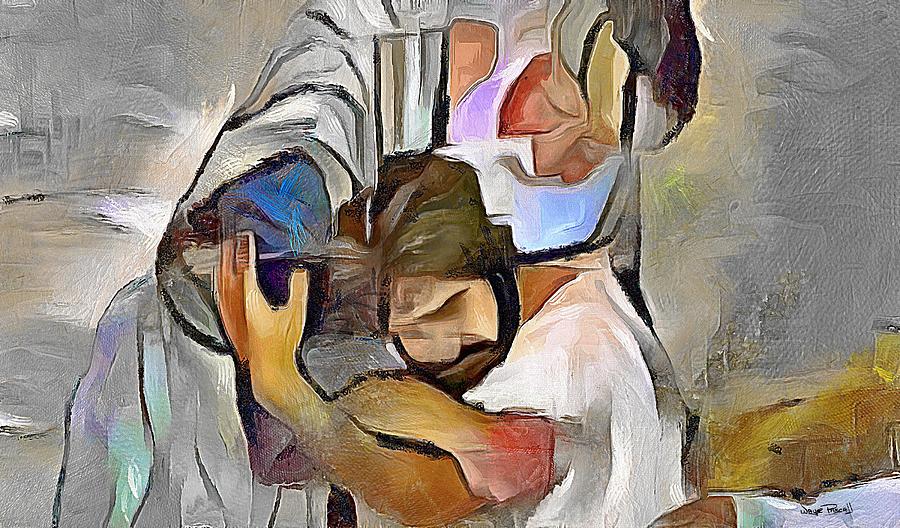
The Prodigal Son (2019) by Wayne Pascall

So, thanks be to God that what the scribes and Pharisees say is true: Jesus welcomes sinners, and communes with them. The Parable of the Prodigal Son is a symbolic explanation of God’s mercy, but that mercy is actually encountered not in a story but in real life. We need to experience it personally, and we do so most fully in the sacrament of penance. We will have an opportunity to participate in this sacrament again this week in our parish’s penance service on Tuesday evening. I encourage us all to come and make use of this great sacrament – if not here, then somewhere, before the end of Lent. Let’s do this even if – especially if – we have been away from the sacrament for a long time. There can be lots of things that might tempt us to stay away: perhaps fear, or shame, perhaps a past bad experience in confession, perhaps a lack of certainty about just where we are at spiritually, of what we need to confess and how we need to change. But don’t let any of those things be an obstacle that prevents you from making your way back to the Father’s house. If you trust that the Lord desires to unburden you and liberate you of your sins, and if listen to the voice of the Holy Spirit urging you to get up and return to the Father’s house, I know you will find the sacrament to be what I myself find it to be: an experience of reconciliation, of being welcomed back by the heavenly Father, who is always loving and merciful.

And if, for some reason or another, it's not possible for you to receive sacramental absolution at this time, don’t lose heart. Consider offering to God just a few words of sorrow for your sins, perhaps through an Act of Contrition, or a prayer of your own making. Tell him how much you regret going astray and how much you desire to be liberated from your sins and renewed in your spiritual life. I bet you’ll find that, much like the younger son in the Gospel, you will hardly begin to speak before the Father interrupts you with his mercy and assures you in some way of his abiding love.

Friends, as we continue our Lenten journey, let’s give thanks to God for the great Emancipation Proclamation he has given us in the love of his Son. We are journeying closer to the solemnities of the Lord’s Passover, the great celebration of his setting us free from sin and death by his Passion, Death, and Resurrection. In these last few weeks, let us set aside our pride and hesitance, and return to the Lord’s loving embrace. And as we prepare for this Eucharist, may we be reminded how it is here in this Sacrament where the Lord restores and renews us, giving us no manna as our food for the journey, but his own Body as our true and living Bread. May its graces enliven us and lead us onward to our rightful place, our place of rest, our true and heavenly homeland.

Sunday, March 13, 2022

Confirming Faith

Doubt and uncertainty are part of life. Sometimes we wrestle with those things right after putting ourselves forward boldly in some way. It’s not uncommon for a person who makes a big purchase to feel a little buyer’s remorse right afterward. Or a person who accepts a new job might second guess whether they made the right decision. Someone who declares their love for someone else may feel uncertain if that love is not immediately reciprocated.

And if we know what those experiences are like, in those situations or others like them, we also know, after a moment of doubt or uncertainty, how great it feels to be reassured. Maybe we receive a word of approval from someone else, or some sign that confirms that what we said or did, going out on a limb in some way, was the right thing. Today’s Gospel offers us just that kind of reassurance, if we understand it in its context. The Transfiguration of Jesus is a familiar story for us, but what exactly does it mean? Perhaps we feel we can understand more easily the parables of Jesus, or his words of admonition, or the stories of the miraculous healings he did. But this story is understood rightly only if we know what came right before it.

In all of the Gospels, Jesus’s Transfiguration is preceded by two things: first, the profession that Simon Peter makes in Jesus. Remember that episode? Jesus asks the disciples who people say that he is, and then he asks them who do *they* say that he is. And Simon Peter responds: “You are the Christ, the Son of God.” And Jesus confirms him. He says, “You’re right. And I will call you ‘Peter’, ‘Rock’, and upon you I will build my Church.” But immediately after this, Jesus tells the disciples something surprising – that he, the One whom they had just declared to be the Son of God, was going to Jerusalem to suffer and to die and rise again.

The Transfiguration of Jesus follows on these two things: Peter’s profession of faith and Jesus’s declaration that he’s going to be put to death. If we put ourselves in Peter’s shoes, perhaps that second part would have been enough to make us hesitate about the first. Peter’s conception of who the Messiah was, of who the Son of God was, certainly would not have included the idea of him being crucified. And so perhaps there was for him, and for the other disciples, a little uncertainty. Maybe a little bit of doubt crept in to their minds. Were they wrong about what they had declared – that Jesus was the Son of God?

In today’s Gospel, Jesus answers that question with a definitive YES. The Transfiguration isn’t just a cool, random event – it’s a confirmation that Jesus really is who the disciples have professed him to be. To his inner circle, Peter, James, and John, Jesus gives them a glimpse of his own divinity as the Son of God, and as a sign to reassure them about his upcoming passion and death. St. Thomas Aquinas calls this the greatest miracle Jesus worked because it anticipates his Resurrection: it reveals the glory that Jesus possessed not only within himself but that which he promises to all who believe in him.

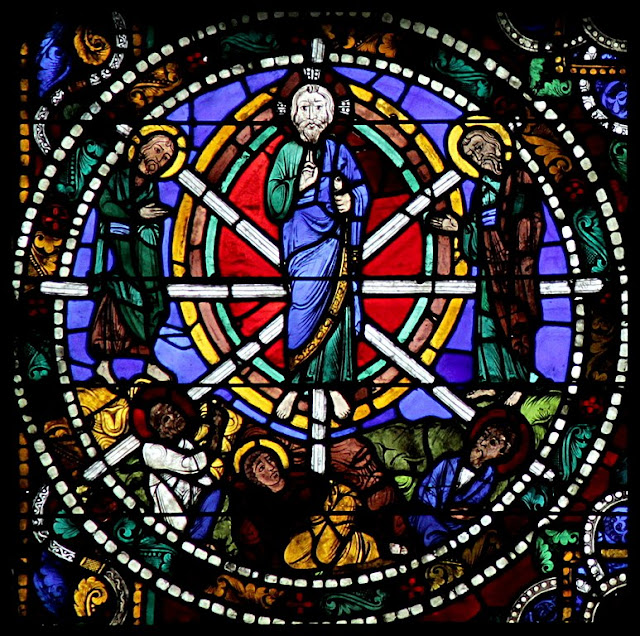
Stained Glass Image of the Transfiguration (13th cent.), Chartres Cathedral

In these days of Lent, we are encouraged to adopt certain practices of faith – prayer, fasting, and almsgiving especially. We do these as a sign of our repentance, but they have another purpose as well: that is, to strengthen our will and our spiritual insight. Like Peter, we are called to boldly proclaim our faith in Jesus, but at times, fear and uncertainty can afflict us, especially in times of difficulty or sorrow. The wearying and worrying things of life can get us down and perhaps tempt us to doubt the goodness of God the promises of our faith. In those moments, God wishes to reassure us, to confirm our faith, and to give us hope for the true reality – the heavenly reality – that lies under the surface of our everyday experiences. He does so by reminding us of what he has done in and through his Son; what is true of Jesus can be true of us, too, if we are conformed in the image of Christ.

And that’s where prayer, fasting, and almsgiving come in: they help us to grow a little more into the image of the One laid down his life for our salvation. When we deprive ourselves of material things, when we deny some of our earthly desires, we can focus more fully on spiritual things. And we begin to see, with spiritual sight, how God is confirming our faith, strengthening our hope, putting the challenges we face in the larger context of Jesus’s Passion, death, and Resurrection, and how we share in that. When our attention is focused less on earthly desires, God begins to train our hearts and minds to yearn for a happiness that goes beyond this life – that is satisfied only in the heavenly glory of the life to come.

Friends, let’s strive to let our faith be purified this Lent. Let’s not let doubt or hesitation creep in to our hearts but, like Peter, let’s be bold in proclaiming our faith and looking for the ways that the Lord reassures us in it. It’s important that we understand every day – all of our decisions and actions, and even our words – in the context of something greater: indeed, in the light of what St. Paul tells the Philippians in our second reading: “Our citizenship is in heaven, and from it we also await a savior, the Lord Jesus Christ.” It is He, who was Transfigured on the mountain, who is Risen and lives forever, who comes to us now, in our Sacrament of the Altar: to confirm our faith in him and strengthen our hope to share in his heavenly glory.

Sunday, March 6, 2022

Tested Together

Sometimes when I am thinking about what to say in my homily each week, I’ll go back and take a look at what I said in previous years on the same Sunday. I did that this past week, and saw that a year ago, the First Sunday of Lent came right after the double snowstorm, which left many people in our area and region in bitter cold and recovering from property damage and other aftermath for long after the snow and ice melted. And then two years ago, I saw that I encouraged us to shake up our routine for Lent, to not be afraid to live differently from how we were accustomed. And then, just a week or so after that, the pandemic began, and our lives changed much more radically than any of us could have imagined.

All of that is to say that sometimes we don’t have to go looking for struggles and hardships – they find us. All year round, we face them, in different ways, but in the season of Lent we look directly at our challenges, our trials, our sufferings, and we strive to accept them, with humility and with faith. We do that because when we suffer, there can at times be a temptation to think that God has forgotten us, that he’s not helping us, and that we are alone in what we face. In fact, this is maybe the most common way that people can lose their faith altogether, in whatever way that looks: when they come to believe that the very existence of struggle and suffering indicates that faith doesn’t do all that much for us.

It’s fortunate, therefore, that we begin each Lent hearing that Jesus himself struggled – that for forty days and nights he suffered hunger in the desert, and at the end of that time was tested by the devil. This Gospel episode is important for us in a couple ways. First, it shows us a preview of what Jesus will endure at the end of his life, in the testing of his Passion and Death. The Cross of Christ gives meaning to all suffering, since it is the path – the only path – to the Resurrection. All of Lent is directed in this way: to see our trials and testings in the light of that final reality – that is, not as meaningless experiences, but as preparations, steppingstones toward the light of heaven.

But today’s Gospel is important in another way, too, and that is as a sign of solidarity. In the temptations of Jesus, we see that the Son of God in his humanity really knew what it was like to endure testing and trial. You might say there is an exchange that happens. Jesus, the Word of God made Flesh, takes on himself the human experience of suffering and temptation, showing solidarity with us in our trials. In exchange, he offers us a share in his victory; because he resists the devil’s allurements, he shows us that in him we can do the same. Jesus is not just our Savior; he is our Salvation – he is literally the means by which we conquer the evils that we face. When we see God as not absent from our trials but very much entering into them – redeeming them and allowing us to overcome them through the presence of his Son – then it can change the whole way that we understand them and face them. We begin to understand that the Lord is not just with us – in our spiritual corner, so to speak – but even more, he is the one fighting within us. It’s his grace that enlivens us and helps us persevere, to overcome temptation and to endure suffering.

Moretto da Brescia, Christ in the Wilderness (c. 1520)

What’s more, the solidarity that Jesus shows us, and that he gives us with him, also allows us to show solidarity with others. St. Paul recommends just that in his Letter to the Romans: “Rejoice with those who rejoice, weep with those who weep. Live in harmony with one another” (Rom 12:15-16). Lent gives us a chance to recognize and even enter into the experiences of those with whom we are spiritually connected. Maybe that is a family member or a friend who we know is going through a rough time, and by prayer or generosity, we can show our support for them. Maybe it is to support in the same way those who, though distant from us physically, nonetheless are connected to us spiritually: Christians in Ukraine living in bunkers and risking their lives to protest an unjust invasion of their country; priests and catechists in China who have been arrested for their faith and will spend this Lent incarcerated; religious sisters and seminarians in Africa who face ongoing threat of kidnapping and other violence. With these and others, we recognize that we are united in Christ: “the same Lord is Lord of all,” he who is our Head enriches all of us in his Body, so that tested together in him, he sustains in our trials.

Friends, take some time this week to think about you’re being tested this Lent; but think also about how the Lord is with you in those trials, sustaining you, giving you faith and perseverance. And then consider how he’s inviting you to show your solidarity with others, just as he has shown his with you. How can you be the presence of Christ for another in these next forty days? May his Real, sacramental Presence be our food for the journey ahead.

Wednesday, March 2, 2022

Humble Repentance

Evil is real. That’s a basic truth that we hopefully agree with, one that our faith teaches. We tend to think of evil as external – as something outside of us, out in the world. The current war in Ukraine might be a good example and a painful reminder of that. But the Christian faith teaches, just as the Jewish faith before it, that human beings also must recognize that there is evil within our hearts. We heard about this idea just last Sunday, when Jesus said the fruit we bear in our lives is a reflection of what is within us. And so, because each of us has within us a mixture of some good and some evil, the idea of repentance is central and essential to our lives of faith – to recognize and turn away from that which has crept up within us that is not Godly and not in accord with what God calls us to.

The season of Lent, that we begin today, is the season of repentance par excellence. But even here there is a danger, one which Jesus talks about in our Gospel today. Even the desire to repent can become an opportunity for pride and for boasting, especially when we do it not for God but for others to see us. Isn’t there a little bit of that in how we typically approach Lent: “Oh, look at me and what I’m giving up! See these great and pious things that I am going to do to show my faithfulness!” I know that’s true in my life. Even our practice of coming to receive ashes – a good sign of our repentance – can be, if we are not careful, a temptation to feel self-righteous, to show off our penitence, and maybe even to think ourselves a little better than others.

Jesus tells us in the Gospel today that repentance is good – our works of fasting, prayer, and giving alms are good – but at the heart of them must be a spirit of humility. Do you remember the parable of the publican and the Pharisee in the Gospel of Luke, chapter 18? It could well be another passage to reflect on for Ash Wednesday. Both the Pharisee and the tax collector go to the temple to pray. But the Pharisee prays boastfully, thanking God that he is not like other people, that he prays and fasts much better than others, including the tax collector next to him. For his part, the tax collector only lowers his head and asks God to forgive him, and Jesus says that because of his humility he went away justified before God, while the Pharisee did not.

The Pharisee and the Publican by John Everett Millais (1864)

Friends, let’s make sure that’s we begin this Lent with that same spirit of humility. Our praying and fasting and almsgiving are good, we need to do them; but as Jesus says, we also have to guard against the temptation to take pride in them, as if we want others – or even just ourselves – to be convinced of our repentance. Maybe God isn’t so concerned with what we are giving up, or what we are going to do this Lent – in fact, maybe he prefers we keep those things to ourselves, since they are really just between us and him, anyway. Maybe he’s much more concerned with whether we’re doing whatever it is we are doing with a humble attitude. Maybe that’s the best way, in the end, to recognize what is not Godly within us, to repent of the evil present in our hearts, and to show God in these forty days how much we truly desire to return to him.

Sunday, February 20, 2022

Friends and Enemies

How many friends would you say you have? According to Facebook, I have some 3300 friends, but for some reason, I suspect the actual number is a bit lower than that. Whether you use Facebook or not, you probably agree that in our day and age the term “friend” and “friendship” have come to be used much more loosely than they once were.

What about the opposite – how many enemies do you have? I don’t have any enemies, according to Facebook at least; once again, I’m not sure that’s completely true. Most of us probably don’t think we have many enemies, if we have any at all – at least none that we know personally, that we interact with in daily life, that don’t live on the far side of the globe somewhere. For that reason, we might be tempted to dismiss what Jesus says to us in the Gospel today: “love your enemies, do good to those who hate you.” Perhaps we want to respond, “Okay, Jesus, but that doesn’t apply to me; I only have friends.”

But is that really accurate? What if we replaced the word “enemies” with a category that we might be more familiar with. Do you have any rivals? What about competitors, in business, perhaps? What about friends who are more like frenemies? What about relatives that we butt heads with, or neighbors that we don’t particularly like, or the people with whom we have had past disagreements and offenses and grudges. And then there are those who challenge us or push our buttons, those with whom we disagree politically, those who have cultural viewpoints or social priorities different from ours.

If we start to think about it that way, we see that what Jesus has to say in today’s Gospel probably applies to lots of people that we know. And what does he have to say? He challenges us, his disciples, to take an approach radically different from the one what we are naturally programmed to. It’s natural, Jesus says, to love those who love us, and to do good to those who do good to us; even sinners do that, he says. But Jesus calls us to a higher standard: the standard that he himself sets. Remember the words of John 3:16: “For God so loved the world that he gave his only Son, so that everyone who believes in him might not perish but might have eternal life.” And the words of St. Paul to the Romans: “God proves his love for us in that while we were still sinners Christ died for us… If, while we were enemies, we were reconciled to God through the death of his Son, how much more, once reconciled, will we be saved by his life” (Rom 5:8, 10).

Jesus Teaching His Disciples, Egyptian Gospel manuscript, c. 1684

In other words, Jesus came to save us despite the fact that we were wretched sinners – yes, enemies of God – to make us God’s friends by the shedding of his blood. To follow Jesus means, you might say, to override our natural programming of antagonism, self-defensiveness, “eye-for-an-eye, tooth-for-a-tooth” attitude, and instead be overcome by the supernatural love of Christ. In the love of Jesus, we can do what he commands: to do good to those who hate us, to bless those who curse us, to pray for those who mistreat us, to turn the other cheek, to give without expecting repayment, to stop judging, to stop condemning, to be merciful. Surely, we can do those things, if we remember the One who came to sae us was crucified our sake. Those things that would seem impossible by our own powers become possible in the light of Christ's love. 

It’s important to realize, however, that to love as Christ calls us to love doesn’t mean that we will never have enemies. I think we are called to see every person as potential friend in Christ, no matter what our differences might be, or what our past interactions have been, but sometimes it could be that we will make enemies precisely by standing up for what is true and good and just. So, we shouldn’t think that today’s Gospel is inviting us to some kind of idyllic, kumbaya existence; to follow Jesus means that we will suffer, because we will be called to set other priorities, even other relationships, secondary to the one we have with him. What today's Gospel does call us to, I think, is to guard our own reactions and responses, external and internal. We may not be able to always make others love us, but we can seek to love everyone – even those who hate us, especially those who hate us – because of the love of Christ.

So, friends, – and I hope I can rightly call you friends, in Christ – I’m sure over the course of the last few minutes, as I’ve talked, at least one or more persons have sprung to your mind. Maybe “enemy” wouldn’t be the first way you would describe them, but in some way or another your relationship with them is strained, you’ve suffered some insult or offense, you find that you just don’t want anything to do with them. But try to overcome that natural programming for a moment, and consider what the love of Jesus might be asking of you? Maybe it’s just to offer a prayer for them, or try to forgive them in your heart, or to recognize their humanity and indeed the image of God in them. But maybe the love of Christ – he who has made us friends out of enemies – maybe he is calling you to do something more: to reach out to them, to be open to being reconciled, to let whatever has come between you in the past be renewed in light of your friendship with Jesus.

After all, in the end it’s Jesus who should be our best and truest Friend, and with his grace, nothing is impossible – including making friends out of enemies. May this Eucharist bring us renewed strength from the Friend who is also our Savior, that he might strengthen us to love as he loved us, to do good to others as he showed us.

Sunday, January 30, 2022

Suffering Rejection with Love

In any sphere of human life, rejection is painful. Whether it’s being betrayed by a friend, or turned down for a job interview, or having a potential romantic partner not reciprocate interest, no one likes that feeling of being rebuffed for who we are or what we are about.

Despite being God’s Son, Jesus wasn’t spared this human reality of rejection, as we hear in today’s Gospel. This episode continues the story of last week’s Gospel, when Jesus was celebrated by the people of his hometown of Nazareth, who listened with rapt attention to what he had to say. Even in this story, we are told they were amazed by him and spoke highly of him. But by the end, when at last they find out that he’s not going to do what they want, and that his mission doesn’t conform with their expectations, their rejection of him is so great they literally throw him out of town.

This turn of events perhaps feels surprising, but upon reflection, it probably shouldn’t be. Jesus encountered rejection throughout his life, from his birth in Bethlehem, when King Herod seeks to kill him, to the final rejection of the crowds that cry “Crucify him!” I mentioned last week that Jesus has come to fulfill God’s promise of helping those in need, of bringing his joy, healing, and peace to those who were lowly. The reality though is that we human beings often reject those gifts; there is something deep within us that often recoils at what is good for us and rejects what we most need. We call that reality sin, when we choose other things and follow other desires instead of choosing God as our greatest good. God knew that, and sent his Son also for that reason – to confront our sinfulness, to lay it bare, and finally uproot and defeat it by his Cross, Death, and Resurrection. Even now, the reality of sin is present among us, even in us; though it’s been conquered, it continues to wage little skirmishes in our wills and egos.

The Brow of the Hill Near Nazareth (c. 1890) by James Tissot

Jesus was rejected because of sin in the human heart, and it’s for that reason that we wrestle with rejection, too. I mentioned last week that we share in the mission of Jesus; because we have been baptized in him, and are members of his One Body, we are also sent to those in need. But as we do that, we should recognize that at times, we will be rejected for our faith, and for our identity in Christ. It’s not a possibility; it’s a certainty – it happened to the Lord, and it will happen to us as well. Maybe it will be the scorn of those who mock our belief and our prayers; maybe it will be the rejection of those who say the Church needs to get with the times, or the silent rejection of those who walk way from it altogether; maybe it will be the scorn of those who don’t want to forgive, or work for justice, or seek peace and reconciliation. Often, it won’t be anything overt, but just hardened hearts, fractured relationships, and a temptation to make compromises in what we hold to be true.

In all these ways and more, rejection can be painful, as it surely must have been for Jesus, to have his own friends and neighbors, people who he’d known since childhood, drive him to the edge of town and want to throw him off a cliff. But notice how he responds. He doesn’t let the crowd’s anger and jealousy disturb him, but rather he passes peacefully through the midst of them. Jesus was focused on being faithful to his Father’s will, because he knew that his Father loved him. And that’s how he would have us respond too: with love. St. Paul, in fact, reminds us what that means in the second reading: responding with patience, kindness, not jealousy or rudeness, not being quick-tempered, not brooding over injury, but bearing and enduring all things. If you think about it, that’s a perfect description of Jesus himself, in this Gospel or any other. When we encounter rejection, we too can be Christ-like, confident in the love of the Father and the share we have in that.

There is one last piece to this puzzle, which is this: at times, we are the ones rejecting the Lord. Despite our faith in Jesus, despite our identity as part of his Body, at times we don’t want to accept what God wants to give us. We know that sin still has some hold over us. That’s why it can be okay, even good, for us to experience rejection from others. It can help to humble us, make us more patient and kind, and remind us perhaps of our own faults and sins, those areas of our lives where we need to stop keeping God at arm’s length. In the degree to which we need to still be purified of sinfulness, a little bit of suffering can help us to love the One who was crucified for us a little more and love ourselves a little less.

Friends, as Saint Paul reminds us, we’re all awaiting the day when we see God face to face, and can understand all of the experiences of this life, good and bad, in the way that he does. Until that time, let’s suffer rejection with love, and make sure our love for the Lord never leads us to reject him. For that, and for all of our prayers, may the grace of this Eucharist come to aid us.