Wednesday, August 14, 2013

Why Is Mary Important? The Meaning of the Assumption

The Assumption of the Virgin (1476), Francesco Botticini

On August 15 of every year, Catholics commemorate the Solemnity of the Assumption, a Holy Day of Obligation and one of the great Marian feasts of the year. The following is my homily for the Masses this year:

As part of my summer reading this year, I’ve recently been making my way through a history of the Second Vatican Council. As you may know, it’s been 50 years since Vatican II, and I’ve been interested to learn more about the deliberations that led to the documents we now have.

The Council considered a whole variety of topics – the liturgy, the Church, the priesthood, bishops, the laity, relations between Christians and non-Christians, religious freedom, the modern world, and many more. One of the topics considered was Mary. In fact, during the second session of the Council, there was a big debate between the cardinals and bishops about whether they should craft a separate document just about Mary, or whether she should be treated in a special chapter within the document about the Church.

What they ultimately decided – they went with the second option – is not as important as the fact that they had the discussion. As Catholics, we place great importance on Mary, just like the Orthodox and some Protestants do. But why is that? Why was a young Jewish woman who lived in a backwoods town two millennia ago the subject of debate and discussion by hundreds cardinals and bishops in the modern day? Why is Mary so important for us?

Of course, it has to do with who her Son was, who Jesus is. As our Savior, Jesus has forged a New Covenant between mankind and God. As his Mother, Mary is the instrument by which God chose to bring his Son into the world. In the first reading we heard about the ark of the Lord, that great vessel which the Israelites carried, which bore the Ten Commandments and Moses’ staff and some manna. The Israelites revered it greatly, because they saw it to be the symbol of God’s abiding presence in their midst. Mary is sometimes called the ark of the new covenant, for it is she who bore God into the world, so that in Jesus, God would be not merely in the midst of his people but one of them, like us in all things but sin.

Just as the Israelites honored the ark of the Lord because of what it contained, we honor Mary because of who she gave us. She welcomed Jesus at the Annunciation, she gave birth to him at Christmas, she raised and formed him. But on the Solemnity of the Assumption every year, we honor Mary not only for what she did for Jesus, but for what Jesus did for her. We recall that it is our firm belief as Catholics that at the close of her life, God assumed Mary to himself – he took her to heaven, soul AND body. Because she was without sin, because she had been the vessel by which God had given us our salvation, God preserved her from any stain of corruption or decay and welcomed her wholly to heaven.

As the bishops and the cardinals who were at the Vatican Council knew, Mary is indeed important for all of us who are in the Church – not merely for what she once did, as great as that was, but for what she still can do and does for us who wish to follow Jesus. By the faith and virtue of her life, and by the power of her intercession, Mary always points us to Jesus. Today, though we also see how, in the Solemnity of the Assumption, Jesus points us to Mary. In what he did for Mary at the close of her life, Jesus gives a preview and a promise of what he will do for all who live their lives in communion with God’s will. Our Savior has given us a powerful ally in our struggles for holiness, a friend and a mother who will not fail to be there for us. Let us turn to her in all of our needs, that she will be our guide and companion on our journey through this life, so that at the close of our days, we might share in the same glory that she now enjoys.

Monday, August 12, 2013

The Real "Miracle" of the Miraculous Priest Story

Have you been following this story? Over the last week or so, first among Catholic news services, and then in the national media as well, people have been speculating as to the identity of the mystery priest in Missouri. As described here, apparently a woman was in a serious car accident in that state and was trapped in the wreckage. Rescue workers attended to her, attempting to extricate her, but without much success. Soon, her vital signs began to fail. Around the same time, a priest appeared who prayed with the woman, anointed her, and then left. The emergency personnel were subsequently able to free the woman, and when they turned around to thank the priest, he was not to be found.

Several things about the incident seemed to suggest a supernatural explanation. For one, the highway was blocked for a quarter mile or so in both directions, and no one rememebered walking up or walking away. Descriptions of the priest's words and of his appearance varied from person to person, and despite the dozens of photographs that were taken at the scene, none contained a picture of him. Beginning with the woman and her family, words like "angel" began to be tossed around. Days passed and the speculation increased. Some believed that it was a holy priest who was able to bilocate from some other location to be present in the moment of need. Others thought it could have been an apparition of a long-dead priest who was invoked through prayer. Some even said there was no priest at all, but merely some spiritual (or hysterical) experience shared by all present.

Then, this morning, the flesh-and-blood priest who was at the scene came forward. He was born in Ireland, is a priest of the Diocese of Jefferson City, and was returning from celebrating Mass in a nearby town, filling in for another priest. While certainly the priest was doing the Lord's work -- his presence brought calm to the situation, he administered the sacraments of reconciliation and anointing to the young woman, and his prayers very likely aided her rescue -- the true story seems fairly commonplace, even plain, when compared to the hypotheses of ghosts and guardian angels.

Viktor Vasnetsov, Eucharist (1911)

And yet, for precisely that reason, this story is even more important for us. Why? Because this kind of thing happens every day. Every hour of every day people are in dire situations -- physically, emotionally, spiritually -- and it is to them that Jesus the Savior comes. In and through his priests, he meets them sacramentally, forgiving their sins, comforting them in their pain and fear, or feeding them with his own Body and Blood. Miraculous stories of mysterious priests catch our attention, but how attentive are we to the true miraculous mysteries that are present among us each and every day? What greater miracles do we have or do we need than the sacraments, where we encounter Christ and his grace in a real and unmistakable way?

The mystery priest may no longer be a mystery, but in a sense, we should be all the more grateful at the way the story turned out. Nothing overly miraculous or amazing happened -- but, precisely for that reason, we were reminded again of the amazing miracles that God performs among us each and every day and to which we are so often blind. Through prayer, through the guidance of his ministers, and especially in and through the transformative power of the sacraments, God is working real miracles. Are we paying attention?

Tuesday, August 6, 2013

"Eyewitnesses of His Majesty"

The Transfiguration (1594) by Lodovico Carracci

Today the Church celebrates the Feast of the Transfiguration, the memorial of when Jesus took Peter, James, and John up a high mountain to show them the reality of his divinity. This event is not only recorded in all three Synoptic Gospels, but is also explicitly mentioned by Peter in his Second Letter. The Church uses the following excerpt as its Second Reading for today's liturgy:

Beloved:
We did not follow cleverly devised myths
when we made known to you
the power and coming of our Lord Jesus Christ,
but we had been eyewitnesses of his majesty.
For he received honor and glory from God the Father
when that unique declaration came to him from the majestic glory,
"This is my Son, my beloved, with whom I am well pleased."
We ourselves heard this voice come from heaven
while we were with him on the holy mountain.
Moreover, we possess the prophetic message that is altogether reliable.
You will do well to be attentive to it,
as to a lamp shining in a dark place,
until day dawns and the morning star rises in your hearts. (2 Pt 1:16-19)

Note the change Peter has undergone: from the disciple who had been "overcome by sleep" (Lk 9:32) and who "did not know what he was saying" (Lk 9:33) to the Prince of the Apostles who unmistakably declares his faith in Christ's divinity and declares himself to be an "eyewitness" of the event which proved it. It's almost hard to believe it's the same man! And yet, that's what the gift of faith does. It changes and transforms us. It enables us to apprehend mysteries which are beyond human understanding and to glimpse glories which we will only truly grasp in heaven. Indeed, faith gives us a preview, a foretaste of heaven itself, an "assurance of things hoped for" (Heb 11:1) not from our own reason or experience but from the inner certainty given by the testimony of the Holy Spirit.

For Peter, the Transfiguration event was a first glimpse of that glory which imbued this Jesus whom he followed. The glorious events to come -- the passion, death, and resurrection -- would be all the more remarkable for their contrast. And yet, as Peter would come to understand, such was the depth of God's love to allow him (and us) a partaking in Jesus's divine glory, a share in his inheritance, a participation in his Son-ship.

Today's feast is yet another opportunity to ask ourselves: How have I been changed by my faith? Does it guide and illumine my path in such a way that I declare myself to be an "eyewitness of his majesty" for others? Do I trust in God's Providence even when times are troubled and my path is darkened? The gift of faith comes from above yet it is one to which we must "be attentive... as to a lamp shining in a dark place," until that last and final Day dawns and we see the Morning Star rising and returning to us.

Tuesday, July 23, 2013

My First Anniversary

On Sunday, July 21st, I celebrated my first anniversary of priestly ordination. Obviously, such an occasion brings opportunity for much reflection and thanksgiving. As is often the case on a priest's first anniversary, it occurred on a Sunday, and so it was special to spend the day with the people whom I serve, celebrating four Masses over the weekend at I.C. My parents, Robert and Evelyn, also joined me for a few hours and it was great to see and spend some time with them.

When asked if I have any advice on my first anniversary, I'm not sure that I do. It's been a year of many wonderful blessings, as well as a few challenges. I find myself recalling and praying again a prayer of St. Thomas Aquinas that I put on the back of my ordination holy card: Grant me, O Lord my God, a mind to know you, a heart to seek you, wisdom to find you, conduct pleasing to you, perseverance in faithfully waiting for you, and a confidence of finally embracing you. 

Sometimes folks ask me if priesthood is what I expected it to be, and I have to say yes, because my expectations were pretty straightforward. I expected to work hard and to be of service in all kinds of ways that I would not have imagined nor have felt prepared for in advance. And that has proved to be true! What I had not expected, and what I am very grateful for, is that the meaning and fulfillment that I have found in that service is greater than I could have imagined it would be, as is the outpouring of kindness and love from the faithful. As such, I'm very grateful for what God has given me this first year and what he has allowed me to give to others, despite my own faults and shortcomings. Please pray that I may be of faithful service for many more years to come!

Here are pictures of some of the highlights from my first year as a priest. It's not an exhaustive list, by any means.


The 2012 Class of the Pontifical North American College. (May 2012)


The Laying on of Hands during my ordination. (July 21, 2012)


Being vested in the stole and chasuble by Msgr. J. Gaston Hebert, my former pastor and the priest who baptized me.


After the ordination, with the seminarians from my home parish of Christ the King Church 
in Little Rock.


Before my first Mass, with concelebrating priests, at Christ the King. (July 22, 2012)


During my language study in Mexico, I had the opportunity to celebrate Mass in the Basilica of Our Lady of Guadalupe in Mexico City. (September 2012)


Visiting the pyramids of Teotihuacan. (October 2012)


Sampling a local Mexican delicacy chapulines, grasshoppers grilled with spices and chili powder. (October 2012)


With my teacher Elvia on the last day of class. (October 2012)


The family at Thanksgiving (minus my brother, who's taking the picture).


Celebrating the wedding Mass of some dear friends in Baltimore. (December 2012)


Celebrating my first Easter Vigil, in Spanish nonetheless. (March 2013)


Celebrating with my brother his graduation from philosophy studies. (May 2012)


With my parents on my first anniversary.

Natural Family Planning Awareness Week


The U.S. Conference of Catholic Bishops has chosen this week as Natural Family Planning Awareness Week, with this year's theme being "Pro-Woman, Pro-Man, Pro-Child: Natural Family Planning." This annual effort is a chance for Catholics (and all persons) to consider the positive benefits of NFP in comparison to the harmful effects of many contraceptives.

For those unfamiliar, the Catholic Church teaches that couples should plan their families naturally, whether they are seeking to achieve pregnancy or avoid it for the present. Artificial means of family planning, whether contraception or IVF, are morally wrong because they disrupt the natural and essential (and divinely given) bond between sexual intercourse and the possibility of new life. And that's not even to mention the extremely damaging side effects that many chemical and hormonal contraceptives can have on a woman's body and on the environment in general. Many persons from varying religions are finding that NFP is a safe, green, and extremely effective way of achieving or avoiding pregnancy. There are various methods and various groups which teach them, but the point of all of them is to observe and track the natural indicators of a woman's fertility. With advances in modern science, it's far removed from the old "rhythm method" -- and indeed, if practiced correctly, NFP is as effective if not more so than the most effective contraception. And perhaps best of all, many married couples are finding that the increased communication and (short) periods of abstinence that NFP entails strengthen their relationship, increase mutual cooperation, and enhance their own love for each other.

For more information, check out the USCCB's website for the week. There you can find some good articles, testimonials from couples who use NFP and their reasons why, as well as more on the reasons for the Church's teaching on family planning. If you're interested in learning NFP, check out this website. And if you want to learn more about why contraception is harmful, go here and here.

Thursday, July 18, 2013

And We're Back!


It's been two and a half years since I let this blog lapse, and obviously a lot has happened in the meantime. Recently, our parish's Communications Director approached me and said, "Listen, we're thinking about having the pastor and you keep a blog..." And I said, "Hey, I know a little about those..."

So, rather than create something completely new, I thought it'd be wise to bring this baby back from the dead. I had to let it lapse for a variety of reasons, mostly time constraints, and for my old readers, much has changed in my personal life. I finished seminary and am now a priest for the Diocese of Little Rock, ordained last summer and currently assigned in Fort Smith, AR. I'm happy to be the parochial vicar (associate pastor) of Immaculate Conception Church as well as the administrator and chaplain of Trinity Junior High School.

For my new friends, note that this blog was originally started to keep friends and family up-to-date on my experiences while living and studying in Rome. Hopefully you'll agree that this brings a nice sense of continuity (albeit delayed and with lacunae) between time past and time present. Old friends can see what I'm up to now, and new friends can see some of what I used to do in seminary. And who knows? Maybe I can even find some time to fill in some of the gaps.

That's it for now. Time will tell what this space is used for, but certainly I welcome (as a high school teacher used to say) any "questions, comments, or cries of anguish." God bless!

Saturday, December 18, 2010

Merry Christmas from the Holy Land!


Tomorrow, I and about 30 other priests and seminarians from the North American College leave for the Holy Land, the land in which Jesus Christ walked the earth, taught and healed, suffered, died, and rose again. We'll be spending about a week first in Galilee, the area of Israel that Jesus grew up in and considered his home, and then about a week in and around Jerusalem, where he died and rose and ascended to heaven. Please pray for us and for the success of our pilgrimage. Though I don't know all of the readers of this blog, I'll be keeping you and your intentions in my prayers as well.

 
Christ of St. John of the Cross (1951), Salvador Dali

A merry Christmas to you and yours! May God bless you with all good gifts this year at the coming of His Son into the world!

Monday, October 18, 2010

Warning: Blog Re-Design in Progress

I've been wanting to re-design this blog for quite a while. With so many great blog templates out there, the style I initially chose two years ago (intended even then to be temporary) just wasn't cutting it.

I've been trying to find one that I like when I have a free moment. Unfortunately, those are few and far between. Even more unfortunate is that I'm still pretty HTML illiterate, so while ideally I could build my own, I'm not sure that's really feasible right now.

Nonetheless, I have become so sick of the old template, I decided I needed to make some kind of change, at least until I can find/make something better. This hopefully will work for the time-being.

If you have any thoughts or suggestions on the new look, or on what look I should adopt, I'd love to hear them!

Tuesday, September 28, 2010

Movin' on Up: Summer 2010

A family Fourth of July photo

Greetings once again from across the pond! My apologies for the long silence over the past few months. I had planned to take a break after the close of Lent, but that break was also much longer than originally intended. The Easter season begins our busiest time of the year, and I was occupied with multiple projects, papers, exams, and the like. While I had hoped to get online and write a few times, the posts never materialized. My summer assignments, in their own way, kept me even busier perhaps than did the school year, and so while I was home for nearly twelve weeks, it certainly felt much shorter. Here we are now already in September, so I best do a little catch-up.

In August, the diocese hosted a fundraiser in Little Rock for the Diocesan Seminarian Fund called "A Taste of Faith". It was a great success! Many thanks to those who helped make it so.

I'm now in my third year at the NAC and the Gregorian University, far removed now from my days as a "New Man". Since the Fourth Year Men serve as deacons and generally are wrapping up their time at the College, it's the Third Year class that more or less runs the show. We are in charge of nearly all of the organizations for life and many of the College's institutions. For example, I am privileged to serve as the editor-in-chief for the College's magazine, a quarterly publication that seeks to keep our friends and donors abreast of what's happening at the NAC and how they might be able to help. It's a fun but demanding job, so much of my year will likely be wrapped up in its challenges.

Academically, I'm starting my final year in what's known as "first cycle," the comprehensive theology education needed to obtain an S.T.B., or Bachelor's in Sacred Theology. The S.T.B. is the basic ecclesiastical degree offered by pontifical universities around the world and is the degree necessary for ordination. It's roughly equivalent to an MDiv, given by most of the seminaries in the U.S., though the latter has a more pastoral concentration while the S.T.B. is more academically focused. Next year, I'll at least begin the "second cycle" studies toward a licentiate (or "license") which offers a more in-depth specialization in a particular area of theology. The exact plans for that are still to-be-determined, but I hope to know more soon.

The high altar at St. Edward Catholic Church in Little Rock

My favorite of the many beautiful stained glass windows at St. Edward

This summer I got an insight into what might lie in my future when I did some work at the diocesan Tribunal Office. The Tribunal handles the questions related to Canon Law in the diocese, most of which are in regard to the annulment process. It was interesting if often difficult and painful work. If it does await me in the future, I'll need some extra schooling to be academically and psychologically prepared for it. My main assignment for the summer was at St. Edward Church in Little Rock. It's an inner-city and historically important parish with a school and a healthy diversity of cultures at its service. I lived at the rectory and spent a lot of my time following and learning from the pastor. I learned a lot from him, as well as from the folks in the Tribunal Office, and I'm very grateful to both.

I was able to travel the U.S. a little this summer, a nice change from Europe. Here, with my parents, in Chicago.

We were there to visit my cousin after coming back from a conference in Wisconsin. We were able to see the great Chicago Air & Water Show.

That about wraps it up for me for now. I leave tomorrow for a retreat at Santa Marinella, a town northwest of Rome on the coast. In ancient times, it was the location of the Aquae Caeratanae, a bathing resort and community of villas along the coastal Via Aurelia. In more recent years, it was known as the favorite beach spot of Ingrid Bergman and her husband. There's a retreat house there on the beach which the Third Year men traditionally spend a week in silence and prayer. It should be a nice chance to reflect and give thanks for all that I've received over the past two years, as well as all that I have to look forward to in the years ahead.

Check back soon for more!

Update: I finally got around to uploading some pictures from the summer and from my retreat. The latter was great -- very prayerful and restful. Thanks for all of your prayers.

The view from my room. Of the three different places we've been for retreats during my time here, this was by far the favorite of our class!

The view of the Tyrrhenian Sea from the patio at the retreat center in Santa Marinella. A lot of prayer and reflection time was spent here.

I'm swamped with some classes and other obligations right now, but I hope to get on here soon and write some more. For any interested, my course load for the semester is as follows:

- Specialized Moral Theology: Bioethics, Sexual Ethics & Family Ethics
- Protology & Theological Anthropology (Human Origins as Related to the Divine)
- Christian Eschatology (Human Destiny as Related to the Divine)
- Pastoral Theology
- The Psalms & Wisdom Literature
- Themes in 20th Century Thomism (Neo-Scholastic, Existential & Transcendental Thomism)

Friday, April 2, 2010

The Seven Church Walk

The route of the Seven Church Walk. (Note: Right-click and open in new window/tab to enlarge).

A Happy Holy Week to all, and happy April as well. This is the most important time in the Church's calendar, and beginning last evening, we've now begun it's most important feast. The three-day Easter Triduum commemorates the passion, death, and resurrection of Jesus Christ and, through him, the very mystery of our salvation. It's what we've spent all of Lent preparing for, a time for earnest prayer, consideration of what we hold most dear in our lives, and an invitation to draw ever closer to our Savior, before whom all pales in comparison. As St. Paul said, "I regard everything as loss because of the surpassing value of knowing Christ Jesus my Lord. For his sake I have suffered the loss of all things, and I regard them as rubbish, in order that I may gain Christ" (Php 3:8).

On Wednesday, the day before the beginning of the Triduum, I participated in an ancient pilgrimage here in Rome, and one which for me was a nice way to cap off the station church practice I undertook throughout Lent. Known as the Seven Church Walk, the path was first laid out in the mid-16th century by St. Philip Neri and his friends as a way of visiting the four major basilicas of Rome (above: B: St. Mary Major, E: St. John Lateran, G: St. Paul Outside the Walls, and H: St. Peter's) as well as three important minor basilicas (C: St. Lawrence Outside the Walls; D: Holy Cross of Jerusalem; F: Saint Sebastian Outside the Walls). In the succeeding centuries, it's been a way of gathering to worship with friends, spend some time in the fresh air, and see some of the beautiful religious and cultural sights of Rome all in one day. These same things were what appealed to those of us who undertook the walk on Wednesday. Our group included priests and seminarians from the NAC, American college kids studying abroad for the semester, some lay men and women who work here in Rome, and a few other colorful individuals.

Rather than disturb your Triduum with long and detailed descriptions of each place, I thought I'd let the pictures do the storytelling for a change, together with the map at the top and the links to articles about each church throughout. Note that you can right-click on the map to enlarge it a bit. If you do so, you should be able to see our path pretty well, starting at the North American College (A on the map). We left the College at 6 a.m., had Mass at St. Mary Major (B) at 7, and then began our walk. We took a short lunch break after visiting St. Sebastian (F) and then continued our journey to St. Paul's and finally St. Peter's. We finished about 4 p.m., having walked about 14 miles in total.

Crossing Piazza Venezia, heading out in the morning to start with Mass at St. Mary Major.

Along the Via Panisperna (lit. "Ham Sandwich Road"). You can see the dome of St. Mary Major in the distance.

The Basilica of St. Mary Major. After Mass and a quick bite to eat, the Walk commences.

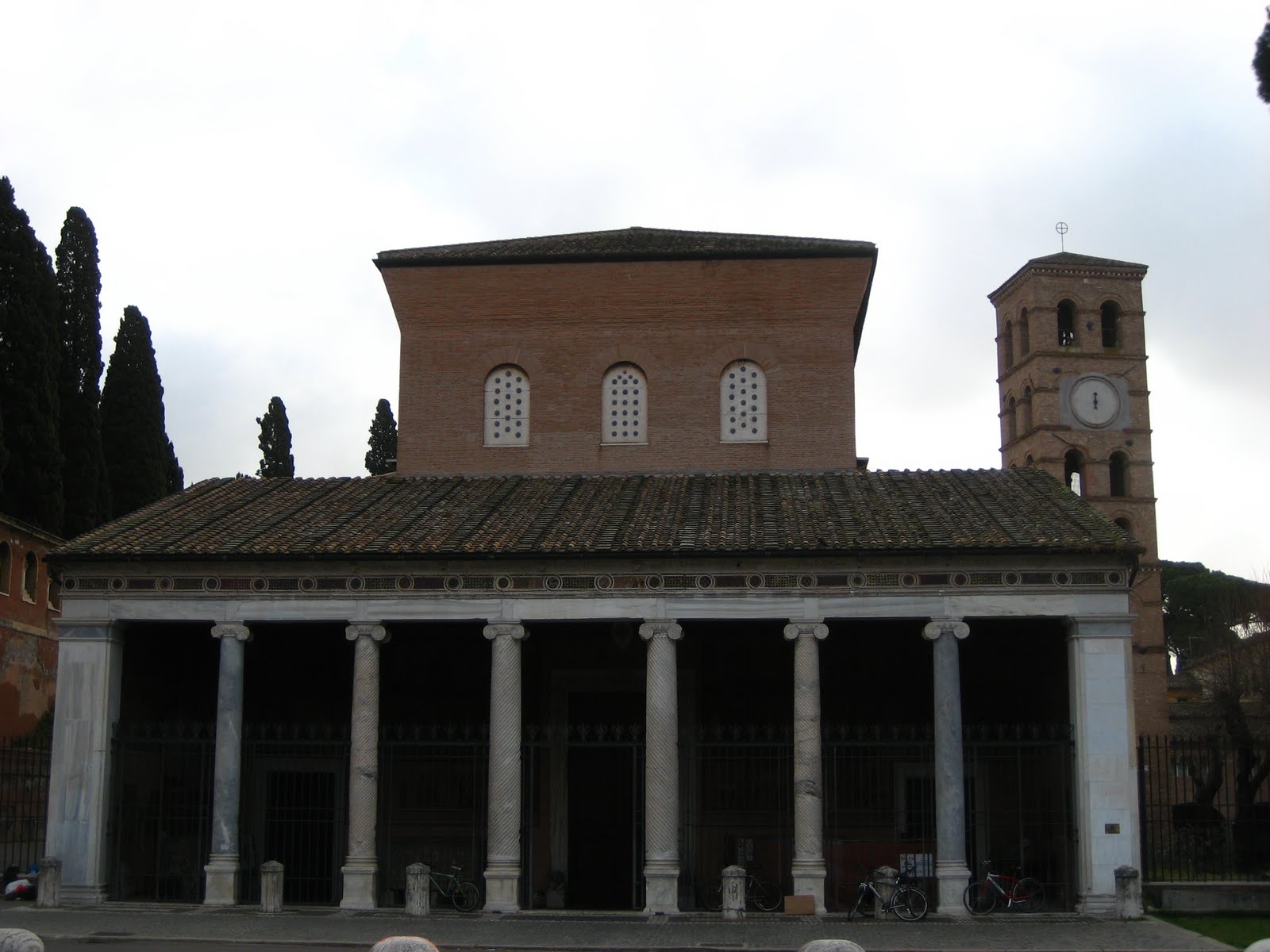
The Basilica of St. Lawrence Outside the Walls. It houses the tombs of St. Lawrence, St. Stephen (the first martyr), and Bl. Pope Pius IX, founder of the NAC.

Crossing through the Porta Maggiore of the Aurelian Wall.

The Basilica of the Holy Cross of Jerusalem. It contains relics of Christ's passion, including part of the cross, a nail, and the I.N.R.I. sign.

The Archbasilica of St. John Lateran, the cathedral of Rome and the premiere church in the world.

Translation: "Most Holy Lateran Church, mother and head of all the churches in the city and in the world."

Waiting to start up the walk again. This obelisk is the tallest in Rome.

Along the Via Appia Antica, or Appian Way, one of the oldest roads in Rome.

Sheep? This stretch doesn't really feel like Rome at all.

Still on the Appian Way, near several catacombs. This is also roughly the spot that Peter experienced the "Domine, Quo Vadis?" vision of Christ.


The Basilica of St. Sebastian Outside the Walls. It houses the relics of the martyr St. Sebastian and more than 200 other saints.

Walking now along the Way of the Seven Churches.


The Basilica of St. Paul Outside the Walls, containing the Apostle's tomb.

Nearly there. Having been on our feet now for some 8 hours, the knees were really starting to ache at this point.

At last, our final destination, the Basilica of St. Peter.

Thus concludes my Lenten pilgrimage blogging project. Many thanks for reading along! I hope you found it insightful and helpful in deepening your prayer experience of Lent. Maybe some of you will find yourself one day in Rome during Lent, and you'll have the opportunity to visit the station church of the day or make the Seven Churches Walk yourself. For those who won't or can't, I hope this has given you a taste of what it's like.

Have a blessed Triduum, friends. May the Risen Lord bless each of you!