Sunday, August 13, 2023

Faith in Fear

Once in a while, someone will say to me, “Father, I want to read the Bible more. Where should I start?” While there are lots of responses to that question – lots of great places to begin reading more Scripture – often I will say, “Read the psalms.” Why? Because unlike other parts of the Bible that recount a story or expound on a theological point, the psalms immediately show us how to pray to God. The Book of Psalms contains 150 prayer-hymns that fit every kind of human circumstance. Joy, sorrow, praise, fear, indignation, gratitude – there’s a psalm for every condition of the human heart. And because we believe that God is the author of Scripture who inspired its human writers, then we can say that the psalms are really examples of God showing us human beings how he wants us to pray to him.

On Sundays, the responsorial psalm often gives us a clue or insight into the theme of the readings of the Mass. For example, today the psalmist says, “Lord, let us see your kindness and grant us your salvation.” Those words tell us that the psalmist’s prayer was being made in difficult circumstances. Maybe the psalmist was going through a difficult time personally, or maybe the whole Israelite people were facing some calamity, but you only cry out to God to show his kindness and salvation when those things are not at that moment readily apparent.

We might well imagine that the words of this psalm – “Lord, let us see your kindness and grant us your salvation” – were on the minds of the disciples in today’s Gospel. They are in very dire straits: caught in a storm, their boat being tossed about on the rough sea, and Jesus not with them. And this story is perhaps symbolic of inner turmoil that was going on within them at the same time. Shortly before this story in Matthew’s Gospel, Jesus and the disciples receive word that John the Baptist had been beheaded. The death of Jesus’s cousin, whom some of the disciples had followed before they followed Jesus, surely filled them with sorrow and grief. And it probably also gave rise to fear – fear that perhaps a similar fate awaited Jesus and perhaps even themselves.

So, turmoil, distress, fear – our Scriptures today focus upon those realities. And that’s a good thing, because those realities are our realities, too – each of us, in some way, because of one or more circumstances in our lives, face something that is causing inner turmoil, or filling us with fear, or giving us anxiety. The question is how do we respond? Often, we are tempted to act based solely on the way we are feeling in that moment. Because we are feeling afraid, and because we don’t like that feeling, we are tempted to alleviate our fear in any way possible – by denying it, or rationalizing it, or numbing it.
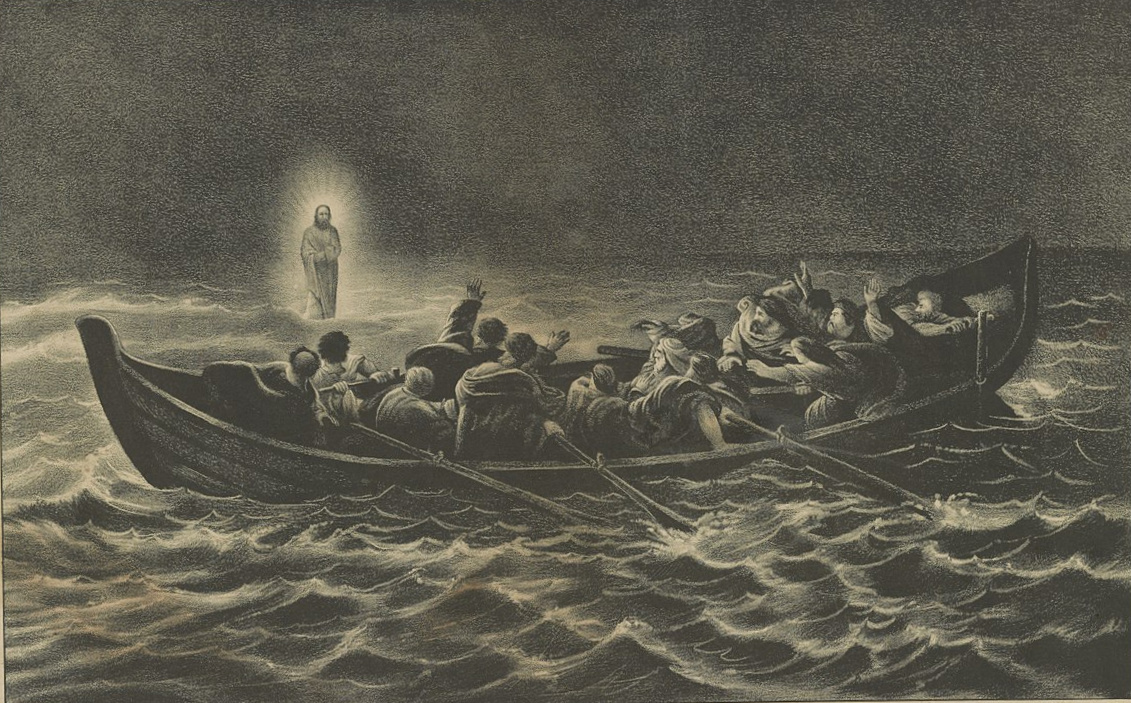
Christ Walking on the Sea, Currier & Ives, 19th cent.

What our readings today invite us to consider is how fear and turmoil, as unpleasant as they may be, are also an invitation into a deeper faith. To do so, sometimes we have to enter into our fear and wait. Sometimes the Lord does not alleviate our fears right away – not because he wants us to suffer, but because he wants us to recognize our total dependence on him. And fear has a great way of doing that. In the midst of fear, there is a temptation to abandon faith altogether; but there’s also the chance to see more clearly what is true. There’s an opportunity to make the prayer of the psalmist our own – “Lord, let us see your kindness and grant us your salvation.”

Friends, like the disciples, our boats are at times tossed about on rocky seas. In those moments, let’s turn fully to the Lord, leaving behind our own devices and self-made ideas. Let’s offer a prayer – our own words, or perhaps the words God has given to us in the Book of Psalms. And may that prayer help us to know that the Lord will surely come, just as he did in the Gospel, just as he does in this Mass. When he does, may he find us with deepened trust in him – not having tried to sort things out ourselves, but rather seeing our turmoil and difficulty as the instruments by which he invites us to a new level of faith.

“Lord, let us see your kindness, and grant us your salvation.”

Sunday, August 6, 2023

Big Words

Our Catholic faith uses a lot of big words. For example, after this homily, we will recite the Creed, during which we will use words like “only-begotten,” “consubstantial,” and “incarnate.” And in our broader tradition, there are even bigger words like “hypostasis,” “perichoresis,” and “transubstantiation.” These words might seem unwieldy or confusing, but learning what they mean helps us to understand what we believe.

Today we celebrate the Feast of the Lord’s Transfiguration – another big word. We probably know “transfiguration” refers to the event in Jesus’s life that we just heard about in the Gospel, but it’s worth looking at the word itself and understanding what it means. A transfiguration is a change in outward characteristics only; the underlying thing remains what it has always been while the figure and appearance change. Standing on the mountaintop, the apostles Peter, James, and John beheld the same Jesus they had always known, but in a radically different way, with his face shining like the sun and his clothes white as light.

Luca Giordano, The Transfiguration (1685)

We celebrate today’s feast in the context of our Sunday Mass. And at every Mass, there is another change which occurs – one for which we use another big word that I mentioned before: transubstantiation. Transubstantiation is the word that explains what we believe happens in every Eucharist. In a certain sense, you can say it is the opposite of a transfiguration. In transfiguration, what something is stays the same while its outward appearance changes. But in transubstantiation, the outward appearance remains the same, but what it *is* changes. During the consecration of the Mass, the elements of bread and wine appear to remain unchanged; but what is present there on the altar – the substance – is no longer bread and wine but the Body and Blood of Jesus. All of the outward characteristics remain the same as before – the appearance, the taste and smell, even the biochemical makeup would suggest that it is still bread and wine present. But we believe, by faith, that on the altar is no longer bread and wine at all but instead the Body and Blood, Soul and Divinity of our Lord Jesus Christ.

Both of these changes – transfiguration and transubstantiation – tell us something important. In the Transfiguration, Jesus showed the disciples his own true identity as God’s Son and gave them preview of the glory he would have in the Resurrection so that they would not be afraid when he began his journey toward the Cross. By the transubstantiation of the elements at Mass, Jesus shows us disciples here at Mass his nearness to us, the closeness of his abiding Presence that reaches down from heaven to be with us continually in the Eucharist. Like Peter, James, and John, we are witnesses to this change – a change not in appearance that we can see, but a change in substance that we believe by faith.

And in faith, the Real Presence of Jesus under the appearance of bread and wine is our food for the journey of life. Like Jesus, we too must journey toward Calvary. We must take up our Cross, as he did, but thanks be to God that he comes to be with us, to nourish us with presence. By receiving him in the Eucharist – he who was begotten of the Father before all time, who was born of Mary into our world, who was transfigured on the mountain, who died and rose again and sits at the Father’s right hand – by receiving him, we pray that we might one day be brought to share in the glory of the Resurrection ourselves.

Luca Giordano, Communion of the Apostles (c. 1659)

I have been following this week some of the coverage of the events of World Youth Day. Around one million young people have gathered from around the world in Portugal to deepen their Catholic faith and to pray with our Holy Father Pope Francis. On Friday, the pope prayed with the youth before they began a Way of the Cross, and he told them that the Cross is “the sacred sign of the greatest love, the love with which Jesus wants to embrace our lives. The Cross shows us the true beauty of love.”

Friends, I think we see the truth of those words in both transfiguration and transubstantiation – in the event that happened on the mountain two thousand years ago, and in the event that will happen here on the altar, at this and every Mass. The apostles beheld the Lord Jesus in glory; we behold him under sacramental signs. But for both of us, it’s the same Jesus who comes to encourage and strengthen us. Let us ask him in this Eucharist to not be afraid by our sufferings, but to be sustained by our faith – faith in the glory that we pray awaits us in the Resurrection and faith in his very Presence here on the altar. And let us say with grateful and believing hearts, “Lord, it is good that we are here.”

Sunday, July 23, 2023

A Harvest by Providence

I have had the privilege of celebrating Mass here various times over the last year, but as the lector mentioned at the beginning of Mass, I’m happy to be here today as your associate pastor, assisting Fr. Greg with the care of the parish. I began that responsibility at the beginning of this month, so it is a nice to finally be able to be here with you for Holy Mass.

It is also nice to be with you on this particular Sunday, the 16th Sunday of Ordinary Time, a Sunday that has had some significance for me through the years. It was on this Sunday eleven years ago that I celebrated my first Mass at Christ the King across town, the parish where I was raised. And going a little further back, it was on this Sunday fifteen years ago that I got on a plane and left Arkansas, left the United States, to move to Rome, Italy for four years of studies for the priesthood. That period of my life was full of a lot of different emotions: excitement, to be sure, but also nervousness and a bit of fear as I left behind everything familiar.

I attended Mass on that Saturday evening of the night before and I remember being struck by what we heard today in the first reading – how the author of the Book of Wisdom speaks of the providential care of God. He “who has the care of all”, we are told, the Lord whose “might is the source of justice” is also the one who rules with clemency, who teaches his children with patience and mercy and who gives them reason to hope. That idea was very consoling to me in that moment, as I was about to move halfway around the world, to pursue a calling which at the time I still wasn’t completely sure about. I was being told to trust that the Lord would care for me, that all was in his hands, that even though everything about my life was about to change, he would not.

Fast forward fifteen years later, and I’m much more sure about the vocation God has called me to, even if I am even more convinced of my own unworthiness for it. But the Lord remains faithful. If there’s one thing that eleven years of priesthood has taught me, it’s that he sustains us – priests and people – in our highs and our lows, always caring for us, always teaching us something powerful and important, although it may take us time to see what exactly it is. That’s what we call God’s Providence – the way he has ordered all things, everything in creation, with himself as the final end of it all. That’s a consoling truth – whether we are on our highest high or our lowest low – that somehow, no matter what is happening, God is there, constant and caring, drawing us more fully to himself.

Jesus also speaks of the Providence of God in today’s Gospel, particularly in relation to the kingdom of heaven. Last Sunday, we heard about how the Word of God is sown in the human heart; today, we hear about how it grows. Because that growth is different from how we might expect, Jesus gives us three images that explain how the kingdom of God is being cultivated. Two of these are familiar to us. The kingdom of heaven is like a mustard seed, or a bit of yeast mixed in with the dough; in other words, its power should not be discounted even if it is not immediately visible to us. Jesus is encouraging us to have faith in what we cannot always see – that the kingdom of heaven is being cultivated even now in our midst.

The third image is a little more difficult, and indeed, that’s the one that the disciples ask Jesus to explain. In cultivating an earthly harvest, we human beings are diligent about getting rid of weeds early in the growing process in order to allow the good seeds to thrive. But God’s harvest operates differently. Because the Lord is constant and caring, dealing with us patiently and mercifully, he prefers to let the good and the bad to coexist until the final accounting takes place. The process of growth is one in which reform and renewal are possible, in which the bad can be changed into the good, and in which the good must continue to prove their goodness until the end.

Jean-François Millet, Buckwheat Harvest: Summer (c. 1870)

This parable has great importance for us as a community because a parish is nothing more than a portion of the Lord’s field. God has sown the seeds of his Word in our midst, and he calls us to become fruitful for his harvest, to be leaven in the world that brings forth his kingdom. We also recognize that, as a parish, we are not a finished product; we are both wheat and weeds – collectively, but even individually. On the one hand, that is a reminder of God’s providence and patient mercy, giving us time to grow and to be changed. On the other hand, it’s also a reminder that we will be judged in the end on whether we produce – on whether we show ourselves to be, in the final accounting, fruitful wheat or barren weeds.

What does Jesus want us to take away today? Perhaps that the kingdom of God can’t grow out there [in the world] unless it first grows in here [among us]. And it can’t grow in here unless it also grows for each of us in *here* [points to heart]. That’s why Jesus says in another place “the kingdom of God is within you.” To further the work of God’s kingdom is to allow the Master to be at work in us, in our highs and our lows, in whatever is happening at the moment. His providential, fatherly care makes us better when we focus upon him as our ultimate end – when we direct ourselves to him by prayer, by regular participation in the sacraments, especially reconciliation, and by works of mercy and service to our neighbor. The Lord wishes to cultivate within us fruitful produce for his harvest, but we must cooperate with that work and persevere in it so that we may be found worthy in the end.

Friends, it’s great to be with you – on this Sunday, and in this parish. It’s great to be present with you in this portion of the Lord’s field, in this place in which by his providence he is bringing forth a harvest for his kingdom. I look forward to serving you and serving with you in whatever way that I can, for I know the Lord is present in our midst, drawing us all more fully to himself. As we prepare for this Eucharist, let us ask the Master of the harvest to bring forth good fruit by our lives, that in the final accounting we may “shine like the sun in the kingdom of our Father.”

Sunday, June 25, 2023

Casting Out Fear

When I was a teenager, there were a few clothing brands that it seemed like all the cool kids wore. I was not a particularly cool kid, but I still was able to convince my mom to buy me one or two of those T-shirts that I thought would make me cool. I remember the first one I ever got was from the brand No Fear, and it had some pithy, slightly ridiculous saying on it about not being afraid.

I look back on that with a smile and a shake of the head; 14-year-old me didn’t really know what fear was. In many ways, perhaps I still don’t, but as I’ve gotten older, I’ve come to realize that there are a lot of things that I think I’m afraid of, no matter what kind of clothes I have on: fear of failure, fear of rejection, even fear of public speaking, which I’ve managed to overcome at least in part.

In today’s Gospel, Jesus speaks to the hearts and minds of his disciples, touching upon what must have been the deepest fear for many of them – the fear of death and bodily harm. Life was precarious in the ancient world, with the threat of violence, disease, poverty ever present. Jesus knows that his listeners would have faced a constant struggle of how to provide for themselves and their families, how to avoid confrontation and conflict with those around them, how to not run afoul of the authorities who could cause them trouble – how to survive basically from one day to the next.

Does any of that sound familiar? Maybe our fears are slightly different than those of Jesus’s day, but if we’re honest with ourselves, we worry about many of the very same things: health, well-being, security, liberty, happiness. And not only do we worry, but we also experience the pain and the loss that comes as part of life. In light of all that, perhaps we wonder then how exactly Jesus can tell us to “Fear no one.” Okay, yes, we need to have faith through it all, but isn’t it a little bold for him to say that we shouldn’t be afraid of all these things that are worth being afraid of?

The answer, of course, is that we must remember who is speaking. Jesus was never afraid of being bold, or of challenging those who heard him. But Jesus’s words are not empty, but are backed up by his own life. As the Son of the Father, he knows of what he speaks, which is why we can trust him when he tells us that there is nothing to fear when we know we are loved. The answer to our greatest fears – death, sorrow, loss – is the perfect love of the Father. All that we experience is seen by him, and he holds us all of us in his grasp.

If all of that sounds a little too neat and nice, then let’s remember Jesus’s own life. He trusted in the love of his Father to such a degree that he was not afraid of those who sought to destroy him; though surely afraid at some level of his being, he also went joyfully and confidently to the Cross, knowing that it was the very means of giving all of us a share in the perfect love of the Father. But Jesus also knew that the Father would raise him – that the perfect love of the Father would not permit death to have the final word but would instead reveal the gracious gift, as St. Paul calls it (Rom 5:15), which is the resurrection of the body. If we’re listening closely to what Jesus says today, he is giving us a preview of the truth of the Resurrection. And it’s that ultimately which helps us to face our fears – indeed, to cast them out: that we believe that no matter what harm or loss or sorrow may befall us, the Father will restore and resurrect all in his perfect love. God will have the last word, not our fears.

Christ the Teacher mosaic (4th c.), Basilica of Saint Constance, Rome

 Perhaps now we can see how Jesus calls us to not be afraid. It’s not by thinking we are so strong or so courageous, as if we can deny our fears entirely. Rather, it’s only by placing our fears within a larger framework of love – contextualizing them, allowing them to be answered by a faith and a trust in the One who himself has passed through death into the eternal life of the Resurrection. And that’s why Jesus says that in the end the only thing to fear is losing out on all of that – being afraid not of the destruction of the body, or anything that might happen to us from outside, but what can happen from inside, the destruction of the soul through our sin, our pride, and our self-justification. A lot of our sins are motivated ultimately by our fears: fear of feeling pain; fear of being criticized; fear of being alone; fear of missing out on something. Today, Jesus tells us, “Don’t be afraid of those things; don’t let your fears compromise your love and your trust in my Father, such that you risk losing what he wishes to give you.”

Do you know what sums up all of this perfectly? That which we do here at Mass. We come with our hearts full of anxiousness and worry, but also commending ourselves to the love of God, trusting that he loves us and trying to love him. And we listen to his word to us, and we respond with faith renewed. And then we participate in the very proof of that love which is the Sacrament of the Altar – when the mystery of Jesus’s self-offering, his death and resurrection, is made present again for us. And receiving that gracious gift (Rom 5:15) of he who once was dead but now lives forever, our hope of sharing in his Resurrection is strengthened and deepened, so that as we face the things that bring us fear and worry, as we seek to live out the joy of the Gospel that Jesus calls us to, we can have the confidence of perfect love which casts out all fear (1 Jn 4:18).

Friends, ask the Lord to give you some insight this week about your own fears. Where are you being tempted to lose your faith, to lose your love because of your worries and anxieties? And then ask him to give you an even deeper insight into the perfect love that the Father has for you, a love that the Son has shared with you by his blood, a love that, if you believe in it, can cast out your fears. May this Eucharist and every Eucharist we celebrate give us the foretaste of receiving one day the fullness of the gracious gift the Lord has prepared for us.

Sunday, June 18, 2023

Care from the Heart

The green vestments I am wearing indicate, if we weren’t already aware, that we are now back in Ordinary Time. In fact, we’ve been in Ordinary Time for a few weeks, ever since Pentecost Sunday. We’re only now switching to green vestments though because on the last few Sundays we’ve celebrated some special feasts that come this time of year: the Solemnity of the Most Holy Trinity two weeks ago, and the Solemnity of the Body and Blood of Christ last Sunday.

There’s one more special feast that often gets overlooked, and that’s because it’s celebrated on a Friday – the Friday of this past week, in fact. The Solemnity of the Sacred Heart of Jesus is sort of the crowning feast of this time of year, and perhaps for that reason, the month of June has long been associated with devotion to the Sacred Heart of Jesus. The history of that devotion is too long to get into here, but briefly, in the modern form is roots date from the 17th century. Figures like St. Margaret Mary Alacoque and St. John Eudes, and groups like the Society of Jesus, helped to popularize the devotion of the Sacred Heart of Jesus and its basic message – that in the Heart of Jesus we see the depth of God’s love for his people.

In today’s Gospel, we hear more about Jesus’s Sacred Heart, and how it is moved with pity at those who are “troubled and abandoned.” Rather than merely feel compassion toward the crowds, Jesus acts to help them. He sends out select disciples to go and minister in his name, giving them the authority to preach, to heal, and to sanctify. And we are told the name of these twelve men, who are called apostles, which means “one who is sent.” They are the twelve apostles who will be Jesus’s closest collaborators throughout his ministry, and indeed the ones who will be charged with continuing that ministry in and through the Church.

In other words, the Gospel today tells us it is out of the compassion and love of Jesus’s own heart that he has called and sent ordained ministers to serve his Church. And that is still true today. Those who are trusted with ordained ministry – whether it’s the original twelve apostles; or their successors, whom we call “bishops”; or their collaborators, the presbyters; or the special servants that we call deacons – Jesus calls and sends all his ordained ministers to care for his flock with compassion – with love, and not just with their own imperfect love, but with the love of his Sacred Heart.

Sacred Heart of Jesus (1767) by Pompeo Batoni

I’ve found sometimes that there’s a danger when a member of the clergy starts talking about ordained ministry. It can come across as self-serving, as self-glorifying. Certainly we all know that there are some clergy who have sought to serve themselves, mistreating or even abusing the flock entrusted to them for their own gain. But the reality is that the majority of us clergy whom the Lord calls do what we do not for ourselves, but for you. We try to respond to the Lord’s command to sanctify, teach, minister – not because it’s all about us, but because it’s all about *you* and the Lord’s love for you. I think sometimes this basic point gets missed when we gather here on Sundays – how everything that is done here is done because of Jesus’s love for you. The Lord calls the priest and deacon to proclaim, to preach, to consecrate, to bless – all so that you can go forth from here to minister to the world.

And that’s the final takeaway for today. What Jesus gives you, he also asks you to share: as he says at the end of today’s Gospel, “without cost you have received, without cost you are to give.” Jesus loves you, and has compassion for you, and has sent his ministers to care for you, so that having been made holy, you will then go and share those gifts with others. We who are ordained ministers do that for you, the lay faithful. And you are called to do the same, in your own way – in your homes, in your places of work, in your families, in every aspect of your life. The Lord sends you now to those who whom you know who are troubled and abandoned, that they too might receive his care and love. In this way, the Lord is sanctifying all the world, making for himself what God foretold to Moses: “a kingdom of priests, a holy nation.”

Friends, as we prepare to celebrate the Eucharist, let’s remember that it is the transforming love of Jesus that has gathered us together this day. And, as priests and people alike, let’s focus ourselves anew on what the Lord has called us to, and what he sends us to do – to preach, to proclaim, to sanctify, each in our own way, always with the love and compassion of his Sacred Heart.

Sunday, June 4, 2023

Believing in Love

It is a pleasure to be here with you all on Trinity Sunday. Today’s feast happens to fall this year on the first Sunday of June, a month which in recent years has become associated with cultural dialogues about love, identity, and the authentic nature of self. There’s a lot that could and should be said about those cultural dialogues and about how they relate to our lives and our Catholic faith. But for the moment, perhaps it’s enough to say that these themes of love and identity are at the heart of today’s feast – not only in terms of how we understand ourselves but in how we understand God. Allow me to explain what I mean.

The reading we just heard was short – only three lines taken from the Gospel of John, the first of which was: “God so loved the world that he gave his only Son, so that everyone who believes in him might not perish but might have eternal life.” This passage, John 3:16, is maybe the most famous in all of the Bible, and rightly so: it sums up perfectly, in his own words, Jesus’s identity. He speaks these words to the Pharisee Nicodemus, who has come to him at night in search of answers about who he is. And Jesus gives them to him: he is the Son of God, sent so that we might believe in him and thus receive salvation rather than the condemnation we deserve by virtue of our sins. Jesus’s presence among us, the whole reason for his coming, is due to love: the love of God for human beings.

How important it is for us to return to this idea again and again! So often our understanding of God, and our ideas about religion and faith generally, can become sidetracked into other things. We might even wonder, “Does God love me? Does he care about what I am going through?” And the answer is YES – God himself, in the person of Christ, tells us today that his love is at the root of everything. The foundation of God’s entire focus toward us human beings is saving love. And the reason for that is because God himself *is* love, as we know from the First Letter of John. That’s what we celebrate today in the Solemnity of the Holy Trinity. Who God is, is Love – a communion of Love, between the Father, the Son, and the Holy Spirit. And as God reveals his own identity to us, he also invites us, amazingly, to participate in that identity: we as mere human being can come to know the divine love of the holy Trinity, be caught up in it even now, and even share in it forever in eternal life.

But if all of that sounds great, here’s the challenging part: where do we see God’s love most clearly and visibly? In the Cross. In the history of Christian art, some of the most frequent depictions of the Holy Trinity are with Jesus on the Cross, with the Father and the Holy Spirit above him, showing him to the viewer. That’s because more than any of Jesus’s sermons, more than any of his miracles, more than anything else he does, it is his suffering and death that reveal the depth and totality of God’s love. Jesus makes reference to this in the same dialogue with Nicodemus that our Gospel passage comes from. He says that we human beings are asked to believe in the love that is revealed when the Son of Man is lifted up – in other words, when he Jesus will be raised up on the Cross. It’s in the Cross of Christ that we come to know and believe in the saving love of God, the love he has for sinful humanity.

The Most Holy Trinity (1625) by Guido Reni 

And this is important for us, too, because if it’s true that we sometimes lose sight of love as being at the heart of who we are and what we believe, it’s also true that we too often think of love in some way other than how God reveals it – the love of the Cross. You and I experience love in all kinds of ways. We know it through our families, through our friends, through love of the world and what is in it, even through a proper love of ourselves and our own identities, unique among creation. But all of these loves, good as they may be in some way, also must be purified. Because we exist in a fallen world, and because we are ourselves are fallen, our loves can be distorted – they can distract us from or even lead us away from true Love itself, Love with a capital L, which is the love that Jesus has revealed on the Cross. This is the love that God has for us, but it’s also the love that he calls us to have – to imitate, to strive for, and to be purified in our own manner of loving, so that our love may be ever more fashioned in the love of the Cross.

Perhaps we might think today about how we think of love: love as an abstract idea, as a cultural touchstone, and above all love as it is lived out in our lives and the lives of those we know. And perhaps we might each ask ourselves: How are my notions and experiences of love rooted in the love of God? Are my loves self-serving, or do they try to imitate and be purified by the sacrificial love that God has revealed for me in the Cross? How can my ways of loving myself and others be directed not toward earthly ends but toward sharing one day in the eternal love of the Holy Trinity?

To answer these questions, my friends, surely all of us, in some way or another, must seek out Jesus, like Nicodemus did, and find in him again the authentic identity of what it means to love. This month of June that we have begun has for centuries been the month dedicated to the Sacred Heart of Jesus – the devotion which sums up everything I’ve said. The love of God, the love that is his very identity as Holy Trinity, is revealed to us in the Cross of Christ. He continues to love us now, and with the continuing love of his Sacred Heart, he calls us to encounter the love of the Cross, to believe in it, and to conform our own ways of loving to it. 

May the Eucharist that we celebrate this day help us to experience anew the saving love of the Holy Trinity, so that by our own sacrificial, Christlike love we may be led to eternal life.

Saturday, May 20, 2023

The Goal of Heaven

May, traditionally, is known as the month of the Blessed Virgin Mary. And so it is appropriate to honor her in different ways in these days with special prayers and devotions and customs. For example, many people focus on praying the rosary each day of this month, and many parishes have a May Crowning to recognize Mary as queen of heaven and earth. That tradition may come from the fact that for centuries the last day of May was the Feast of the Coronation of Mary, although now that day is celebrated in August.

Since much of May falls during the Easter season, we also remember in this time that Mary is in heaven, body and soul, because of the Passion, Death, and Resurrection of her son Jesus. And today we celebrate the second to last feast of the Easter season, the great Feast of the Ascension. Jesus, as God and man, is himself the union of heaven and earth. But when he ascended, he brought what is earthly – our human nature – into the very place of God’s true presence. And in so doing, he paved the way for mere human beings to follow him – Mary, the saints, and eventually, we pray, us.

The notion of going to heaven is one that probably sounds familiar to us. Most Christians are aware that that is what we should be aiming for and what we hope awaits us at the end of our life. Perhaps the true danger in this day and age is presuming that everyone, or nearly everyone, will surely make it there, and assuming that certainly we ourselves at least will. With that assumption in place, then, heaven often just recedes from our daily focus, and becomes something of an implicit expectation that in reality we don’t think of too much.

Frankly, this is not really what the Lord wants or expects. Having gone ahead of us, Jesus wants us to make joining him in heaven the ultimate goal of our lives and the daily purpose behind everything we do. Think for a moment about all of the dreams and hopes and aspirations that people have, that you probably have: a good education, a successful job, a rewarding career, hobbies that you enjoy, a sense of purpose and fulfillment, a life partner who makes you happy, the blessing of children and grandchildren. All of these things are good and beautiful, and they are not in themselves contradictory with the Christian life. But it’s also true they aren’t the *goal* of the Christian life either – no single one, or even all of them together, are the purpose for which we were created or the ultimate goal of our daily existence. That is, and should be, getting to heaven.

Ridolfo Ghirlandaio, Coronation of the Virgin with Six Saints [detail] (1504)

It’s important, of course, to know how to get to heaven. Jesus tells us in today’s Gospel, just before he ascends to heaven: to make disciples of all nations. It is obeying this commandment that will bring us to where the Lord is. And so, everything we do should be about following Jesus ourselves, and about giving a sign to others of how to do the same. But the first step in living this out is learning to yearn for the goal we are striving for. Think of Mary, again: after Jesus ascended to heaven, she surely was a sign to others of the Good News of Jesus. How could she not be, as Jesus’s Mother? But surely she did all that she did because she desired to be with him again in heaven. How much she must have ardently desired that, at every moment – how much it must have been the singular purpose for everything she did! And as we know, that goal that was in her heart was rewarded at the end of her life when she was taken body and soul into heaven and crowned by her Son.

Friends, as we celebrate today Jesus’s Ascension into heaven, let’s ask ourselves how ardently we are yearning to join him there. The other plans and purposes of our lives can be good, and we can strive for them too, but never to the detriment of our ultimate goal of reaching heaven. And if Jesus should ask us to give up one or more of them in order to reach this goal, how greatly will he surely reward our earthly sacrifices with heavenly joys, just as he did for his Mother. O Blessed Virgin Mary, Queen of Heaven and Earth, pray for us!

Sunday, May 14, 2023

Still With Us

Happy Mother’s Day to all. A few days ago, I was watching the nightly news, and at the end of the segment, the anchor went out into Central Park to ask a few kids about Mother’s Day. He asked them why we celebrate our moms and what they were preparing to do for the day. Finally, he asked them what word best describes their moms. One child said, “kind.” Another said, “caring.” One kid though responded, “stressed.” I bet he’ll never hear the end of that.

Whether as kids or as adults, at some point we all realize that our moms aren’t perfect. But we love and appreciate them anyway: because they love us, and they do their best for us, to nurture us, to teach us, to support us – no matter how old or gray we might get. So much of what we experience and how we see the world is shaped by what our moms have given us, how they have formed us, how they have made us who we are. That’s why we can say truthfully that they are always with us. No matter how physically separated we are from them – even when they pass from this world and await us in the next – they are with us.

In today’s Gospel, Jesus uses similar language to describe God’s fidelity and love. We are used to thinking of God in masculine terms, because that is how he has revealed himself to us: a Trinity of Persons, Father, Son, and Holy Spirit. But we might also say that God’s love exhibits many of the same traits as those we admire in our mothers, only to a far greater extent. Even more than our mothers, God has formed us and given us life; he nurtures, teaches, and supports us; and he desires to be so connected to us as to always be with us. In fact, as we hear Jesus tell us today, God’s love is such that he gives his very self to those who believe in him, such that he dwells in them and they in him.

Jesus lays out how this works at the Last Supper, the context for our passage today. He explains to the disciples that he is about to go away from them, to enter into his Passion, Death, and Resurrection. At the same time, those very same events – what we call the Paschal Mystery – also become the means by which he remains with his disciples. We say that our mothers are with us always because of their profound influence on us, but God, because of his all-powerful love, actually does remain with those who love him. The proof of that love, Jesus explains today, is following his commandments. If we follow what Jesus has taught us, God reveals everything of himself to us and dwells within us by means of the Holy Spirit.

The Supper (19th cent.), Sebastian Winterhalder Workshop, Germany

Notice the clear causal connection: in order to receive this gift of God with us, we must love the Lord, and this is shown by being faithful to his commandments. In other words, loving Jesus is not primarily about having any particular sentiment; it’s about what we *do* – the way we live, and the purpose and intention for how we live. This is the most important reason to obey the precepts of our faith, to follow the teachings of the Church, and to strive to be more faithful each day – not because we make ourselves holy by following commandments, but because the Lord has promised *he* will make us holy if we do. He will give us the Spirit, who will enlighten us further on how we are to live, and he will dwell within us, giving us a share in his life that goes beyond the grave.

We give thanks for our mothers today, and rightly so. We think about the ways they have shaped us, and we recommit ourselves to doing our best to living out what they have taught us. The same should be true of us in relationship with God, only to a far greater extent. The Lord Jesus promised not to leave us orphans, but to remain with us, if we remain faithful to him. If he were asked to describe in one word how well we are living out his commandments, what would it be? “Well-intentioned”, “inconsistent,” “stressed”? Let’s strive today, as best as we can, to live out his commandments perfectly, proving our love for him anew each day, knowing that he will do his part – sending forth the Holy Spirit to give us peace, encouragement, and love.

Friends, as we prepare to receive the Sacrament of the Altar, we recognize that in the celebration of this mystery, the Paschal Mystery becomes present anew – and so too the Lord himself comes to be with us. Following his commandment to do this in memory of him, may we become aware of how his words are fulfilled in this very Sacrament: “Whoever has my commandments and observes them is the one who loves me. And whoever loves me will be loved by my Father, and I will love him and reveal myself to him.”

Sunday, April 16, 2023

Open Wide the Doors

A few weeks ago, many of our priests and deacons gathered together at the diocese for our continuing education days, which we have twice a year. In one of the sessions, our speaker focused on the Gospel that we just heard, and he asked us to identify which word stood out to us – one single word. Was there a word that stood out to you? I can see some of you searching back through your missals right now. Don’t worry, I won’t call on you.

The word that immediately jumped to my mind then, and did again just now, is the word “locked”. Twice we read in this Gospel passage that the disciples were behind “locked doors.” At first, that might seem like an odd or irrelevant detail. We are dealing with the major events of Jesus’s death and apparent resurrection. What does it matter about the doors?

Sometimes, a good storyteller will include a detail which seems insignificant but which is in fact clues us in to what is really going on – and Saint John the Evangelist, the author of our today’s account, was a really good storyteller. By telling us that the doors were locked, what he’s really doing is telling us about the interior dispositions of the disciples. They were afraid, and more than afraid – closed off, shut down, locked away from everything outside of themselves. They were fearful of those who had put Jesus to death, they were fearful perhaps of further betrayal and division among themselves, and they may even have been fearful of Jesus himself – who, if he was risen, would perhaps surely be less than pleased that they had abandoned him in his time of need.

However, as we hear, locked doors are of no concern to the Risen Christ – not the physical doors that he passes through easily, nor the closed off doors of the disciples’ hearts. Twice he breaks through both because he desires to be *with* his disciples. He desires, as we hear, to stand in their midst, to show them his glorious victory, and to communicate to them his peace, a peace stronger than fear and death. The Lord’s peace is accompanied with the presence of the Holy Spirit, that heals and restores the friendship he has with his disciples, and which prepares them to be sent to communicate that same peace to others.

Image of the Divine Mercy (1982) by Robert Skemp

We might say that this peace that Jesus gives is also known to us by another name: Divine Mercy. Our celebration of the Sunday of Divine Mercy comes a week after Easter Sunday, at the end of our eight-day Octave of Easter, as a reminder that it is only in and through the Paschal Mystery of Jesus – his Passion, Death, and Resurrection – that God’s mercy is extended to us. We can have true peace, we receive Divine Mercy, because of what Jesus has done for us, and because in his new and risen life, we too are raised to something higher. Not only is our individual relationship with the Lord transformed, but also our relationship with all those to whom the same gifts are given. That’s why at Mass we exchange a Sign of Peace – offering it to each other as an expression of the grace of forgiveness that the Lord has given to us and which we freely extend to each other.

The peace of Jesus is also the instrument by which he opens the doors to our locked hearts. In one of the most famous images of Divine Mercy, he stands in front of a closed door, as if he has just passed through whatever was keeping him out. The season of Easter is a good time to reflect upon our interior dispositions – our fears, our anxieties, the sources of resentment and hardness of heart – and to pray intentionally for each of those things to be unlocked by the transforming forgiveness of the Risen Christ. Jesus can overcome any obstacle, any barrier that stands between us and him, and often he will break through them in a surprising way to show us the power of his love. And the same time, the Lord would prefer if we willingly open the doors of our hearts, welcoming him with faith and joy. Whatever our fear or anxiety, he urges us to remember those immortal words of Saint John Paul II, “Be not afraid… Open wide the doors to Christ!”

Friends, let’s reflect upon where we can do just that. Let’s ask ourselves, in the joy of this Easter season, “How can Jesus unlock new life for me? Where do I need to hear again his healing words of peace?” May this holy season be a time of renewal in our friendship with him, days of our continuing education in our discipleship, so that the merciful power of the Risen Lord may open wide our doors – to him and to all. “Peace be with you,” he says to each of us. “As the Father has sent me, so I send you.”

Sunday, April 2, 2023

The Master Has Need of You

Palm Sunday is the only day of the year in which we hear two Gospel readings at Mass. We tend to focus on the reading we just heard, the narrative of Jesus’s Passion and Death. But it’s such a powerful reading; maybe it’s better to let it speak for itself. Perhaps a better way to enter into Holy Week is to take a moment to reflect upon the Gospel at the beginning of today’s liturgy, the story of Jesus entering into Jerusalem.

In that reading, we heard that before Jesus makes his way into Jerusalem he sends two disciples ahead of him to find an animal for him to ride in on: in Matthew’s account, a colt and a donkey. And Jesus tells those two disciples that when they are asked by the animals’ owner what they are doing they are to say, “The Master has need of them.” 

“The Master has need of them.” Interesting – Jesus is in need. He who is going into Jerusalem to fulfill his Father’s will, he who as God and Man is at the brink of undoing the ancient evil of sin and death and throwing open the doors of heaven, is himself in need of something first. The whole drama of God’s plan of salvation hinges upon those willing to cooperate with what the Lord needs.

James Tissot, The Foal of Bethpage (c. 1890)

And so it is still today. The Lord’s plan of salvation has been accomplished, but Jesus is still unfolding his redemption in the world around us. And he does so asking us to cooperate with him, asking us to bring him what we have because he has need of it. He has need of our generosity, our material goods, our work and our service, to bring help and healing to those in need, such as those who suffered damage and devastation from Friday’s storms. He has need of our mercy and our compassion, to help heal divisions, to bring peace to the brokenhearted, and reconciliation in homes and in families. He has need of our teaching, our example, our commitment, to give witness of our faith to the world, especially to our young people. In some way, the Lord calls each of us this week to do something for him, to be at his disposal, so that his work of redemption can take place in a fuller and deeper way. Even if we feel we have nothing we can give – even if we ourselves are suffering and in need – the Lord asks us to bring him our faith, our perseverance, our trust, so that even our emptiness can become a sign of his fullness.

Friends, as we listen this week to hear how the Master sends us, to see how he has need of us, let us also recognize our need for him. The meaning of this Holy Week – the whole point of our celebrating it – hinges on whether we realize anew how much we need Jesus’s redemption and so enter again into his saving mysteries. “Hosanna to the Son of David; blessed is he who comes in the name of the Lord. Truly He is the Son of God.”