Friday, April 2, 2010

The Seven Church Walk

The route of the Seven Church Walk. (Note: Right-click and open in new window/tab to enlarge).

A Happy Holy Week to all, and happy April as well. This is the most important time in the Church's calendar, and beginning last evening, we've now begun it's most important feast. The three-day Easter Triduum commemorates the passion, death, and resurrection of Jesus Christ and, through him, the very mystery of our salvation. It's what we've spent all of Lent preparing for, a time for earnest prayer, consideration of what we hold most dear in our lives, and an invitation to draw ever closer to our Savior, before whom all pales in comparison. As St. Paul said, "I regard everything as loss because of the surpassing value of knowing Christ Jesus my Lord. For his sake I have suffered the loss of all things, and I regard them as rubbish, in order that I may gain Christ" (Php 3:8).

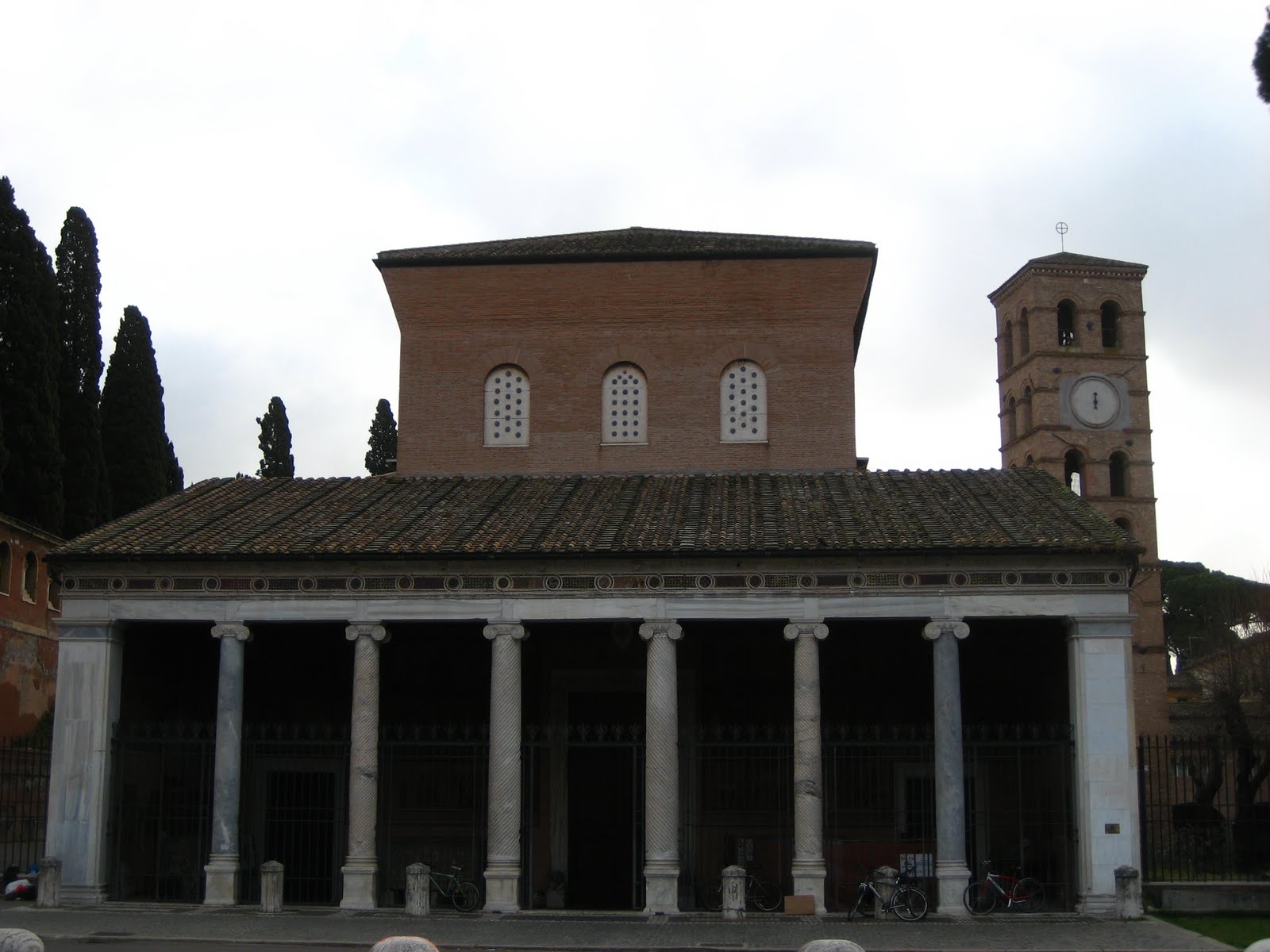
On Wednesday, the day before the beginning of the Triduum, I participated in an ancient pilgrimage here in Rome, and one which for me was a nice way to cap off the station church practice I undertook throughout Lent. Known as the Seven Church Walk, the path was first laid out in the mid-16th century by St. Philip Neri and his friends as a way of visiting the four major basilicas of Rome (above: B: St. Mary Major, E: St. John Lateran, G: St. Paul Outside the Walls, and H: St. Peter's) as well as three important minor basilicas (C: St. Lawrence Outside the Walls; D: Holy Cross of Jerusalem; F: Saint Sebastian Outside the Walls). In the succeeding centuries, it's been a way of gathering to worship with friends, spend some time in the fresh air, and see some of the beautiful religious and cultural sights of Rome all in one day. These same things were what appealed to those of us who undertook the walk on Wednesday. Our group included priests and seminarians from the NAC, American college kids studying abroad for the semester, some lay men and women who work here in Rome, and a few other colorful individuals.

Rather than disturb your Triduum with long and detailed descriptions of each place, I thought I'd let the pictures do the storytelling for a change, together with the map at the top and the links to articles about each church throughout. Note that you can right-click on the map to enlarge it a bit. If you do so, you should be able to see our path pretty well, starting at the North American College (A on the map). We left the College at 6 a.m., had Mass at St. Mary Major (B) at 7, and then began our walk. We took a short lunch break after visiting St. Sebastian (F) and then continued our journey to St. Paul's and finally St. Peter's. We finished about 4 p.m., having walked about 14 miles in total.

Crossing Piazza Venezia, heading out in the morning to start with Mass at St. Mary Major.

Along the Via Panisperna (lit. "Ham Sandwich Road"). You can see the dome of St. Mary Major in the distance.
The Basilica of St. Mary Major. After Mass and a quick bite to eat, the Walk commences.

The Basilica of St. Lawrence Outside the Walls. It houses the tombs of St. Lawrence, St. Stephen (the first martyr), and Bl. Pope Pius IX, founder of the NAC.

Crossing through the Porta Maggiore of the Aurelian Wall.

The Basilica of the Holy Cross of Jerusalem. It contains relics of Christ's passion, including part of the cross, a nail, and the I.N.R.I. sign.

The Archbasilica of St. John Lateran, the cathedral of Rome and the premiere church in the world.

Translation: "Most Holy Lateran Church, mother and head of all the churches in the city and in the world."

Waiting to start up the walk again. This obelisk is the tallest in Rome.

Along the Via Appia Antica, or Appian Way, one of the oldest roads in Rome.

Sheep? This stretch doesn't really feel like Rome at all.

Still on the Appian Way, near several catacombs. This is also roughly the spot that Peter experienced the "Domine, Quo Vadis?" vision of Christ.


The Basilica of St. Sebastian Outside the Walls. It houses the relics of the martyr St. Sebastian and more than 200 other saints.

Walking now along the Way of the Seven Churches.


The Basilica of St. Paul Outside the Walls, containing the Apostle's tomb.

Nearly there. Having been on our feet now for some 8 hours, the knees were really starting to ache at this point.

At last, our final destination, the Basilica of St. Peter.

Thus concludes my Lenten pilgrimage blogging project. Many thanks for reading along! I hope you found it insightful and helpful in deepening your prayer experience of Lent. Maybe some of you will find yourself one day in Rome during Lent, and you'll have the opportunity to visit the station church of the day or make the Seven Churches Walk yourself. For those who won't or can't, I hope this has given you a taste of what it's like.

Have a blessed Triduum, friends. May the Risen Lord bless each of you!

Friday, March 26, 2010

Santo Stefano Rotondo


On this final Friday of Lent -- Good Friday technically falls within the Easter Triduum ("three days") -- the pilgrim community of Rome journeyed to the station church of the day, the Basilica di Santo Stefano Rotondo. Also sometimes referenced by its location on the Caelian Hill, St. Stephen in the Round is an ancient basilica dedicated to both St. Stephen, the first martyr, and St. Stephen I, the first king of Hungary.

Santo Stefano Rotondo (19th cent.), Ettore Roesler Franz

Inspired by the Church of the Holy Sepulcher in Jerusalem, which had been built by Constantine and his mother St. Helen in 326, St. Stephen's was constructed and dedicated by Pope Simplicius in the late 5th century on the site of an old Roman army camp on the Caelian Hill. The basilica was one of the first churches in the West to be built "in the round," as opposed to the traditional rectangular style. The pastoral setting on the Caelian Hill and the basilica's circular structure would have given the church the distinct connotation of a tomb, since the tombs of emperors and great statesmen were located and constructed in the same way. The intention by Pope Simplicius was to give the Christians of Rome an experience, without leaving home, of what it would have been like to visit Christ's tomb and the church that surrounds it in Jerusalem. For a city that has such a legacy of martyrs, it was fitting as well that Pope Simplicius brought the relics of St. Stephen -- one of the first seven deacons of the Church and its first martyr -- to Rome to be placed under the main, tomb-like altar.


The original church structure was larger than the current one, which underwent heavy renovations in the early and late middle ages. Nonetheless, the basilica remains one of if not the oldest existing examples of the "in the round" style of Christian churches. For this reason, it's fairly important architecturally; I remember studying it in my high school art class! The church is also famous for the series of 34 frescoes along the outer wall which depict various religious martyrdoms in Biblical and ecclesial history. Commissioned by Pope Gregory XIII in the 16th century, the frescoes were thought to have been an encouragement to the seminarians of the German (and Hungarian) College who maintained and worshiped at this church. Because of the political and religious unrest of the time, as well as battles against the Turks in Hungary, many Catholic priests were returning to their home countries to face certain death.

The Mass readings for today speak of persecutions against those who are just, life and death situations for the righteous. Jeremiah feels his life is threatened by those whom he is prophesying against, and Jesus knows that the Jews are wanting to stone him to death. Though today we may not often face the prospect of certain death at the hands of others, we can relate with feelings of being persecuted unfairly. In our lives, whether it's for what we have said or not said, done or not done, or perhaps because of what we believe, we often suffer deeply from unjust causes or in unnoticed ways.

The Stoning of St. Stephen (c. 1660), Pietro da Cortona

Perhaps we can take some solace in today's Responsorial Psalm, "In my distress I called upon the Lord, and he heard my voice." Our faith, rooted in hope, teaches us that God will justify those righteous men and women who are faithful to his truth. Indeed, he has already done so and continues to do so through the once-and-for-all sacrifice of his Son Jesus, whose Passion and Resurrection we are preparing to celebrate. We don't always feel or see this reality daily, but we know it to be true. For those who witnessed the deaths of early martyrs like St. Stephen, it might not have looked like God had heard their voices in distress. Yet, we know that he did and we celebrate today the glory of their sacrifice. In our contemporary struggles, we have hope that we, like them, can persevere in faith, knowing that if we do, we will see what Stephen saw when he said, at the point of his death, "Look, I see the heavens opened and the Son of Man standing at the right hand of God!" (Acts 7:56)

* * *
The station church practice ends next Wednesday, the day before Holy Thursday and the start of the Triduum. I hope you've enjoyed these posts as much as I've enjoyed writing them. The idea was to help give you a taste of what this Lenten practice is like here in Rome and, hopefully, help make your Lent a little more spiritual and a little more in touch with the universal Church.

Next week, although it won't be a station church post, I hope to write about another long-standing Lenten practice here in Rome. I'll be taking part in the fabled Seven Church Walk, a day-long, 15-mile trek through the city to the seven most important churches of Rome. Be sure to check back on Thursday to read and see more about it.

Thursday, March 18, 2010

San Martino ai Monti


North and east of the Roman Forum and the Colosseum lies the Monti rione, or neighborhood, of Rome. One of the largest of the 12 sections of Rome, the "Mountains" neighborhood is named thus because it covers the Esquiline and Viminal Hills and part of the Quirinal Hill. In ancient times it was the most heavily populated area of the city and also one of the poorest. It's fitting then, perhaps, that this area of the city is the location of a church named after one of the greatest patrons of the poor, St. Martin of Tours. This church, the Basilica di San Martino ai Monti, is our station for today.


The church is alternately known as the Basilica of Sts. Martin and Sylvester, the latter being the pope-saint who founded it in the early 4th century. It originally was the dwelling place of the priest Equitius and the house church took its name from him for a time, the Titulus Equitii, dedicated to the martyrs of Rome. About the year 500, the complex was rebuilt and dedicated at that time to St. Martin and St. Sylvester. The current basilica dates from the mid-9th century, when the name St. Martin's on the Mount became the most common title for the basilica. The church has been served by the Carmelite Order since the 14th century, and the facade and much of the interior dates from the 16th century.

As I mentioned, it's fitting that a church located in one of ancient Rome's poorest areas should be named after St. Martin of Tours. Named after Mars, the Roman god of war, Martin was raised to be a great soldier like his father, who served as head of the Roman cavalry in early 4th-century Gaul. At the age of 10, and to the great displeasure of his family, Martin became entered into the catechumenate, the long process of study and piety that was the process one started upon in order to be baptized a Christian. Although Christianity had recently been legalized by the emperor Constantine, it was still a minority religion with a stigma of appealing mostly to the poor, uneducated, and marginalized social strata. Martin's choice of becoming Christian would also have bucked strongly against the Mithraic cult, which was the typical religion of the military elite.

Martin gives up his career as a knight and soldier. A 13th-century fresco by Simone Martini, in the Chapel of St. Martin in the lower part of the Basilica of St. Francis in Assisi.

Saint Martin and the Beggar (c. 1599) by El Greco

At the age of 15, still unbaptized, Martin became a cavalry officer like his father and served in the area around Amiens. One winter day, coming upon the gates of Amiens with his soldiers, he met a scantily-clad beggar freezing in the harsh conditions. Martin quickly and impulsively sliced his own cloak in half and handed one piece to the poor man. That night, Martin dreamt he saw that half of his cloak again, now wrapped around the shoulders of Christ, who said to the angels, "The soldier Martin, still unbaptized, has clad me." Taking the vision as a sign of confirmation in his faith, Martin was baptized at the age of 18. He continued to serve in the cavalry until the age of 20, when on the eve of a great battle he determined, "I am a soldier for Christ. I cannot fight for man." He was imprisoned for disobedience and cowardice, but though he offered to step to the front of the ranks unarmed, the sides sued for peace and battle was averted. Martin was released and left for Tours, where he became a disciple of St. Hilary of Poitiers and an ardent proponent of orthodox Trinitarian theology in the fight against the heresy of Arianism. He founded monasteries across Italy and France, continuing to argue against Arianism and other heresies. In 371, he was named the bishop of Tours, where he was known as a loving and dedicated shepherd, especially concerned always for the poor. One of the most popular saints in Europe's history, he is venerated today as the patron saint of soldiers and the national patron of France.

An icon of the First Council of Nicaea. There, the teachings of the priest Arius (in brown, foreground) are condemned.

The Basilica of Saint Martin has another interesting historical note, which also happens to relate to Arianism. The other saint for whom the church is dedicated, Pope St. Sylvester I, used the house church originally built on this site to prepare for the First Council of Nicaea. The council had been called to deal with the threat of Arianism, the heresy which denied the dogma of the Trinity by asserting that the Second Person of the Trinity (the Word, Jesus Christ) is not divine in the same way or to the same degree as the First Person, the Father. It is from this council that the Nicene Creed was written, which we still recite today in the liturgy. According to tradition, Pope St. Sylvester and his theological advisers gathered at the Titulus Equitii to examine the writings of the priest Arius and to prepare their arguments against him. After the council had ended, and Arius and others had been condemned, the Pope and his clergy gathered at the house once again to formally burn the heretical texts. The episode is remembered today as an important example of the duty of the pope and the bishops of the world to defend the Catholic faith from all moral and doctrinal error.

The Crypt of San Martino ai Monti (1806), by François Marius Granet

What the crypt looks like today.

In today's Gospel from St. John, Jesus rebukes the Jews for their lack of belief. Just as they failed to understand Moses, who -- like all the prophets -- foretold of Christ's coming, so too did they fail to see the Christ when at last he appeared. In our day, too, the temptation is ever present to abandon Christ, to see him merely as a wonder-worker who lived a holy life, or even as a prophet of social and moral virtue. Let us not confuse ourselves! "The works that the Father gave me to accomplish, these works that I perform testify on my behalf that the Father has sent me. Moreover, the Father who sent me has testified on my behalf." John testified that Jesus is the Christ; the works of Jesus testify that he is the Christ; and indeed, as he says, the Father himself, at the moment of Jesus' baptism, testified "This is my beloved Son, in whom I am well pleased" and again at his Transfiguration, "This is my beloved Son; listen to Him!"

My friends, let us be ever vigilant to guard ourselves from any influence or source that causes us to doubt this most fundamental of our beliefs, that Jesus is the Holy One of God, the Savior sent to redeem us. Like Pope Sylvester and the council fathers of Nicaea, we must remember that our faith has no other foundation, no other savior, no other hope than He to whom even the Father has testified. Indeed, imagine the Apostle St. John, long after witnessing the events of the Gospel above, writing again of the same truth, a truth he himself had understood from Jesus' words: "And we know that the Son of God has come and has given us understanding so that we may know him who is true; and we are in him who is true, in his Son Jesus Christ. He is the true God and eternal life" (1 Jn 5:20).

Saturday, March 13, 2010

Acolyte Installation


This past Sunday, my classmates and I advanced another step closer to ordination as we were installed as acolytes in the College's Immaculate Conception Chapel. It's a pretty big annual event for the whole house, since it's the last formal step prior to diaconate ordination. As such, it was a great day for all of us in the Second Year class and also another hopeful reminder of the aim that we're working toward.

The Most Reverend Thomas Rodi of the Archdiocese of Mobile presided at the Mass and installation. Three of my classmates are from the Mobile diocese, so it was fitting that he was there. It was also quite nice, I must say, to hear a good Southern homily again, and delivered without a text at that. His words were encouraging and affirming and spoke of the relationship that must exist between the doors of the church and the altar. Just as the doors of the church permit us to enter and approach the altar, so too does the altar send us, now renewed by the Eucharist, back through the doors out to the world to renew it as well. All that we do at the altar, he said, must be done with this in mind.


My row and I stand and declare that we are "present" at the beginning of the rite of institution.

What exactly is an acolyte? Some background might be a little helpful here. Until about 40 years ago, acolyte was the second to last of the "minor orders" (coming after porter, lector, and exorcist and before the final one, subdeacon) which were considered the lowest of the ordained states and steps on the way to priesthood. After 1972, however, the minor orders were suppressed and replaced with two "instituted ministries," lector and acolyte. Those who have been instituted lectors and acolytes continue to have a recognized canonical status, but they are no longer considered to be "ordained" in any way and thus are laymen rather than clergy. While the provision allows for any layman to be instituted in these ministries, it's been the practice of nearly every American diocese to formally install as lectors and acolytes only those men preparing for priesthood. There is, at times, some debate about this practice, especially since many dioceses already use lay people as lectors and even occasionally as acolytes, though only temporarily and only for a particular parish, like a deputized extraordinary minister of Holy Communion.

According to Pope Paul VI, acolytes are those who are "set aside in a special way for service to the altar." The duties of the acolyte are basically those of the commonly-known altar server; or, better said, the modern altar server typically performs the duties of the acolyte, namely, assisting the priest and deacon in the celebration of the Mass. Acolytes are specifically charged with handling and purifying the sacred vessels. They can also serve as extraordinary ministers of Holy Communion and bring the Eucharist to the sick and home-bound, if necessary. Unlike the altar servers or lay Eucharistic ministers often seen in parishes, the abilities of an acolyte to perform these functions are permanent and universal, i.e. able to be done anywhere in the world. And, apparently, before 1983, an acolyte was also given power to bless things, specifically fruits, nuts, and fishing gear. I've no idea why. According to some snarky seminarian humor, "fruits" and "nuts" might be used to describe just about anybody!

Archbishop Rodi says the prayer of the rite as he hands me the paten, symbolic of the sacred vessels.

My classmates and I (front row, far right) with (from l to r) our rector, Archbishop Rodi, and Bishop Aquila of Fargo

As I mentioned, this is just a step toward priesthood, the goal we're striving toward ultimately. I recently came across this link, which I think is inspiring (maybe a little too much, even), and I thought I'd share it with you.

Thursday, March 11, 2010

Santi Cosma e Damiano


Well, we've made it to the halfway point of Lent. Today's a good opportunity to reflect on our progress thus far in preparing and improving ourselves before Easter and to re-double our efforts in the second half. I hope this station church practice has been helpful and enjoyable; thanks for following along. I'm always on Thursday, but be sure to check out the blogs for the other days of the week: Monday, Tuesday, Wednesday, Friday, Saturday, and Sunday. No matter the day, we've got you covered.

Today's station church is the Basilica dei Santi Cosma e Damiano. Located in the famous Roman Forum (specifically, the Vespasian Forum or "Forum of Peace"), the basilica is situated right on the Via Sacra, the most important street of ancient Rome which ran from the Capitoline Hill to the Colosseum past many important government and religious buildings. Two such buildings were the Temple of Romulus -- dating from the 4th century but possibly the site of the much earlier Temple of Jupiter Stator which Romulus himself founded -- and the Bibliotheca Pacis, a 2nd-century library which housed important literary and historical works as well as artifacts from conquered Roman lands, including apparently pieces from the Holy Temple in Jerusalem. In the early 5th century, these buildings were given by Theodoric the Great, king of the Ostrogoths who controlled Rome after the empire fell, to the Christians. Pope Felix IV combined the buildings and founded a basilica dedicated to Cosma and Damiano, or Cosmas and Damian, as they are known in English.

The entrance to the original Temple of Romulus on the Via Sacra, now the closed rear of the basilica

Born in Arabia but later living and working in Syria, Cosmas and Damian were twin brothers and doctors. They ministered to all, including the poorest of the poor, and never accepted any payment for their services, which earned them the nickname Αναργυροι, "the silver-less." They worked many healing miracles, most famously replacing a man's leg with the leg of another, according to tradition. Their charity and good work brought many to the Christian faith, yet it also drew them to the attention of the authorities. Under the persecutions of Diocletian in the late 3rd century, Cosmas and Damian (together with, according to some sources, their three younger brothers) were arrested, tortured, and beheaded. Invoked in the Litany of Saints and in the Roman Canon, they are honored today as the patrons of physicians and surgeons.

The Basilica of Cosmas and Damian became an important site for the Christians of the time, housing both a charity center for the poor and a house for those suffering from disease or injury. According to tradition, if a sick person slept over night in the basilica, he/she would be cured. Regardless of the legends, the Basilica of Cosmas and Damian was the first church to be founded in the Roman Forum, which would have been an important event for the Christians of the time. Though the faith had been legal for some two hundred years, such a moment would have marked a kind of final triumph over the pagan society which had so oppressed and persecuted them in their earliest days. The heart of ancient Rome, the center of its pagan and imperial worship, was now itself Christian.


Detail of the 6th-century apse image, the Second Coming of Christ

In the Mass readings for today, we detect a consistent theme of turning to and believing the words of God. Too often, we take for granted the good things that have been given to us and fail to recognize the loving Father who gives them, asking instead for some sign before we truly believe. The Israelites were brought out of the land of Egypt, yet they "stiffened their necks" and turned away from God. Jesus casts out demons yet people question whether he is himself from the devil. As Christian believers, our religion was persecuted by the greatest empire in the history of the world for nearly 300 years, yet it survived. Psalm 95, "If today you hear his voice, harden not your words," might just as easily say, "If today you see his hand at work, do not turn away in unbelief!"

The hand of God is indeed at work all around us, and we are invited to assist the Lord in furthering and advancing this work. The Resurrection of Christ, that which we are preparing for in these 40 days, forever changed the world; as St. Augustine said, "We are an Easter people," and it is surely now more than ever that we must remember it and live like it. Jesus tells us in the Gospel, "Whoever is not with me is against me, and whoever does not gather with me scatters." Let us, at this halfway point of the Lenten season, rededicate ourselves to gathering, to showing the world through the example of our lives that "the Kingdom of God has come upon you."

UPDATE: Dan from Oakland points out in the comments that the mosaic of Christ in this basilica played a key role in the conversion of Thomas Merton, later a Trappist monk in Kentucky and popular spiritual writer of the 20th century. Many thanks, Dan, for the tip! And, again, thanks to him and the rest of you for reading.

Thursday, March 4, 2010

Santa Maria in Trastevere


The station church for Thursday in the Second Week of Lent is the Basilica of Santa Maria in Trastevere, one of the most ancient and, in my mind, most beautiful churches in all of Rome.

Located in Rome's neighborhood of Trastevere, literally "across the Tiber," the modern church community is probably the descendant of the earliest Christians in Rome. It's known that the Trastevere area was a popular area for artisans and immigrants since for a long time it was not actually part of Rome but rather the beginning of Etruscan territory. It was only formally incorporated as the fourteenth district of the city by Augustus Caesar at the dawn of the imperial era. The area of Trastevere was also known for being inhabited by many Jews, both Roman citizens and Jewish pilgrims from other parts of the empire. It's likely that Sts. Peter and Paul would have visited and perhaps even stayed in this area when they were in Rome.


The Basilica of Santa Maria has the distinction of being most likely the first place the Eucharist was publicly celebrated in the city if not in the entire Roman empire. Until this point, the liturgy would have been a secret affair conducted in the home of a believer. However, in the early 3rd century, some 100 years before Christianity would be legalized by Constantine, a dispute broke out between Christians and Roman soldiers over a public building, the Taberna Meritoria, which had been used by both groups at various points. Pope Callixtus I and the other Christians wanted to use the spot as a house church while others wanted to use it to operate as a tavern to cater to Roman soldiers and veterans who lived in the area. The emperor of the time, Septimius Severus, decided to allow illegal Christian worship rather than the debauchery sure to follow from the patronage of soldiers at the tavern. The founding of the church at this spot, then, was one of the small but important steps toward the legalization of Christianity.

According to legend, the importance of the spot upon which the church was later built dates back even farther. Some time around the birth of Christ, a stream of oil was said to have shot up out of the ground and continued to flow all that day. Such a strange event would have been interpreted by all as a sign of some great divine occurrence, but for Jews especially, it would have been a sign of the coming of the Messiah, the "One Anointed" by oil, who would restore Israel to its place of prominence in the world and justify all those who believed in the one God. Some years later, when stories of Jesus and his message of salvation came to the city, this event would have been recalled and interpreted in light of this new Gospel. Others think that the presence of "oil" was actually that of dirty water, pumped by Augustus into this area so that he could put on the naval battles he so enjoyed. Whatever the origin of the story, the area has been associated with the event ever since, and even today, the place of the "Fons Olei," or fountain of oil, is located to one side of the basilica's altar.

The facade of Santa Maria in Trastevere

Santa Maria's apse mosaic

The current church dates from the 12th and 13th centuries, with some later additions. While the basilica as a whole is beautiful, two particular works of art are quite impressive. First, the exterior artwork of the front facade is quite famous. Statues of Pope St. Callixtus I, St. Cornelius, Pope St. Julius I, and St. Calepodius, all of whose relics are located beneath the high altar insie the basilica. Behind them is a mosaic of the Virgin Mary feeding the Christ Child, with five virgins on each side processing forward, calling to mind the Parable of the Ten Virgins, who filled their lamps with oil. Remembering the ancient story of Trastevere's fountain of oil, the mosaic's message is that Christ is the true Fountain, the Light that illuminates all things. Inside the basilica, the huge apse mosaic depicts the same four saints previously mentioned, as well as St. Peter and St. Paul, on either side of Christ and his Mother, both of whom sit enthroned. Beneath this image, ten lambs process toward the Lamb of God, the one whose sin takes away the sin of the world.


Today's readings tell us how foolish it is to put our trust in anyone or anything of this world, since this world is passing away. The wise man puts his hope in God rather than in riches or honor. In the Gospel, Abraham says to the rich man who is in torment: "If they will not listen to Moses or the prophets, neither will they be persuaded should someone rise from the dead." Such words should be a stark warning to us. Should we, who know that one has risen from the dead, expect any less of a fate if we fail to amend our lives?

The centrality of Christ in the images from Santa Maria remind us that true hope lies only in Jesus, he who is both God and Man, the perfect and the fullest expression of God's message of salvation. Continuing with this season of Lent, let us today examine our lives for those areas where we continue to hope in something of this world rather than in Jesus Christ. Let us, to use the imagery of Jeremiah, plant our foundation firmly in him, stretching out our roots to drink deeply from that stream of Living Water, remembering the words of the Lord: "Everyone who drinks of this water will be thirsty again, but those who drink of the water that I will give them will never be thirsty. The water that I will give will become in them a spring of water gushing up to eternal life."

Wednesday, February 24, 2010

San Lorenzo in Panisperna


The Lenten station church practice is in full force, now more than a week into it. It's been good although a challenge to commit oneself to attending every morning. However, I have learned more about this great city, which I thought I knew pretty well already. It's funny -- yesterday, on my early morning walk to the Basilica of St. Mary Major for the station Mass there, I passed a church with an interesting facade and wondered if it might be a station church somewhere down the road. Lo and behold, it happens to be today's station church, San Lorenzo in Panisperna.

The church is named for St. Lawrence, one of Rome's most famous martyrs and one of the most venerated saints in the Catholic Church. A deacon of the Roman Church in the mid-3rd century, St. Lawrence was put in charge of the administration of Church property and keeping its records. When the emperor Valerian, hoping to quash the young Christian religion, asked Lawrence to give him the treasures of the Church, Lawrence is said to have returned a day later with all of the sick, lame, and orphaned in Rome that he could find and declared, "These are the treasures of the church!" Valerian, of course, did not take kindly to this bit of spiritual wisdom and threw him to prison. Lawrence further enraged the emperor and his court when he successfully converted his jailer and the jailer's family. Valerian ordered the deacon to be roasted alive. Lawrence nonetheless kept his sense of humor about him since tradition says that he advised his executioner, "You may turn me over, I'm done on this side." No joke, he's still the patron saint of chefs!

The Martyrdom of Saint Lawrence, behind the high altar, by Pasquale Cati, a student of Michelangelo.

The church of San Lorenzo in Panisperna is reputedly the oldest church in Rome related to the saint's life. Though it has now been passed in importance by the place where St. Lawrence is buried, the Basilica of San Lorenzo Fuori Le Mura (also a Lenten station church, coming up in a few Sundays), the church of San Lorenzo in Panisperna was erected on the site of the saint's martyrdom some time in the mid-4th century. Not much is written about the church until the Middle Ages, when it was attached to an abbey, run first by the Benedictines and then by the Poor Clares. The word Panisperna, roughly translated "ham sandwich", likely comes from this time, when the sisters at San Lorenzo would distribute food to the city's poor along the road that runs in front of the church. (Others say it's because the church known to hand out really great ham sandwiches to the medieval pilgrims who were visiting Rome and walking from the Basilica of St. Mary Major to St. Peter's Basilica.) San Lorenzo is still run by the Franciscan order and continues to have an active ministry to the poor.

Steps from the Via Panisperna lead up to the courtyard in front of the church's portico, separating it from the street.

Beneath one of the side altars on the right hand side of the church rests the relics of St. Crispin and St. Crispinian. The two brothers, born into a noble Roman family in the third century, converted to Christianity and had to flee to Gaul because of their faith. There, they preached the Gospel and made shoes by night in order to get by. They were successful in spreading the Christian faith, enough in fact to make the emperor and the local governor take notice. Crispin and Crispinian were tortured and beheaded ca. 286 AD and their bodies were brought back to Rome some time in the Middle Ages. According to some accounts, the local governor, inspired by their faith, converted to Christianity himself and was later martyred.

The Feast of Sts. Crispin and Crispinian occurs on October 25 and has long been commemorated in England. Historically, it is most famous for being the day on which the famous Battle of Agincourt was fought in 1415, when an English force led by Henry V defeated a much vaster French army. In Shakespeare's Henry V, one of the most famous passages from the Bard is given by Henry to his men in the moments preceding the battle -- the famous "St. Crispin's Day speech." Below, Kenneth Branagh delivers the speech in his film version from 1989:


The Mass readings for today speak to us of the importance of asking God in prayer for all that we need and, even more, of the assurance of God answering those prayers. Jesus tells us, just as he told his disciples: "Ask and it will be given to you; seek and you will find; knock and the door shall be opened to you" (Mt 7:7). God is infinitely near to us, waiting to grant us what we need, whatever is best for us, if only we turn to him to ask. The saints surely knew this, especially perhaps the martyrs who must have turned to God in their hour of need, not so much to be rescued from their fate but to have the strength of perseverance in enduring it. What kind of amazing courage Lawrence must have had to face the grill of martyrdom! Surely such courage is only the fruit of intense prayer, prayer that relies confidently and solely on God. In this season of Lent, when we are called especially to rededicate ourselves to prayer, may the lives of the saints remind us of prayer's daily and indispensable role in our lives as Christians, remembering as Jesus tells us "how much more will your heavenly Father give good things to those who ask him" (Mt. 7:11).

San Lorenzo's ceiling fresco The Glory of St Lawrence by Antonio Bicchierai

* * *
In case you didn't see my last post, some fellow seminarian-bloggers and I have teamed up to chronicle the Lenten station churches of Rome. I'm not going to feature every church on this blog, but you can see them on the blogs of my friends Victor and Doug, who are putting up each day's post. You can also check out the full list of the station churches and some information about all of them, much of which we're using in our posts.

Second semester has started with a bang so, as always, I thought I'd give you an idea of what courses I'm taking:

- Canon Law
- The Prophets & Apocalyptic Literature
- Paul Today: Applied Exegesis of the Major Pauline Letters
- Church History: the Reformation
- Fundamental Moral Theology
- Introduction to the Theology of H.U. von Balthasar
- Sacramental Theology: Penance, Matrimony, Orders, & Anointing

Plus a fun morals seminar in Italian. It's going to be a rough semester to say the least. Keep me in your prayers!

Wednesday, February 17, 2010

A Lenten Exercise: Santa Sabina

The view from the Aventine Hill toward the Vatican

Exams are finally behind us once again, and after a crazy semester, another that looks to be just as harried started on Monday. The first few days and weeks though usually aren't too overwhelming and I'm hoping to finally make good on some of my promises to get to some long-awaited and long-intended posts on the past few months. Thanks to those of you that are still reading and commenting -- I hope to be around a bit more as the second semester progresses.

Today, as you may know, is Ash Wednesday and thus the start of another season of Lent. You might remember my thoughts from last year on the season of Lent and the Roman practice of visiting various "station churches" throughout the 40 days. Each day, a different church is designated as that day's station for the inhabitants and visitors of the city as they progress toward Easter. It's an ancient practice that enjoyed popularity during the early Middle Ages and again during the days of the Reformation and counter-Reformation. The NAC community is one of the few groups who practice this collectively and we're joined most morning by various Italians and English-speaking emigrants who worship with us.

The Basilica of Santa Sabina


The apse of Santa Sabina

The Basilica of Santa Sabina is the traditional home of the Ash Wednesday liturgy. The NAC has a Mass at 7 a.m., followed shortly thereafter by the Dominicans, who are based at Santa Sabina. Finally, in the early evening, the Pope travels to Santa Sabina to celebrate Mass with guests and members of the Curia. Situated on the Aventine Hill, one of the famous "seven hills of Rome," Santa Sabina was likely built atop the home of the Roman widow Sabina, who converted to Christianity with her slave Seraphia and was martyred with her around the year 125 AD. Their relics rest beneath the main altar. The original church was built in the early 5th century though the modern church dates from the Middle Ages. The apse of the basilica features a fresco of Christ as both preacher and font of living water for the universal Church. In the wooden doors leading into the basilica is one of the oldest depictions of the crucifixion of Jesus. Martyrdom, often by crucifixion, was an imminently present reality for the early Christians, and thus such scenes were not needed or wanted in art. However, by the 5th century, Christianity was the religion of the empire and the crucifixion of Christ was seen more and more as its foundational event.

Detail of the crucifixion scene at Santa Sabina, one of the oldest in Christian art.

So that's the first of the 40 station churches. This year, I've teamed up with a few seminarian buddies and fellow bloggers to mark our progression as we make our way through the station churches and toward Easter. So, each day, we'll visit the church designated for that day, and then one of us will blog about it. The idea is to help you viewers at home get a fuller taste of what the station church practice and Lent in Rome are like. I'll try to update this blog occasionally with some of the posts that I write, but most of the daily write-ups will be on my friend Victor's blog since he came up with the idea: http://seekmeandlive.blogspot.com/. You can also check out the websites of my other friends who will be contributing: Doug (http://whatfuturedoihave.blogspot.com/); Colin (http://www.sactownseminarians.com); Dave (http://thebrotherinrome.com); Francis (http://francismarotti.blogspot.com); and Fr. Adam (http://fatherrust.blogspot.com).

I should be back soon with some details on some recent travels, visits from family, and other recent happenings. For now, enjoy the online station church guide!