Monday, October 5, 2015

God & The Order of Creation

Giotto, Francis Preaching to the Birds (c. 1298), Basilica di San Francesco, Assisi

Every year, on October 4th, the Church celebrates one of its most enduringly popular saints. He came from a prominent family, had a wealthy inheritance, and was a man of ingenuity at a time when society greatly helped those who helped themselves. But he gave up what he had – his political influence, his fortune, even literally the shirt off his back – in favor of helping others, to live a life of love and service.

Francis of Assisi remains one of the most beloved figures of our faith, a man who continues to inspire people of all faiths to this day, including our current Pope. People love and identify with St. Francis for a variety of reasons, but perhaps one of the most common is his love for the created world. Maybe you’ve heard the story of how Francis once preached to the birds about the glory of God or tamed a wolf that was terrorizing the inhabitants of a village. Francis felt closest to God in nature. He was the original outdoorsman, in a sense, because he found in creation a way of understanding life. He often preached and wrote about how everything in the world – ourselves, animals and plants, even the sun and the moon – exists in a relationship with everything else, in a communion that brings us together and puts in touch with God.

Today happens to be October 4th, and although we celebrate the Sunday of Ordinary Time instead of the liturgy for Francis’s feast day, I think we can still honor St. Francis in a way. It just so happens that our readings today speak about creation, about the natural world as God has created it and of which we are a part. If we try to understand these readings with the mindset of Francis – of understanding creation as a lens by which we understand God and ourselves – I think we will draw close to what Jesus is seeking to show us.

In the Gospel, the Pharisees are trying to trip up Jesus. They ask him about the lawfulness of divorce, a hot topic and a common problem in the society of that day much as it is in our own. Divorce had been permitted by Moses, as they know, but they also expect him to demand something more. And Jesus does not disappoint – but he also appeals to an authority higher than Moses – pointing out how God created humanity as male and female, equal but distinct, and made for one another. Rather than referring to just a particular Mosaic law, Jesus is showing that the design of human love is written into who we are, who we have been created to be, and God’s plans for marriage are as part of the natural order of creation as the physical world that we see around us.

Creation, as St. Francis and Jesus both understood it, is not empty of meaning. Rather the very way in which the world has been created is something God has revealed to us – especially about who we are. Just as Francis understood our lives as humans to be intricately connected with the rest of the created world, so too Jesus is asking us to understand marriage and human love as part of the divine plan, as part of the way in which God has created our very natures. Love and marriage have a high ideal, for Jesus and for us, because they are given to us by God – they’re not merely social constructs but a path to communion with others, a path to holiness through love.

As in Jesus’s day, the reality though is often very different than the ideal. And while we are called to give witness to the truth – to acknowledge how the way in which God has created us is of great consequence – we also are called to speak the truth in love. Today, in Rome, bishops and cardinals from around the world are gathering for a synod – a fancy word for a meeting – about challenges that currently face marriage and the family. There has been a lot of discussion – maybe you’ve heard some of it – about various proposals for ways in which the Church might be able to assist those who are struggling in some way with living out the truth about human sexuality, the marriage, and the family. I hope you’ll join me in praying earnestly for the guidance of the Holy Spirit over the next few weeks – that we as a Church, as a Christian community, might understand how God wants us to speak the truth about who we are, who he has created us to be, but to always do so in love, with charity and mercy.

My friends, at the end of today’s Gospel, after teaching a truth that was hard – for the disciples and for us – Jesus draws their attention to the humility and love of a little child. Our salvation ultimately is not about solving some social or political question, but rather it rests on whether we are willing to humbly accept the kingdom of God. With the innocence of a child, with the humility of St. Francis, may we be open to allowing ourselves to be awed by the beauty and the majesty of the nature that God has given to us – the nature that surrounds us and the nature within us – and may we find there a reason to respond to one another always with mercy, and truth, and love.

Monday, September 28, 2015

The "Challenge Coin" of Discipleship

Jacob de Wit, Moses Chooses the Seventy Elders (1792)


(Since my previous post, I have been transferred to St. Thomas Aquinas University Parish in Fayetteville, Arkansas. This is my homily for the 26th Sunday of Ordinary Time, Year B.)

I got a message earlier this week from a friend of mine who works for the Secret Service – he’s not an agent though, just a lawyer – saying that he wanted to send me something special. It’s called a challenge coin. I wasn’t familiar with that term so I looked it up. A challenge coin is a medallion given by an organization that marks the bearer as an official member. These days, they’re normally given as awards or commemoratives of special events, such as the Pope’s visit to the United States. However, traditionally, if someone were to question you as to whether you really belonged to a particular group, you could pull out the challenge coin as a sign of being an official member. Inevitably though, the coins would somehow end up in the hands of someone who was not a member, and a scandal would ensue.

Something similar is going on in the Gospel today. The disciples are upset that people who were outside of their group are casting out demons in the name of Jesus. Jesus had given this specific power to his disciples, so when they see others doing it, they’re upset. They are the official disciples – their visible discipleship is a kind of challenge coin, if you will, which they possess and these outsiders do not. But Jesus is unconcerned – indeed, he is glad that good is being done in his name. “Whoever is not against us is with us,” he tells them.

The Christian life – like life in general – is at times rife with the danger of tribalism. We see that just in the various proliferation of churches and Christian communities – we all profess faith in Jesus as Lord, but can’t seem to agree on very much else. Even in the Catholic Church, too often we allow ourselves to be divided into factions and parties, this side against that side, this particular group pushing back against the agenda of another, this member who wants to criticize or oppose or exclude that member over there.

Jesus is not interested in such petty disputes. Instead, he warns us against what really causes division – sin, especially the sin of scandal, of leading another astray because of our own poor example. Indeed, in the Gospel today he uses strong images to warn us – being thrown into the sea with a millstone around our neck rather than leading another to sin; cutting off our hand or plucking out our eye rather than sinning ourselves. The point is that whatever we think we might gain by giving into sinfulness, or worse, leading another into it – we will lose far, far more. Sin leads to divisions among us because it separates us from God.

How many of you were able to catch at least a glimpse of the media coverage of Pope Francis’s visit over the last few days? I myself probably watched too much of the coverage – not only because I get excited about anything related to the pope but also because of just how fascinating a figure Pope Francis is. It was remarkable to watch how no matter where he went, the people came out in masses to greet him, and no matter what station you turned to, the pundits seemed almost beside themselves with admiration and praise. Pope Francis is, in the words of one bishop, the most powerful spiritual leader of our time. Why? Certainly, many reasons – but, one at least, because he unifies, he unites. He calls out patterns of sinfulness wherever he finds them, right or left. He doesn’t care about appeasing one side or the other. He’s not concerned with distinctions of class or race or even religion. He’s only interested in pleasing Jesus, in identifying the face of Jesus in every person, no matter how lowly, and helping them and us see that same face as well.

Is it that surprising that this Pope is helping us to grow in understanding and respect for one another, to see various issues as not just political or social questions but as matters of morality and human dignity, to grow in awareness of the love and mercy and joy that comes from God? Is that that surprising? Not to me – because that’s what Jesus did. Only Jesus ultimately can bring together the factions that crop up among us, only he can disrupt our tribalism, only he overcomes the sin that divides us. Pope Francis is able to be such an inspiration to so many not because of who he is in himself, but because of who he represents.

But what happens when Pope Francis gets back on the plane today, when he returns to Rome, and the memories and emotions of his visit fade? Do things go back to being the same as before? They certainly don’t have to. Why? Because we’re not that different than Pope Francis. Yes, we may not have the white cassock or the title of Roman Pontiff; but we do have what all Christians have by virtue of our baptism – the Holy Spirit, living and breathing within us, capable of uniting us and doing the work of Jesus through us, if we let him. The same Spirit that fell upon Moses and the elders of Israel, the same Spirit that descended upon Mary and the Apostles, the same Spirit that guides and invigorates Pope Francis – we have a share in that Spirit too. We too can be prophets, disciples, spiritual leaders, representatives of Jesus. Where? In the classroom, in the conference room, around the dinner table, on the street, in the stadium, at the bar – every day, in every moment, you and I have the opportunity to not just say we’re the disciple of Jesus but to show we are, to let the Spirit we possess overcome the patterns of sin and division.

My friends, there’s no challenge coin to show you’re a Christian – there’s only the thoughts that guide us, the words we speak, the actions we do – there’s only the manner of our life that is proof of whether we really are following Jesus. Let’s open ourselves to where the Holy Spirit wishes to guide us to be instruments of healing and mercy and love, to conquer the sin and discord that still divides us in our day-to-day. In five days in our country, Pope Francis has inspired millions because we see in him the love of God. Could just one person today see in you or me the same?

Sunday, August 23, 2015

Accepting the Hard Sayings of Jesus

Henrik Olrik, The Sermon on the Mount (c. 1880), altarpiece, St. Matthew's Church, Copenhagen


(My homily for the 21st Sunday of Ordinary Time was my first in English at IC since May.)

Let me say first it's great to be back with you, back in Arkansas, after my summer studying canon law in Washington, DC, and I’m grateful to everyone for your prayers while I was gone.

It’s also great to be back celebrating Mass publicly, and preaching to people, things I didn’t get to do over the summer. However, I confess that I was a little dismayed earlier this week when I looked at the readings to start preparing for this homily. I was hoping I could sort of ease back into life in the parish with some crowd-pleasing words. But the readings for this Sunday are hard, and so perhaps you’ll find some words in this homily a little challenging as well.

For the last several weeks, we have been hearing Jesus tell his disciples that he is the Bread of Life, come down from heaven, to give eternal life. We understand these words as a clear teaching about how essential the Eucharist is for us, but the disciples didn’t understand him. They had seen the Master perform great miracles – multiplying the loaves and fishes, and healing the sick – but when he commanded them to consume him, to eat his Flesh and drink his Blood, they were baffled, even repulsed. Today, we hear that many of them stopped following him, returning to their former ways of life. It was the breaking point for them – they couldn’t take Jesus seriously any longer.

It’s a sad scene in the Gospel, and yet it’s not one that should be unfamiliar to us. How many of us know someone who who has left the Church, stopped following the Lord or decided to follow him in a different way? Even for those of us who continue in our practice of the faith, sometimes we encounter a teaching that is difficult to accept, and which – whether consciously or not – we tend to just sort of ignore or set to the side.

Sometimes, I think, especially in the modern day, we tend to operate in a mindset that values keeping our options open above all else. We like to be able to decide what we want to eat, what we want to wear, what we want to do from a range of different possibilities. When we encounter something we don’t like or don’t want, we simply choose something else.

But faith doesn’t work that way. Jesus never tells his disciples – "Here... here is a variety of different thoughts and teachings and bits of wisdom, and take which ones you want and leave which ones you don’t." No, Jesus is very clear throughout the Scriptures that we can’t be part-time followers of him; he wants us to be all-in and nothing short. "He who is not with me is against me," Jesus says at one point. If we hold anything back, then we are faced with the same question from Jesus from today's Gospel, “Do you also want to leave?” That question is posed to the Twelve Apostles, Jesus’s closest followers, who probably didn’t understand any better what he had been talking about than had the disciples who had left him. But Peter and the other Apostles looked past their own confusion; they looked beyond their own misgivings and saw before them the one whom they had left everything to follow. 

The teachings of Jesus, the life of following him, is always going to be a challenge in some way for us. Maybe you and I aren’t so concerned with his command to eat his Flesh and drink his Blood because we know he’s talking about the Eucharist – but what about some of his other sayings, such as “Love your enemies and pray for those who persecute you”? Or “If your hand causes you to sin, cut it off and throw it away”? Or “Every one of you who does not renounce his possessions cannot be my disciple”? What about those teaching of the Church that we find difficult: about understanding and living out marriage as God (and not society) has defined it; or about the obligation to support the poor; to work for social justice; to maintain an openness to life in every embrace of marital love; to welcome the stranger and the migrant; to forgive the criminal and the debtor and anyone who offends you? If you haven’t found any of these things hard, just start flipping through the Gospels or through the Catechism, and I guarantee you will find something challenging soon enough.

Let me give one last example, one which is a little more subtle but perhaps most challenging of all. In the second reading today, we heard St. Paul’s famous exhortation to wives and husbands: in short, wives be submissive to your husbands and husbands love your wives. These words are often misunderstood, especially by our modern ears, but they are nonetheless still challenging. A wife is called to see in her husband as her head, the one that she follows and respects, the one whose voice she follows just as the Church follows the voice of Christ. That’s hard. But believe it or not, husbands, you have the harder task, for you are called to love your wife in the same way that Christ loves his Church – that is, totally, completely, pouring yourself out for her, emptying yourself of any selfishness to the point of total self-gift. If your wife is to see you as her head, then you must see her as your heart; if she is called to be led by you, where exactly are you leading her? A true marriage, as Paul sees it, is one in which each spouse continually puts the good of the other first, out of love for them, and does so joyfully, understanding that in that self-sacrifice, a true image of the eternal love that exists between Jesus and his Church is being displayed to all who know them.

My friends, the fact of the matter is following Jesus is hard, because it’s supposed to be, because it has to be – after all, he’s in the business of making us better, of perfecting us, of saving us from our sins. Perhaps, as I said at the start, I wish I would have had easier words for you this morning – but then I myself wouldn’t really be accepting my challenge to point you down a path of more closely following him. And because that road is sometimes hard, we have to be prepared to have our preconceived notions challenged and our comfortable ways of life and ways of thinking disrupted. When that happens, don’t panic, don’t run away, don’t lose faith – rather allow yourself, as Peter did, to look beyond your discomfort or uneasiness and look instead to the one who is speaking: Jesus, who loves you, who wants to make you better so that you might have life and have it more abundantly. 

As we prepare to celebrate the sacrament by which our Lord himself becomes present for us on the altar, let us ask for him for the grace to continue to follow him – unreservedly, without any hesitation – He who has the words of eternal life.

Friday, April 10, 2015

The Lord's Supper

The Supper at Emmaus, c. 1637 Matthias Stom

When I was in the fifth grade, my classmates and I had the chance to learn about the Jewish seder meal at the synagogue just down the street from our Catholic school. That particular year Passover fell very close to Easter, and so as we were getting ready to celebrate the Resurrection, our teachers thought it would be good for us to learn what our Jewish neighbors were preparing for. We met with the rabbi of the temple who told us all about the story of God bringing the Israelites out of slavery in Egypt, and about how Jews remember this event every year, at the Passover seder meal.

I remember well one particular thing the rabbi said to us. He said that for Jewish people, the Passover meal isn’t just a normal meal, just a normal way of remembering something that happened long ago – instead, it’s as if they are really back in Egypt and going through the Passover for the first time. He said, “We know of course that this all happened long ago – but inside, it’s as if we’re back in Egypt, three millennia ago, going through it for the first time.”

That insight has always stayed with me – that Jews celebrate Passover as not just a remembrance of things long ago but a way of those things becoming really present again. But that way of thinking is not just unique to them – we Catholics also think in this way, not about the Passover, but about the Eucharist.

The Mass of the Lord’s Supper, which we celebrate each year on Holy Thursday, emphasizes in a special way those events that are actually present to us at every Mass throughout the year. On the night before he suffered and died, Jesus shared with his disciples the Passover meal, what we call the Last Supper. In that meal, he gave his disciples a way of sharing in, of being present already in what was about to happen to him on Good Friday. You and I, when we recall the Last Supper at every Mass, when we hear again the words Jesus said to his apostles – we too are not just recalling it as something that happened long ago. In fact, mysteriously we are made present again at that event – not to the Last Supper but rather to his suffering and death on Calvary. In short, in every Mass, through the Eucharist, it’s as if you and I are not here in Fort Smith in 2015 but rather at the foot of the Cross at the death of our Lord.

The Last Supper must have been an extraordinary event. So many things occurred that resonate with what we believe. Jesus washed the feet of his disciples as a sign of the humility and service that he asks all believers to embody for one another; he gave to the apostles the power to forgive sins and prayed to the Father for their unity in leading his Church; and most importantly he said “This is my body, which will be given up for you” and “This is my blood, the blood of the new and eternal covenant, which will be poured out for you.” He wanted his disciples – the twelve apostles gathered in the Upper Room, and you and I today – to have a way of always being in touch with, always being able to share in the saving mystery of his Passion.

At every Mass, we are put in touch again with a great event – not just being saved from slavery in Egypt but being saved from sin and death by the Lord’s Cross. In every Eucharist, what we receive is not a symbol of past events, but the real event, the Real Person – Christ himself Really Present in his Body, Blood, Soul and Divinity.

In a few moments, I will remove my chasuble and following the example of Christ, will wash the feet of 12 individuals of our community. I will do so as a symbol of my service to you, indeed of the service that Jesus asks all of us as his disciples to perform on the part of one another. But even more important than having our feet washed with water, Christ has washed the souls of all of us with the blood he shed on the Cross – that is truly the mystery of service that he invites us to share in, “to do this” in memory of him.

Ten years ago today, now St. Pope John Paul II passed into eternal life. The Eucharist was at the heart of his life. He once wrote: “Only through the Eucharist is it possible to live the heroic virtues of Christianity: charity, to the point of forgiving one's enemies; love for those who make us suffer; chastity in every age and situation of life; patience in suffering and when one is shocked by the silence of God in the tragedies of history or of one's own personal existence. To be authentic Christians, you and I must be Eucharistic souls.”

My friends, as we prepare to adore the Lord in the coming days in the mystery of his Passion, death, and Resurrection, may we never be too distant from adoring him in the Most Blessed Sacrament, which puts us in touch with those mysteries, which puts us indeed in communion with his very self.

Saturday, February 21, 2015

The Struggle of Lent

Briton Riviere, Christ in the Wilderness, c. 1898 

In the Gospel we just heard, Jesus goes into the desert following his baptism, where he stays for forty days and forty nights. But did you notice how Jesus got there? The words used by the Evangelist Mark are very specific: “the Spirit drove Jesus out into the desert.” Only Mark uses this very dramatic language, and he does so for a purpose. Following his baptism, filled with the Holy Spirit, Jesus immediately is impelled to begin what he had come to do – to journey into the desert to confront the forces of spiritual darkness and thus begin his mission of conquering sin and death.

The season of Lent has always drawn its inspiration from these 40 days and 40 nights that Jesus spent in the desert. It is a time of preparation and prayer – but even more, it is a time of struggle, of confrontation with the forces of sin and chaos that are at work within us and among us. For ancient peoples, including the Jews, the desert was the home of the devil, a place of spiritual wilderness and lawlessness. And it is in the desert, as we hear, that Jesus is tempted by Satan – not tempted to give in to Satan, as we are – but nonetheless he encounters the Prince of Darkness in a real way. Perhaps more importantly, for us, though, Satan comes face to face with Jesus – and loses. The devil fails in his temptation. And he begins that long losing streak that ends at last with his final defeat – and Jesus’s final victory – in the Resurrection.

This past week, on Ash Wednesday, we began again this season of Lent, recognizing our own need for mercy and penance. And today, the Church sets out for us what this period 40 days must be like – a period of struggle, of real confrontation. To do so, the Church typically invites us to take up in an intense way three spiritual disciplines to help us do battle with the devil. I’d like to focus on each of these three disciplines for just a moment and then ask some questions related to them which all of us might use for reflection:
• The first spiritual discipline is prayer – the Church invites us to deepen our prayer life during Lent. This doesn’t necessarily mean just saying some extra prayers. An hour of mumbling Hail Mary’s mindlessly may be less valuable for us than 10 minutes of honest, heartfelt conversation with God. What does your prayer life consist of? What are you avoiding in your prayer? Who are you avoiding? Are you offering prayers daily for those you are closest to you – your spouse, your child, your friend, your boss, your coworker, your enemy? Are you remembering in prayer those who are suffering around the world right now, even to the point of dying, because of their Christian faith? Is Jesus calling you to pray with him in his Passion, perhaps through the Sorrowful Mysteries of the Rosary or by attending our Friday evening Stations of the Cross? Have you thought about hearing the greatest prayer, the Mass, a little more often during Lent, maybe attending daily Mass once a week in addition to your Sunday obligation? How long has it been since you’ve heard that most consoling of prayers, the prayer of absolution, by which you are forgiven of your sins in the sacrament of reconciliation?
• The second spiritual discipline is fasting. Fasting is not just giving something up. If we think we’re really fasting just by giving up chocolate or soda for Lent, we’re missing the point. Fasting is about putting into their proper place the desires of our body, raising our eyes in a sense from our stomachs to our God. The Church says we’re required to fast on Ash Wednesday and Good Friday, but what other ways can you fast during Lent? Can you fast from sleep – not hitting the snooze button, or waking up 20 minutes earlier each morning to begin the day with prayer? How about fasting from the radio in the car, maybe to listen to a spiritual audiobook or just to allow a little silence in your life? Are you willing to fast from, or indeed to give up entirely, the impure sexual desires and actions that do not conform to who you are before God? What about fasting from other things – things like TV, or alcohol, or road rage, or gossip, or pessimism?
• The third spiritual discipline is giving alms. In its essential form, this is sharing our resources with the poor, who have a claim upon us, because Jesus himself said: “Whatever you do for the least of these, you do for me.” Remember that story about separating the sheep from the goats? What’s the criterion Jesus will use – whether we fed him when we saw him hungry, clothed him when he was naked, visited him when he was sick or in prison, welcomed him when he was a stranger. Jesus doesn’t say do these things only when we have extra, so how are we doing at this almsgiving? Are you tithing to this parish? Do you help support the outreach to the homeless and the ill in this city? Are you going to contribute 1% of your annual income to the CASA appeal, as our bishop has asked? Is God inviting you to give up something you would have spent on yourself, maybe in a frivolous way, and instead give that money to the poor? Are you sharing what you have in other ways – sharing your time with someone you needs you, sharing your joy with someone in sorrow, sharing your faith with someone who feels lost, sharing your patience with someone who annoys you? Can you reach out to someone you’ve held a grudge against to tell them you forgive them? Can you invite back to Church someone whom you know has stopped coming?
That’s a lot of questions, a lot of suggestions for us, and one of course could keep going. Perhaps one or two hit home for you, as they have for me. If not, perhaps that itself says something about God is calling you to do this Lent – to examine your own conscience in regard to these areas.

My friends, these 40 days we have entered into are not always easy, but they are not meant to be. Embrace the disciplines of prayer and fasting and almsgiving as a way of not just giving something up for 40 days but as a way of being purified, of becoming holier, of eventually leaving the desert for the glory of Easter. Use this season to allow yourself to struggle, to really confront the darkness of sin that has gained ground in your life. But as you do so, don’t rely upon your own strength; rather allow yourself to be driven by the Spirit, guided by him, relying upon the power of Jesus, because only through him, and with him, and in him can we face the devil who tempts us, and be victorious.

Friday, December 26, 2014

The Lasting Joy of Christmas

The Adoration of the Shepherds (c. 1646) - Workshop of Rembrandt van Rijn

Perhaps like many of you, Christmas has always been my favorite holiday. It’s somewhat ubiquitous to say so, I know, but it’s true for me for all the reasons that it’s true for so many people – the memories of family celebrations, of the traditions associated with the season, of the general feelings of joy and warmth and good will toward men.

As a child, I especially remember the magic of Christmas morning. After all the anticipation and expectation, after so much waiting, it finally arrived. As children, of course, we were waiting for presents primarily, but that same idea – of the anxious waiting and the wondrous amazement – tends to resonate with us long after childhood has ended. And it’s something deeper than just a fond memory, something more than nostalgia – the arrival of Christmas morning speaks to us at the very core of who we are.

Nowadays, you hear a lot about keeping the “Christ” in Christmas, and I understand the point. In our ever more commercialized society – amid all the materialistic noise and celebratory hoopla – there are some who want to split off the holiday season from the identity of Christmas. But I think perhaps we sometimes give those forces a little too much credit. Because as much as we may at times get distracted by all the presents, and the parties, and the shopping, and everything else, we know deep down the real reason for our joy this Christmas morning, and it’s none of those things. We are joyous because a Savior has been born to us.

In the Gospel today, the shepherds make haste to Bethlehem to see “this thing that has taken place” as they say. Having received in the night this amazing message of the angels – “Glory to God in the highest, and peace to people of good will” – they are changed somehow, they feel the desire deep within them to go and visit the Christ child. They are wondrously amazed at the arrival of someone they had not even expected. When this joyous news of his birth reaches them, they abandon their flocks to go and meet this newborn king.

What is that the shepherds found there in the manger in Bethlehem? The Gospel tells us that too – Mary and Joseph and the child Jesus. Encountering this holy family, despite the humble circumstances surrounding them, the shepherds are transformed into something else – they become prophets, messengers, evangelizers – going to tell everyone about this Good News that had been made known to them.

What was it that changed them? Nothing other than a little child. And yet in that baby Jesus, the shepherds recognized something sublime – the face of the invisible God, the perfect image of the Father made visible, the Savior promised by God who is God himself. That is a joyous thing, a thing of wonder and amazement, a thing that we ourselves would do well to return to and contemplate today and every day. Because just as it is in our day, the world of the shepherds was a cold, chaotic, desperate place – and yet in the manger at Bethlehem, they found a cause for joy, and having found it, they wanted nothing other than to share that joy with others.

My friends, the challenge of Christmas is not just to be truly joyous – it’s to allow that joy to invade our cold and chaotic hearts in such a way that it never truly leaves us – to allow the joy of this morning to resonate within us in every morning, in every day, in every dark and terrible night that we will yet face, and in every person we encounter. Christmas means we can stay with our joy and it stays with us, because he has a name and a face and a message of love: Emmanuel, God-with-us.

This Christmas, let’s make a journey with the shepherds to the manger at Bethlehem to see again – to see anew – this thing that has taken place, this child that has been born for us. Let’s take a moment to remember that old feeling of the joy of Christmas morning – perhaps to look into the bright eyes and excited smile of a child – and recover there our own childlike expectation and excitement, not for what lies under the tree but for who has come to dwell among us. A light has dawned for us, a Savior has been born for us … come, let us adore him.

Sunday, November 30, 2014

The Journey of Advent


Traveling, undertaking a journey, always has at least two important aspects to it. First, you have to have a clear idea of where you’re headed – the whole point of a journey of course is to arrive at a final destination. Second, you have to know how to get there. Setting out for a destination without an idea of the way to get there isn’t a journey – it’s just wandering.

The season of Advent is a journey, one which we undertake as a Church beginning today. It’s important therefore that we understand those two aspects: where we’re going and how to get there. One might say that the destination we’re headed for is Christmas, and that’s certainly true to an extent. Advent is indeed the season preceding Christmas, and it’s a time to reflect upon the wondrousness of the Christ Child’s coming. But at a deeper level, Advent is also meant to prepare us for the final coming of Christ, when we will meet him in his glory and be judged for our lives.

In the Gospel today, Jesus tells us his disciples to be watchful, to be alert. The Master has gone away on a journey, but he is going to return, and we do not want to be found unaware, unready for him when he does. Advent offers us the opportunity to reflect on a broader scale how we are readying ourselves for the coming of Jesus – not just as the Christ child at Christmas, but as the Master who will return in judgment.

So that’s where we’re going. How do we get there? In the first reading, the prophet Isaiah cries out that the people of Israel have lost their way. It seems as if God has abandoned them, that he is angry with them. As he reflects, he realizes that it is not God who has rejected Israel, but Israel who has rejected God. By their sinfulness, they have drifted from the path that he laid for them, and so Isaiah cries out to God to return to them, to set them straight, to mold them again – like clay in the hands of the potter – according to his purpose.

We don’t like to admit it, but couldn’t the same be said for us? God has molded us after himself, and yet by our pride, often we end up rebelling against his fashioning. He has set us on a path for himself, and yet by our sinfulness, we often take off in our own direction and end up lost and isolated. As this Advent begins, maybe the best thing we can do is to acknowledge before God our sinfulness. Only then do we realize how much we need to be refashioned according to his purpose; only then, do we realize how much we need the redemption that Christ comes to bring.

Throughout time and history, whether to Israel in the time of Isaiah or to us here and now, God calls human beings to repentance. He does so not to make us feel bad but rather to return us to himself, to create us anew with his grace. If we begin this Advent season recognizing our own sinfulness and our need for repentance, I think all of us will come to realize individually how this season offers us the opportunity to draw closer to him. It will be different for each of us – maybe we need to open the Bible for a few minutes to start each day; or maybe we need to recommit ourselves to refraining from gossip or grousing; maybe we just need to make a thorough examination of conscience and a good confession because it has been too long. Whatever it is, it starts with recognizing that we have gone astray, and that we need to prepare for the Lord who will return.

My friends, as we begin this Advent season, “be watchful, be alert” are the words Jesus speaks to each of us. Let’s not wander through this season or let it slip by but rather let’s undertake the journey of Advent with a purpose, a direction determined not by ourselves but by God. “Lord, make us turn to you,” the psalmist says. We need his grace, we need his redemption. Make us turn to you, O Lord, and we shall be saved.

Saturday, October 11, 2014

RSVP'ing for the Heavenly Banquet

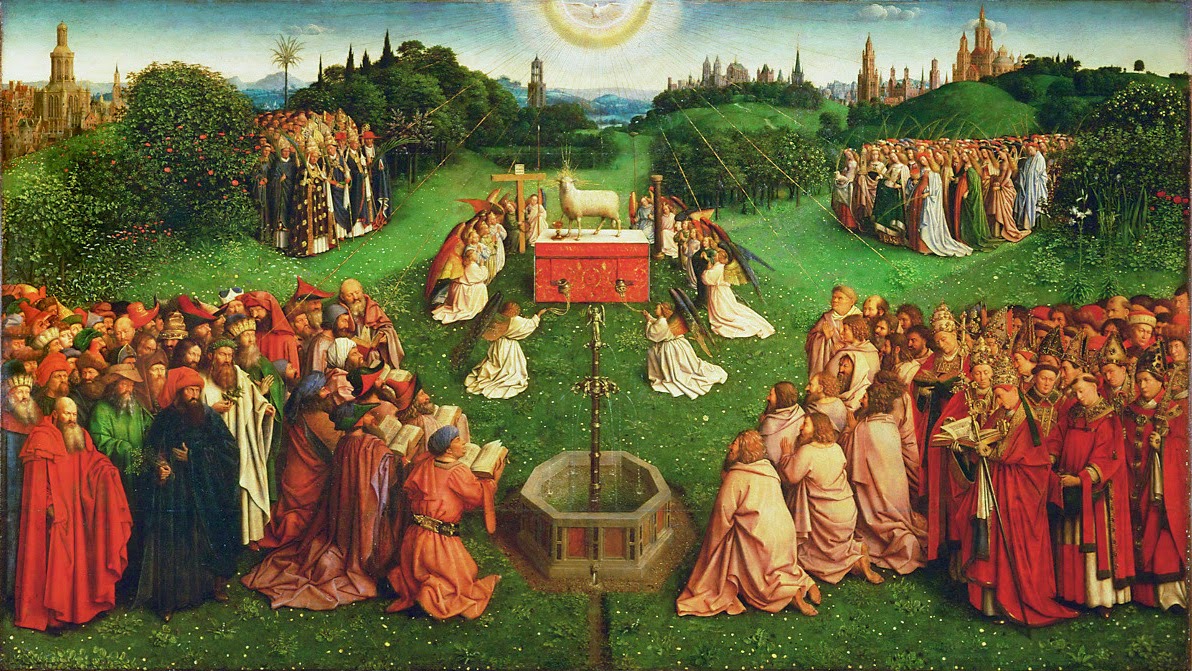
Jan & Hubert van Eyck, The Ghent Altarpiece, "The Adoration of the Lamb," c. 1432.


Jesus again in reply spoke to the chief priests and elders of the people
in parables, saying,
"The kingdom of heaven may be likened to a king
who gave a wedding feast for his son.
He dispatched his servants
to summon the invited guests to the feast,
but they refused to come.
A second time he sent other servants, saying,
‘Tell those invited: “Behold, I have prepared my banquet,
my calves and fattened cattle are killed,
and everything is ready; come to the feast.”’
Some ignored the invitation and went away,
one to his farm, another to his business.
The rest laid hold of his servants,
mistreated them, and killed them.
The king was enraged and sent his troops,
destroyed those murderers, and burned their city.
Then he said to his servants, 'The feast is ready,
but those who were invited were not worthy to come.
Go out, therefore, into the main roads
and invite to the feast whomever you find.’
The servants went out into the streets
and gathered all they found, bad and good alike,
and the hall was filled with guests.
But when the king came in to meet the guests,
he saw a man there not dressed in a wedding garment.
The king said to him, 'My friend, how is it
that you came in here without a wedding garment?'
But he was reduced to silence.
Then the king said to his attendants, 'Bind his hands and feet,
and cast him into the darkness outside,
where there will be wailing and grinding of teeth.’
Many are invited, but few are chosen."

- Mt 22:1-14


Recently, I’ve been engaged in witnessing a lot of marriages – that is, I’ve been doing a lot of weddings. For us priests, weddings are a part of our ministry that is at once both a challenge and a joy. They’re a challenge because in advance of the wedding, the Church asks that we spend significant time with the couple in forming them to understand what they’re undertaking, to make sure they know the rights and obligations that go along with marriage and ensure they are truly ready to accept them. That’s a fairly weighty responsibility to have. But weddings are also a joy because we priests are privileged to be there to witness the exact same thing – a couple who, through love and hard work, grow together and come before the altar of God to accept their vocation and to consecrate themselves to each other for life.

My favorite part of a wedding is the reception. That’s partly some of the pressures of the wedding ceremony itself are finished, and I can breathe a little easier. But it’s also because I really enjoy being there to witness the first few moments of the couple’s life together. I’ve found that there are few things as beautiful and happy as a wedding reception. The guests are ready to celebrate, the family and friends of the couple are jubilant, and the husband and wife are overjoyed – and very often, overwhelmed – at the blessing they have just received.

In the Gospel today, Jesus uses just such an occasion to give us an image of the great joy that has been prepared for us in the kingdom of God. The wedding feast which Jesus describes for us is the heavenly banquet, the feast which awaits us at the end of time in celebration of the union between heaven and earth that he, the Son of God, achieves. You know, so often as Christians – and often, I find, in the homilies of us priests – we talk about having to struggle through life’s dark moments, of bearing difficult circumstances well, of sacrificing and enduring hardship by means of our faith. Those things are important, but they’re also temporary. You and I have been invited to a greater reality, a joy that far surpasses any joy that this world knows, that far exceeds anything we could imagine. Too often, we lose sight of the fact that we’re asked to bear in faith the burdens of life now precisely in such a way that we can journey closer to the ultimate, eternal wedding feast.

Perhaps now we can understand a little better the parable for today that Jesus gives us. He describes for us a wedding feast, to which all of the king’s honored guests have been invited in celebration of his son’s wedding. And yet, as we hear, the people of the kingdom don’t heed the invitation. They fail to accept it, they ignore it, they reject it – why? Perhaps because they are too wrapped up in their own circumstances; perhaps they’re too weighed down by life’s burdens; perhaps they’re just too busy with the concerns of the present moment. Whatever the reason, when the invitation comes, they don’t respond; they fail to recognize and appreciate the amazing joy to which they have been invited. They’ve forgotten that life – at its foundation – is about joy.

I think at this point it’s important to ask ourselves a very serious question – do I feel joy in my life? If we took some time to think, we might say that we often feel contentment – satisfaction – perhaps gladness – perhaps happiness. The answer of course for each of us would vary according to our own demeanor, our own circumstances, our own ability to be in tune with the inner workings of our heart. But, if we are really honest with ourselves, I think we would say that true, real, lasting joy is probably something that most of us experience in this life only occasionally, only in passing. So often what we think will make us happy turns out to disappoint; so often what we take pleasure in at the moment fades with time.

And that is exactly the way God wants it to be; it’s the way he has created us to be. He’s created us ultimately for himself, and so if our hearts are only to find their full and lasting joy in encountering the one who has created and redeemed us, then necessarily every thing we might take for joy in this life will fall short. And if we bear that in mind, if we remember how what we sacrifice now in faith is bringing us closer to heaven, then we can endure it, we can get by. The problem comes in when we fail to remember that we’re being invited to that final, full, ultimate joy. When we look for things here, in this reality – even good things – to satisfy us, then we risk missing the opportunity to accept the invitation to the heavenly banquet.

At times, all of us need reminders, and that’s why what we’re doing here right now is so important. The obligation to attend Mass every week is something that perhaps we don’t too much about, but it’s ultimately helping us on our journey to heaven. Gathering together as the family of God, listening to his word, asking for his forgiveness – these are things that remind us of our final calling. I know sometimes we feel like the words we say, and the actions we do are repetitive – and perhaps we get disappointed when the homily, or who is giving the homily, isn’t what we want. But every Mass is important not so much for who is present there in the pews – or who is here behind the ambo – but for who becomes present there on the altar, who we receive on our hands or our tongues, who enters into us. The Eucharist is the foretaste of the heavenly banquet. It’s the Eucharist that is the tangible presence of the One who reminds us himself what he’s inviting us to.

This week, I came across a quote about the Eucharist that stopped me in my tracks. It’s from St. Josemaria Escrivá, a Spanish priest from the last century who emphasized finding the hand of God in our daily life, and I’d like to share it with you. He said, “Have you ever thought how you would prepare yourself to receive the Lord if you could go to Holy Communion only once in your life?” …. I for one had not thought about it, but I began to. Perhaps some of you are thinking about it now. I hope that most of us would want to do something different – do something more than how we often find ourselves prepared for communion. If we could receive Jesus only one time in Holy Communion, I hope that most of us could say that we would pay extra attention to how we had prepared ourselves, both outside – our clothes, our hands, our mindset before and after communion – and especially inside – the state of our hearts, our relationship with God, the condition of our soul.

My friends, I enjoy weddings for all the reasons I mentioned above – and for one other reason as well: because every wedding reminds me that all of us are being invited to a final, heavenly wedding banquet in the house of the Lord. Are we aware of that eternal joy to which we are called? Are we excitedly seeking to accept the invitation to it by the way we live, or do we settle for the passing pleasures of this world? Every Sunday we are called to come to this church to renew our faith in God and to receive the Lord himself in the Eucharist. Is it just another moment in our week, or do we look beyond with the eyes of faith to see, to taste, a preview of heaven? The Lord has prepared a banquet for us – are we prepared for him?

Sunday, September 14, 2014

The Exaltation of the Holy Cross

"The Exaltation of the Holy Cross" (detail), Luigi Gregori, c. 1885,
ceiling of The Lady Chapel, Basilica of the Sacred Heart (Notre Dame, IN)


Jesus said to Nicodemus:
“No one has gone up to heaven
except the one who has come down from heaven, the Son of Man.
And just as Moses lifted up the serpent in the desert,
so must the Son of Man be lifted up,
so that everyone who believes in him may have eternal life.”

For God so loved the world that he gave his only Son,
so that everyone who believes in him might not perish
but might have eternal life.
For God did not send his Son into the world to condemn the world,
but that the world might be saved through him.

-Jn 3:13-17

In the Gospel today, we hear maybe the most famous Scripture passage ever. Some folks memorize it as a summary of their faith – others write it on their stationery or on Christmas cards. You can find it printed on clothing, fast food containers, and other merchandise. And for several decades now, it’s famously been put on signs held up at sporting events.

The passage of course is John 3:16 – “For God so loved the world that he gave his only Son, so that everyone who believes in him might not perish but might have eternal life.” Why do we seem to like that passage so much? Maybe you’d agree that there is a positive feeling about it – it’s heartwarming in a way. And it gets to the heart of our faith – God wants to save us and to do so he sent his Son for us to believe in.

But while we know this passage pretty well, we may not always remember the context that it comes from. It follows a conversation between Jesus and Nicodemus, a prominent Pharisee and member of the Sanhedrin. Nicodemus is intrigued by Jesus – what he says and especially the signs that he performs. He believes Jesus must be a man of God but he can’t quite understand Jesus’s message. There’s an aspect to what he says and does that Nicodemus can’t quite figure out.

So Nicodemus goes to find Jesus and Jesus is happy to speak to him. Nicodemus clearly is a man who loves God and is seeking holiness. But Jesus says something to him that must have been very troubling: “No one has gone up to heaven except the one who has come down from heaven.” That’s a very interesting and very troubling statement. Jesus is in effect saying that, at that point, no one is in heaven with God – none of the ancient prophets or holy men and women, not even Adam and Eve who were the first friends of God and walked with him in the garden. Nicodemus realizes that Jesus is telling him that despite the fact that he is a good man, despite the fact that he loves God, despite the fact that he is seeking God – all of that is not enough to get to heaven. In fact, as Jesus says, no one has gone to heaven. There is some fundamental block, something terrible that is keeping the gates of heaven closed.

Is this not a little disconcerting to us as well? I think we often find ourselves thinking about heaven as something pretty certain for us. We think, “Well, if I’m a good person who lives a good life and I don’t commit any serious sins, then I can be certain of going to heaven.” Or perhaps we may not even really think about it – we just assume that to be true. But that kind of thinking ignores what Jesus is telling Nicodemus. Something in the world is seriously wrong; something is preventing even good people from getting to heaven; and, as you might guess, that something is our sin.

We can see now the context of that passage, John 3:16. As the passage says, God wants to save us – but he does so because we are desperately in need of salvation .. and we can’t do a thing about it. Jesus comes into the world because we are incapable of saving ourselves. It doesn’t matter how much we might love God or try to live good lives, the fact that we are weighed down by sin has condemned us to eternal separation from God. Only God can save us, and as Jesus explains to Nicodemus, God will do so through the Cross.

Today – here in the middle of September, in the middle of Ordinary Time – we celebrate the feast of the Exaltation of the Holy Cross. We’re celebrating the Cross as God’s triumph, which might seem a somewhat strange idea. After all, it was the instrument used to execute Jesus. But remember what Jesus tells Nicodemus – the reason he came from heaven was to be lifted up, so that he might draw all men to himself. Our sins had condemned us to an eternity of separation from God, but when Jesus goes to the Cross, he takes those upon himself and frees us from them. Just as when the Israelites looked upon the bronze serpent, they were cured of the snakebite that was killing them, so too do we – when we look to the cross of Christ – receive forgiveness for the very sins that otherwise would mean our damnation.

At the very heart of the Christian life, at the center of our faith, stands the Cross. We can’t avoid it. We can’t get around it. When we think about what Jesus suffered or when we accept the Cross in our own lives – it’s a painful, difficult reality. But without the Cross, we have no way to heaven. Without looking up to our Lord on the Cross, we remain trapped in our sins. It’s only when we look to the Cross – when we accept the Cross as it appears in our life – that we remember our own very great need for redemption. Getting to heaven ultimately isn’t about just being good people and trying to live good lives. It’s about recognizing that we are great sinners, that we are in great need of God’s salvation, and accepting that salvation daily as it comes to us through the Cross.

At the end of John’s Gospel, Nicodemus again meets Jesus – but this time, as he hangs from the Cross. I like to imagine that as he looked up to Jesus, and Jesus looked down to him, it became clear to him what Jesus’ purpose and mission had always been about. I like to think Nicodemus understood there that that was his way to heaven – that, there on the Cross, Jesus was taking upon himself his sins - Nicodemus's sins - and the sins of all the men and women of the Old Testament and the sins of all of us, if we believe, so as to open the gates of heaven for us.

My friends, may we, like Nicodemus, never run from the Cross, never shy away it, but always return there to the foot of Calvary, to the place of God’s great victory, to ponder what God has done for us, and so to understand in a new way that passage we know so well: “For God so loved the world that he gave his only Son so that everyone who believes in him may have eternal life.”

Monday, August 18, 2014

The Silence of God's Love

Jean Colombe, "Miracle of the Canannite Woman", Tres Riches Heures du Duc de Berry (c. 1485)


Homily for the 20th Sunday in Ordinary Time (Year A):

At that time, Jesus withdrew to the region of Tyre and Sidon. And behold, a Canaanite woman of that district came and called out, “Have pity on me, Lord, Son of David!  My daughter is tormented by a demon.” But Jesus did not say a word in answer to her. Jesus’ disciples came and asked him, “Send her away, for she keeps calling out after us.” He said in reply, “I was sent only to the lost sheep of the house of Israel.” But the woman came and did Jesus homage, saying, “Lord, help me.” He said in reply, “It is not right to take the food of the children and throw it to the dogs.” She said, “Please, Lord, for even the dogs eat the scraps that fall from the table of their masters.” Then Jesus said to her in reply, “O woman, great is your faith!  Let it be done for you as you wish.” And the woman’s daughter was healed from that hour. 
- Mt 15:21-28

What is your favorite story of Jesus? The Gospels have many to choose from. There’s the one where he saves the woman caught in adultery from being stoned to death. Or the one where Jesus is asleep in the boat and the sea is becoming rough and the disciples are afraid, and they wake him and he calms the storm. Or the one where he meets the widow leaving the town to bury her only son and Jesus raises him from the dead. We could think of countless stories where Jesus is kind, or strong, or comforting, or merciful.

It’s safe to say that probably none of us would choose today’s story of Jesus as one of our favorites. This story seems strange to us, even disturbing, because we see it in a Jesus whom we don’t recognize. We struggle to understand and explain why Jesus acts the way he does. The Canaanite woman comes to him with a very real need – her daughter is in distress – and yet what does Jesus do? First, it says that he is silent – “he did not say a word in answer to her,” the Gospel says. When the disciples want to send her away – perhaps annoyed by her or disturbed that Jesus would not answer – he gives a dismissive response about this Gentile woman. Finally, when she addresses him again, he seems to outright insult her, implying that she and her people are “dogs”.

So what’s going on here? Was Jesus having a bad day? Was he just being a jerk? Well, no – Jesus is trying to teach us something very important. Let’s take a step back from the story for a moment and consider if there’s something in it that resonates in our own lives. We have things in our lives that concern us, real problems and challenges that worry us. Often these are things that are outside of our control – maybe a friend is suffering from a terrible illness, or someone we love is blind to the poor choices they are making or about to make. Maybe we have a troubling situation at work with a coworker, or maybe we’re having trouble finding adequate work. There are countless situations in our lives where we feel helpless.

What do we do? Like the Canaanite woman, we turn to the Lord. We go to God and ask him to help, to give what we or someone else need. And then what happens? Often … nothing. Nothing changes. God seems to be silent – it seems as if our prayers have gone unheard. Or maybe, things get even worse – the situation goes from bad to worse or some new crisis or difficulty arises, and we think “What is going on? What did I do wrong? Why is God punishing me?”

And here is the real danger, because if we feel as if our faith is not helping us, if we feel as if God is not listening to us, then we risk becoming bitter or cynical or unbelieving. We probably all know someone who has struggled in this way – who had some terrible situation and God seemed silent or absent or uncaring – and so what happened? They left the Church, they lost their faith, they stopped believing.

Notice though, how the woman from Canaan reacts in completely the opposite way. She is not discouraged but rather asks all the more insistently – “Lord, help me,” she says. She refuses to give up. She refuses to let her faith be diminished by the seeming lack of a response. From all external factors, it would seem as if she has nothing going for her – she was a foreigner, a non-Jew, and Jesus does not seem inclined to help her. And yet what she does have and what she refuses to give up is the persistence of her faith.

So, why does Jesus act as he does? To test her – not to toy with her, not to be mean to her – but to help her to move from merely asking for something to understanding in a deeper way her own very great faith. He wants to give her the gift of a deeper awareness of what is already present in her. The tests that God gives to us always have a specific purpose, a reason – a good reason. Maybe because we have asked for the wrong thing, or in the wrong way. Maybe because God wants us to realize better how completely we depend on him. Maybe because he is helping us to grow so that we can receive an even greater gift than what we asked for.

My friends, Jesus loved the Canaanite woman just as God loves each of us. And yet, at times our faith will be tested. When it is, we must not give in to doubt or discouragement – we must not give in to the easy way of thinking that God isn’t listening or is punishing us or doesn’t care. At times, we are asked to wait – to make our hearts grow, to make our souls expand – to receive not merely what we’ve asked for but the gifts that God really wishes to give to us – a deeper faith, a stronger hope, a greater love. They may not be exactly what we ask for, but God knows that those are the gifts that will really help us and sustain us and form us into the people that he calls us to be.